
































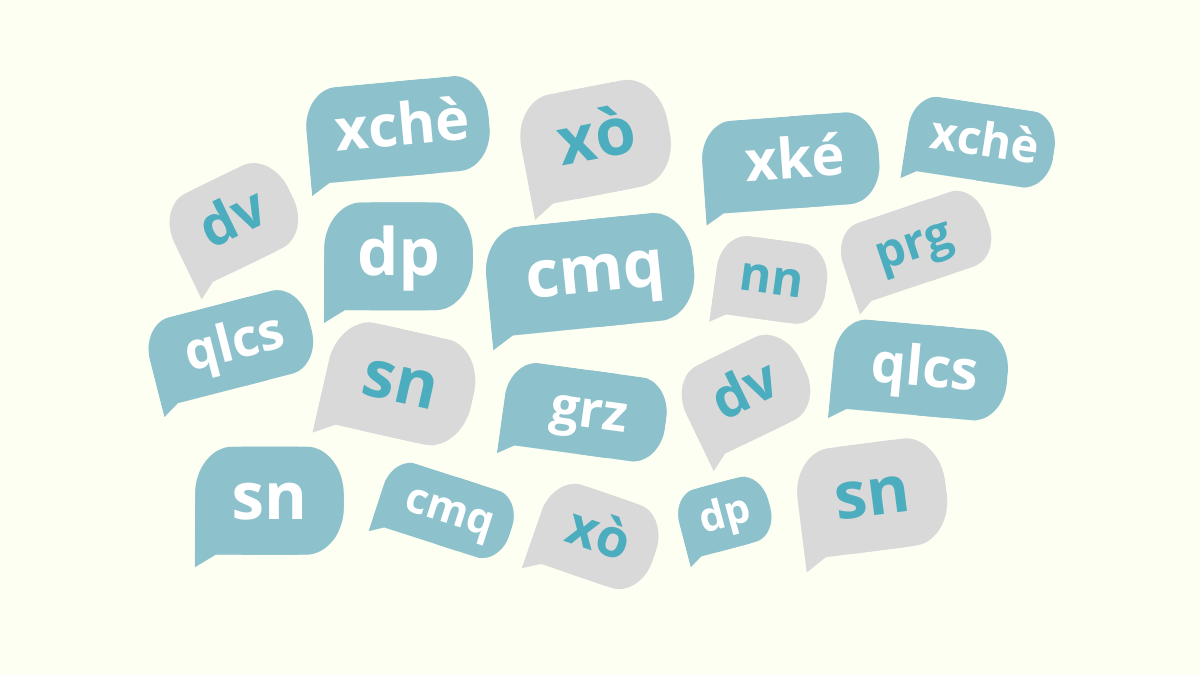
Exchanging messages in Italian can be challenging when abbreviations and acronyms are used in place of full words. Here are some of the most popular abbreviations you’re likely to encounter in everyday conversation.
Just like in Portuguese, Italian has developed a series of abbreviations in “textspeak”, and many of them do not appear in dictionaries. If you have ever exchanged messages with friends, colleagues or Italian neighbors, you may have come across several of these abbreviations.
As in other languages, the “textspeak” Italian is considered informal and should be used among friends or acquaintances. It is not recommended to use them with your boss or mother-in-law, for example.
However, it's useful to have these abbreviations up your sleeve, even if some of them may be a little outdated.
The letter 'x'
If the letter 'x' appears in your conversation, don't worry; it doesn't mean someone is talking about multiplying (or talking about the social network formerly known as Twitter). In fact, the letter 'x' is used to represent the word “per”, which in Italian means “by” or “for”, depending on the context.
- Vado in vacanza x due settimane.
(I'm going on vacation for two weeks.) - Mi serve un caffè x svegliarmi.
(I need a coffee to wake up.)
Furthermore, since “per” appears in many Italian words, several abbreviations contain the letter 'x':
- xchè – perchè (because or why)
- xciò – I perceive (therefore)
- xo – but (but, however)
- xfetto – perfect (perfect)
- xsona – persona (person)
Examples:
- Mi è piaciuto il film xò era troppo lungo.
(I liked the movie, but it was too long.) - Sarebbe xfetto.
(It would be perfect.)
The letter 'k'
Interestingly, the letter 'k' also appears frequently in Italian textspeak, even though it is not part of the language's official alphabet. It often replaces the hard 'c' sound, especially in words that begin with 'ch':
- ki – chi (who)
- ke – che (what)
- anke – also (also)
- because – perchè (because or why)
Examples:
- I did xké eri geloso.
(You did it because you were jealous.) - What is it?
(Who is it?)
Missing vowels
As in Portuguese, many Italian abbreviations arise from the elimination of vowels:
- nn – non (no)
- cmq – communicate (in any case, even so)
- qlcs – something
Some abbreviations, once common, are now used mainly by older generations:
- sn – sleep (I am)
- dp – dopo (after)
- dv – dove (where)
You can also use these forms for polite expressions:
- grz – grazie (thank you)
- Prg – nail (you’re welcome)
Examples:
- I have surpassed the example.
(Anyway, I passed the exam.) - Thank you for my gift.
(Thank you for my gift.)
Anglicisms
Sometimes English abbreviations also appear in the “textspeak” Italian:
- k – ok
- lol – laugh out loud
These abbreviations are useful for understanding quick and informal conversations in modern Italian. Do you have a favorite abbreviation?
FOLLOW ITALIANISM