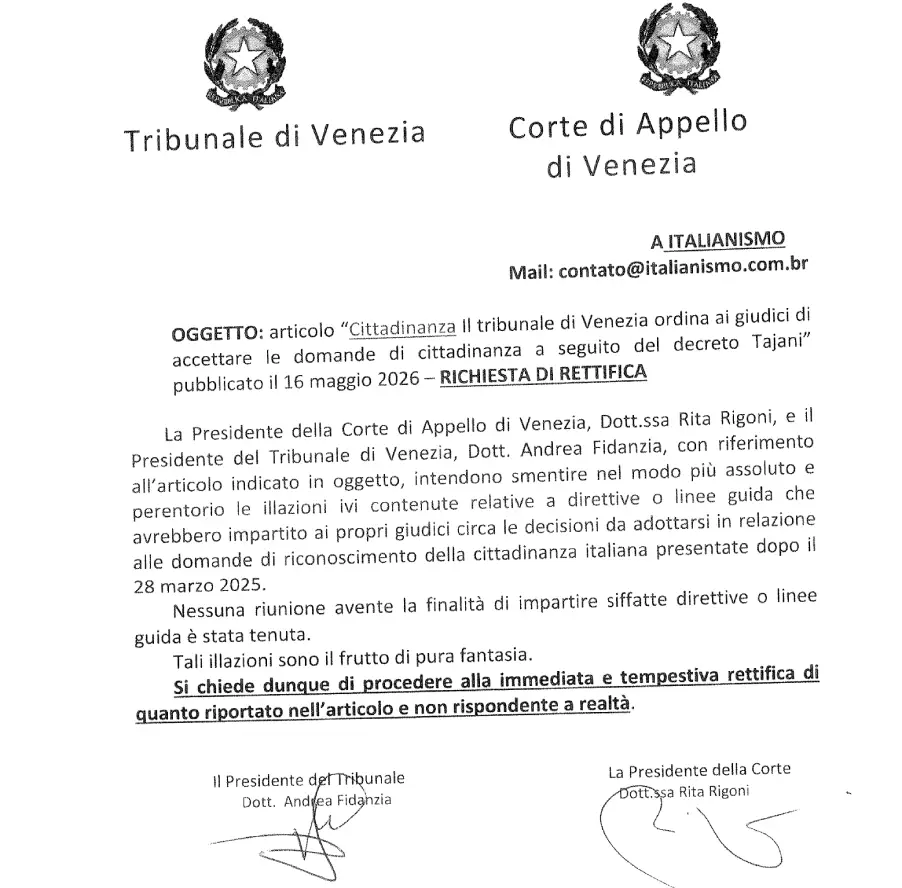




































The Venice Court reportedly held an internal meeting in which the president instructed judges to rule favorably on Italian citizenship recognition applications filed after March 28, 2025, that is, after the Tajani Decreeprovided the applicant proves an attempt to schedule a consular appointment prior to that date. The information was revealed by a reliable source to Italianismo and represents a significant development in the legal landscape, especially after the decision of the Supreme Court of Cassation published this past Thursday (14).
The guidance is not a binding decision, but it signals the Venetian court's position on one of the most sensitive issues in citizenship law at the moment: what to do with the cases of descendants of Italians who were on the consulate's waiting list before the decree, but only managed to file their legal action after March 28, 2025.
The logic behind orientation
The court president's justification is both legal and practical. From a legal standpoint, the ruling acknowledges that an applicant who was on the consulate's waiting list before the decree cannot be penalized for a delay that is not their fault. The responsibility for the delay lies with the Italian state, not the descendant.
From a practical standpoint, the concern is to avoid overburdening the Court of Appeals. The president reportedly cited the 2020 precedent, when the issue of... Large-scale naturalization generated an avalanche of resources. which overburdened the appeals court in Rome. The lesson learned from that episode is that cases that can be resolved in the first instance should not reach the appeals court through a dismissal that could be considered unfounded.
The guidance, therefore, stems from objective reasoning: if the Supreme Court has already established that the right is imprescriptible and that the consulate waiting list justifies judicial intervention, denying these cases at the first instance only means transferring the problem to the higher court, multiplying the workload of the entire judicial chain.
What does the Cassation decision have to do with this?
This Thursday (14), the Italianism published the sentence no. 13818/2026 from the Supreme Court of Cassation, dated May 12, 2026. The document establishes, as a principle of mandatory application of law, that the interest in pursuing citizenship proceedings exists "not only in cases of denial or delay in the recognition of this status, but also in the event of impediments, difficulties or delays that do not even allow the submission of the respective request to the competent administration."
The same ruling reaffirms, in two passages, that the right to citizenship by descent (jure sanguinis) is "an absolute subjective right of primary constitutional relevance, existing from the moment of the holder's birth, which is permanent and imprescriptible in nature."
These two points form the legal basis that supports the Venice Court's ruling. If the Court of Cassation has already declared that the right does not expire and that the consulate waiting list justifies legal action, a first-instance judge who denies these cases would be going against the established jurisprudence of Italy's highest ordinary court.
What the applicant needs to have
The Venice Court's guidance is not an automatic safe-conduct. It starts from a clear premise: the documentation must be in order. According to information gathered by Italianismo, the cases covered by the guidance are those that meet three requirements:
The application was filed after March 28, 2025. The genealogical and civil documentation is complete and in accordance with current Italian legislation. There is proof of an attempt to schedule a consular appointment prior to the decree, whether through the Prenota-me system, by email, by direct communication with the consulate, or by any other means that demonstrates that the applicant was in the queue or attempted to join it before that date.
This third element is the central point. The attempt to schedule an appointment is what distinguishes the applicant who was exercising their right from the one who had not yet initiated the process. Without this proof, the court's favorable ruling does not apply.
The maternal line would also be considered.
what does not change
The Venice Court's ruling does not resolve the larger divergence between the Italian Court of Cassation and the Italian Constitutional Court. This dispute involves the nature of the right to citizenship. jure sanguinis, which is imprescriptible according to the Court of Cassation and precarious according to the Constitutional Court, is still awaiting new definitive decisions.
What changes is the risk of a first-instance denial for those who have their documentation in order and proof of a consular appointment. For this group, the signal from Venice, combined with the Supreme Court's ruling of May 12, represents a significantly more favorable legal scenario than existed 60 days ago.
FOLLOW ITALIANISM