




































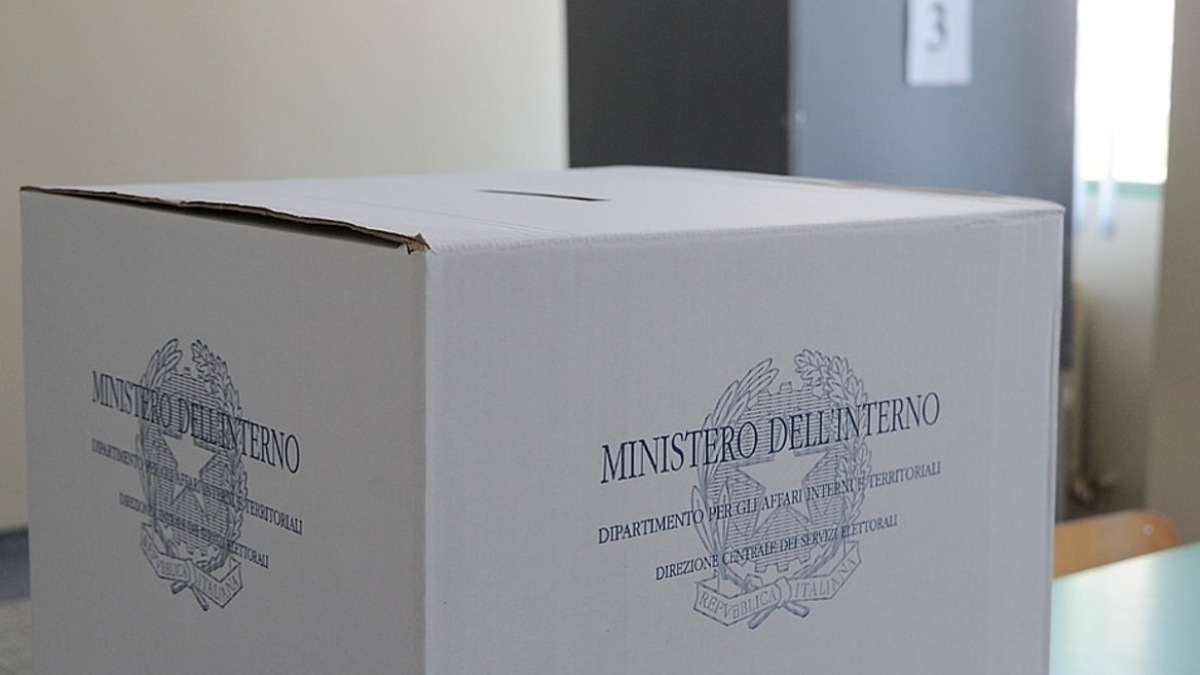
With the results of the constitutional referendum necessary for the approval or rejection of the "Justice Reform" proposed by the Meloni government under the guise of "separating the careers" of judges and public prosecutors now in effect, several hypotheses have been put forward to explain the victory of the... YUP overwhelmingly (72,86%) in South America.
Without going into the merits of the judicial reform (and not "justice reform," as it was presented), this article analyzes why the reform was approved by Italian voters in South America, in a trend contrary to the overall result of the referendum, in which the reform was rejected by almost 54% of Italians who went to the polls.

First, it is necessary to understand the demographics of Italian voters abroad and the dynamics in which they live. In this referendum, almost 5,5 million voters were registered outside of Italy. They therefore represent about 12% of the total Italian electorate, which is composed of almost 46 million citizens. Among voters abroad, those residing in South America number approximately 1,8 million.
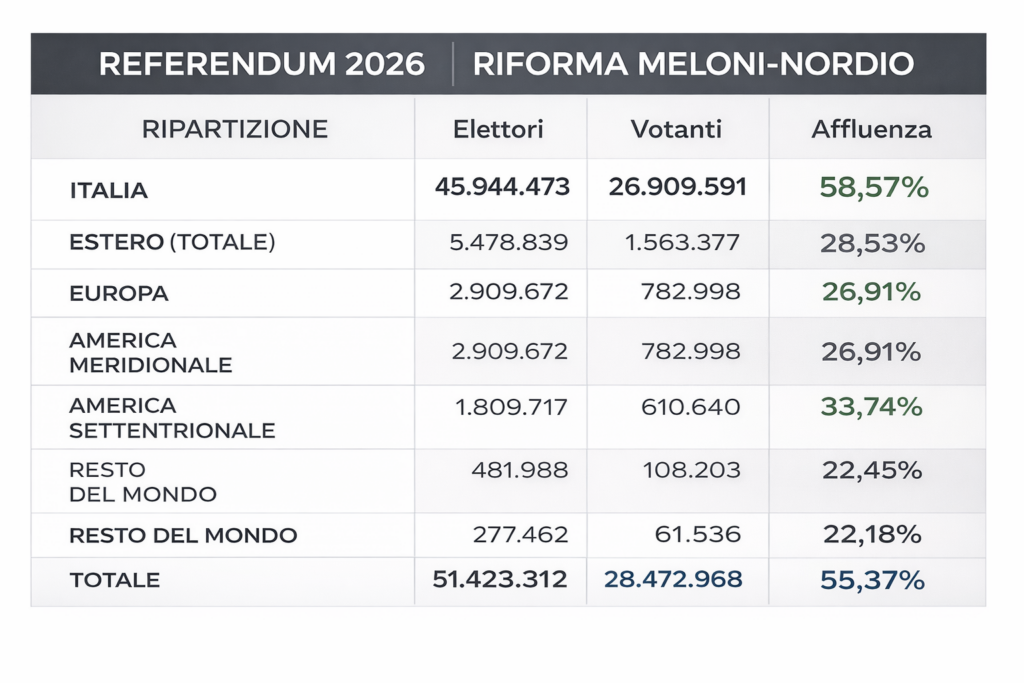
It is well known that among Italians residing in South America, the vast majority of citizens registered with consulates are those born outside of Italy and who have never lived there. In countries like Argentina and Brazil, which account for 48% and 33% of voters in South America, respectively (81% of the total), those born and raised in Italy represent less than 5% of the electorate.
When analyzing this same characteristic in the other large overseas region, Europe, with almost 3 million voters, the demographics of Italians are radically different, with a large majority of citizens born and raised in Italy, who consume daily news from the country and are fully connected to its social and political reality. Even those born outside Italy maintain, in their residence and social relationships, direct contact with Italians deeply connected to the country's current political affairs, a topic of daily discussions.
Therefore, the disconnect between Italian voters in South America and Italian political reality is evident to anyone not swayed by populist pronouncements. Those who experience daily life within Italian-South American communities know that the vast majority of voters are not exposed to the political discussions necessary for making an informed decision when voting.
In fact, a significant portion of the Italian electorate in South America only realizes that there is an election or referendum when, almost immediately, magicallyAn envelope sent by the consulate arrives at your door. Some then begin a process of searching for information; many others vote on impulses that are difficult to explain and have never been scientifically studied to date. Any analysis, therefore, starts from a very weak methodological basis. Still, I accept the challenge.
Italians living abroad have been able to vote in elections and referendums since 2003. It was precisely a recall referendum in 2003 that was the first election in which citizens residing outside Italy could express their electoral voice. Including this latest one in 2026, there have been a total of eleven referendums. With the exception of the 2022 recall referendum, in all the others the options for reserving the presidency have won overwhelmingly. YUP.
Analyzing only constitutional referendums, that is, those called with the objective of confirming or rejecting a reform of the Italian Constitution previously approved by Parliament by a simple majority (when two-thirds is not reached in both legislative houses), the option for YUP In South America, this is crystal clear and consistent, regardless of the ideological orientation of its proponents.
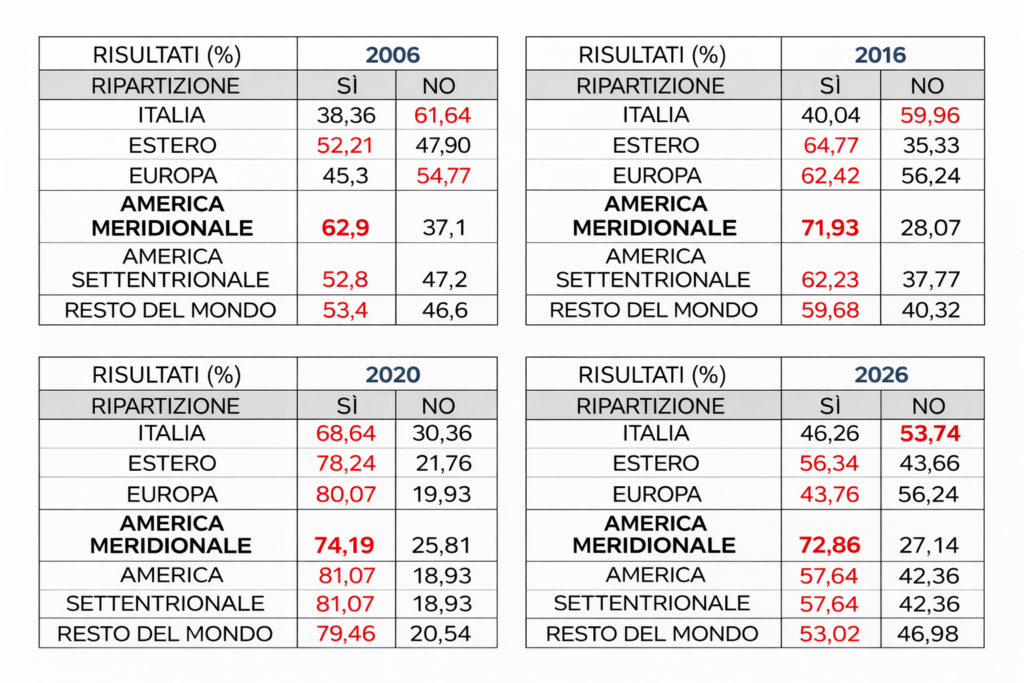
In 2016, it was the center-left Renzi government that proposed a constitutional reform. Italians in South America approved it with 71,93% (DO NOT(28,07%). In Italy, the reform was rejected by 60% of the population. However, Italians residing in Europe approved it with 64,7%, a choice that demonstrates the clear center-left tendency of the Italian electorate in the Old Continent. Note, however, that the South American percentage was higher than the European one.
Ten years later, the Meloni-Nordio Reform was rejected by almost 54% of voters residing in Italy, while it was approved by 72,86% of residents in South America. Residents in Europe followed the national trend and rejected the reform with 56,24% of the vote. DO NOT, a percentage slightly higher than that of residents in Italy, confirming the center-left ideological trend.
What has been presented so far may seem like a "data salad," but it is not. The numbers clearly demonstrate that, while Italians residing in Europe vote based on ideology, with a clear center-left tendency, South American voters systematically vote outside the general pattern in referendums, configuring a... outlier statistical.
It is evident that this is not a matter of statistical noise, but of a structural behavior of the Italian electorate in South America, which clearly favors the YUPThat is, they vote in favor of a change, whatever it may be. But what would explain this behavior? As I said before, I accept the challenge, but I warn that I am conducting this analysis from a sociological perspective, without in any way intending to offer a scientific answer, given the absence of the basic elements necessary for such a decision.
The first hypothesis is based, albeit roughly, on confirmation bias, although this cognitive tendency has limited application to this case. In any case, the low exposure of Italian voters in South America to the intense political debates that accompany constitutional reforms seems to favor a generally optimistic stance towards change. broadlyThe idea of being able to actively participate in implementing a change in Motherland It ends up being an almost irresistible cognitive shortcut.
When voting YUPThe South American voter positions themselves as an agent of change, perceived with naive optimism, and welcomes the fact that they can influence Italy's destiny. The content of the change becomes less relevant: if someone has proposed a reform, it's because something must be "broken." Therefore, the proposed change will "fix" the problem even if I don't know its nature.
The difficulty in applying any political theory to the voting of Italians in South America lies precisely in the absolutely atypical nature of this behavior: the almost total absence of exposure of the voter to informative content and debates on the subject matter of the decision. Added to this is the very limited time available for exercising the right to vote, which rarely exceeds a week.
The informational cost (here I draw inspiration from Anthony Downs' theory in "An economic theory of democracy (from 1957) is already high for the voter immersed in political debate. For the Italian voter in South America, this cost becomes definitively inaccessible. The rationality of this voter therefore adopts a shortcut that is not ideological, as a superficial analysis of the scenario might suggest. It is a cognitive shortcut that I would define as "Panglossian," because it is based on an apolitical and uncritical optimism regarding change.
Other hypotheses for the victory of YUP In this 2026 referendum, the result is linked to an alleged ideological shortcut taken by a predominantly conservative electorate, highly influenced by right-wing local politicians and influencers, as well as a widespread dissatisfaction with the Judiciary, the subject of the Italian constitutional reform. Added to this is the campaign for... YUP led by the most important political party of the Italian diaspora in the subcontinent: MAIE.
As can be seen from the analysis developed so far, I do not share the hypotheses presented in the previous paragraph. The more right-leaning tendency of the Italian electorate in South America is evident and can be explained by demographics themselves. Italians who arrived with labor immigrants, over two generations, became part of the Ibero-American economic elites. Even in relatively homogeneous countries, such as Argentina and Uruguay, descendants of Italians and Europeans in general occupy the most privileged strata of society. In countries like Brazil or Venezuela, this characteristic is even more evident.
However, the data do not corroborate the hypothesis of an ideological shortcut. This applies whether it suggests adherence to right-wing positions or alignment with the MAIE. As already explained, in the 2016 reform of the center-left Renzi government, the percentages of YUP e DO NOT were virtually identical to those observed in 2026. In the 2020 referendum, the MAIE advocated for DO NOT, but the YUP He won with 74,19% of the votes from Italian-South Americans. Note, again, how the percentage of the option YUP (favorable to change) remains statistically the same.
It is reasonable to conclude that the ideological or partisan shortcut does not explain the victory of YUP in the four constitutional referendums. Discontent with the Judiciary in Brazil does not explain the South American result in 2026, as this phenomenon is not observed in neighboring countries, where the percentages were quite similar (Brazil: 71,50%). YUP vs. 28,50% DO NOTArgentina: 72,30% YUP vs. 27,70% DO NOT).
It can be concluded, therefore, that the deviant victory of YUP the 2026 referendum in South America is structurally integrated into the victories of YUP in the other three constitutional referendums. This behavior is sustained by an atypical confirmation bias, anchored in low or nonexistent exposure to political debate and a tendency towards "Panglossian optimism," fueled by the high informational cost that citizens are unable, unwilling, or unable to afford to face. After all, tout est pour le mieux dans le besteur des mondes possibles….

* By Daniel Taddone He is a sociologist, advisor to the General Council of Italians Abroad (CGIE), and president of the NATITALIANI Association..
FOLLOW ITALIANISM

















Zero thousand zero hundred and zero, 00
March 26, 2026 at 17:25 pm
Dani! Your fan here. Different political spectrums with the same worldview.