

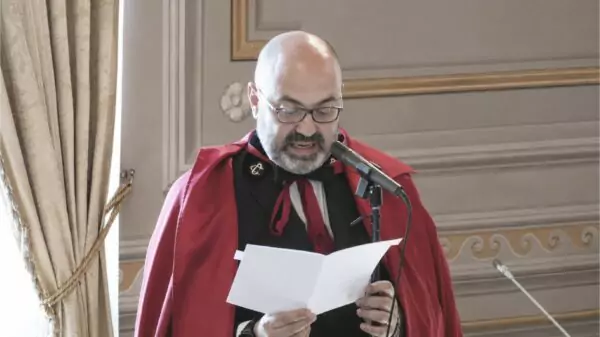




































No decision came out of the Italian Constitutional Court yesterday. No judge asked any questions. But the following morning, among lawyers who follow citizenship by descent cases, the prevailing assessment is almost unanimous on one point: the oral argument of Marco Mellone It changed the dynamics of the trial, regardless of the outcome.
Lawyers interviewed by Italianism On Wednesday (10), they described the performance as decisive. In the assessment of one of them, Mellone “was perfect” and “put things in their proper place”. Another highlighted the contrast with the rest of the session: while most lawyers read their statements, Mellone spoke with the conviction of someone who knows the matter thoroughly, a posture that, in the experience of those who have witnessed many oral arguments, compels judges to pay attention. “When someone argues like that, it’s hard not to pay attention. If you’re reading, the judge thinks: it’s in the file, I’ll read it later,” summarized one of the sources.

The thesis of the agreed panel
The most interesting interpretation circulating among lawyers goes beyond individual performance. According to these sources, the real effect of the hearing was internal to the panel. In courts with many judges, they believe it is common for the other judges to delegate the analysis to the rapporteur, following along without in-depth analysis. This, in their view, is what happened in the judgment that resulted in... Sentence 63/2026.
Yesterday's tough and direct argument would have broken that inertia. By telling the fourteen judges (one was absent), looking them in the eye, that the Court had decided by press release before hearing the defense, Mellone would have forced the magistrates who "let the first trial slip by" to look at the case with their own eyes. "Now something will happen," one of the sources predicted.
One side effect is already considered certain by these lawyers: the Court is not expected to repeat the... press release anticipating the resultAs he did in March, a practice that was harshly criticized in the assembly. According to sources, the "mistake of yesterday," an expression used by one of them to refer to the public exposure of that choice, made repeating the gesture politically untenable.
You can lose, so what?
The optimism, however, is calculated. None of the sources consulted by Italianismo are betting on a guaranteed victory. "Could they lose? They could," one of them admitted. The same source, however, considers that the defense has accomplished what it needed to: it has publicly demonstrated, "by a plus B," that the reclassification of descendants as foreigners without ties does not withstand confrontation with the reality of millions of Italians born abroad.
There is also a technical warning in the conversation between the lawyers: the Constitutional Court is not formally bound by the understanding of the Court of Cassation and the appeals courts, which have been reaffirming citizenship as an original right. This interpretative freedom, they assess, is precisely what makes the outcome unpredictable.
But there is one point where the sources converge strongly: the historical weight of a potential denial. Mellone reminded the judges, in court, that Italian law and jurisprudence have affirmed for 160 years that a descendant of an Italian is born Italian, the so-called living rightThis ruling, recognized by the Court itself and reaffirmed by the Court of Cassation a few weeks ago, is based on the convictions of the Italian legal establishment. According to lawyers interviewed by Italianismo, if the Court confirms Sentence 63, it will not only be deciding a case but will also be marked in the annals as a brutal break with a century and a half of the country's own legal tradition. In the words of one source, the judges were warned that history will record what was decided there.
What if the Court upholds the line set in Judgment 63? The path is already laid out, and it has been announced in the minutes: the European Court of Human Rights. Sources acknowledge the cost, an estimated additional wait of two to three years, but the intention is explicit. "The fight is not over yet," said one of them.
The verdict is expected before the August judicial recess. Until then, the Italian-descendant community lives with a small certainty and a great hope: yesterday, for the first time since March, the fifteen judges listened to everything the diaspora had to say. And they listened looking them in the eye.
FOLLOW ITALIANISM