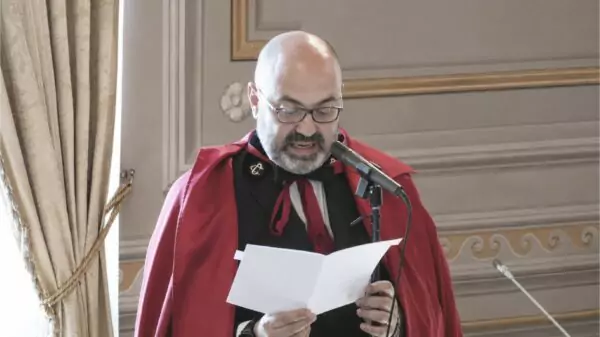







































The Italian Constitutional Court held a public hearing on Tuesday (9) regarding the constitutionality of Article 3-bis of Law 91/1992, introduced by Decree-Law 36/2025, the norm which changed the rules for recognizing Italian citizenship by descent. Five lawyers took the stand, representing a minor, adults affected by the legislative change, and the Presidency of the Council of Ministers. The Court did not issue a ruling. There is no set deadline for the decision.
The rapporteur, judge John PitruzzellaThe court presented three remission orders for judgment: number 4, from the Court of Mantua, involving a minor; and numbers 40 and 41, from the Court of Campobasso. The central issues involve retroactivity, violation of acquired rights, misuse of decree-law, and Article 22 of the Italian Constitution, which prohibits the deprivation of citizenship for political reasons.

Celotto: Two minutes and the case of a child.
The constitutionalist Alfonso Celotto, professor at Roma Tre University, opened the round of arguments and went straight to the point. regarding the case of the minor from MantuaIn less than three minutes, he focused his argument on Article 22 of the Constitution, describing the rule as capable of transforming citizenship from a fundamental right into a weakened legitimate interest.
"We are facing a kind of automatic mass revocation of citizenship," he said.
Celotto also criticized the consular appointment system: "Those waiting lists of years at consulates and embassies: that was also a crazy system."
Mellone: recourse to the ECHR and impossible conditions
Marco Mellone, the defense attorney in the proceedings at the Campobasso Court, used the podium for more than 12 minutes and directly targeted Sentence 63/2026, published after the hearing on March 11. According to him, the Court had already decided the matter before hearing the defense.
"Judges speak through their sentences, not through press releases," the lawyer declared.
Mellone questioned the retroactive conditions created by the new law: “Tell me who decides their own place of birth. Tell me who decides the nationality of their father or grandfather. These are all conditions impossible to satisfy.”
The lawyer also challenged the reclassification of native-born citizens living abroad made by Sentence 63/2026: “If the Constitutional Court of my country calls people to whom the law granted Italian citizenship from birth 'foreigners,' I wonder if the judges know, one by one, all the millions of Italian citizens born and living abroad.”
Mellone reported that he has already filed an appeal with the European Court of Human Rights for violation of Article 6 of the European Convention, which guarantees the right to a fair trial, and reserved in the minutes the right to appeal also based on Article 8, which protects private life.
Restatio: 'the right of blood retains the name, but loses the substance'
The lawyer Monica Lis Restanio, who identified herself as an Italian citizen born abroad, was the most forceful in her criticism of Judgment 63/2026. According to her, the Court's previous decision transformed jus sanguinis into a right subordinated to subsequent bureaucratic recognition.
"In this unprecedented definition, jus sanguinis retains its name, but loses its substance: citizenship is no longer transmitted through filiation, but depends on subsequent bureaucratic intervention," he said.
Estagio concluded her speech with one of the most forceful statements of the hearing: “It is not we, the defense lawyers, who are speaking to you today. The legislators of 1865, 1912, and 1992 spoke. The majority doctrine and European jurisprudence speak. The Court of Cassation spoke just a few days ago. It is the entire history and legal tradition of Italy that is doing so,” said the Argentinian.
Caruso: the safeguard clause and Euripides' metaphor
The teacher Corrado Caruso He focused his argument on the transitional clause of Decree-Law 36/2025, which only protected cases with consular appointments already granted before March 28, 2025. According to him, the clause transfers the consequences of the public administration's own inefficiencies to the applicants.
"It would ultimately shift the burden of inefficiencies and inadequacies of administrative apparatus onto the recipients of the provision, subordinating the success of the request not to the diligence of the applicant, but to the proper functioning of the administration," he said.
Caruso turned to Euripides, the Greek tragic poet, to describe the role that, in his assessment, falls to the Court: just as Heracles rescued Alcestis from Hades, the constitutional judge should prevent those concerned from remaining prisoners of the administrative inefficiencies that have blocked their requests.
State: compensatory measures and proportionality
The state attorney, Lorenzo D'Ascia, representing the Presidency of the Council of Ministers, refuted the defense's arguments and defended the proportionality of the rule. Regarding Ordinance 13.818 of Cassation, widely cited throughout the hearing, he was categorical:
"I find it difficult to believe that a decision by the Cassation Court regarding the interpretation of a law that no longer exists should be used as a parameter to assess the constitutionality of a new law," he argued.
Regarding consular waiting lists, the State pointed out that legal action has always been available without restrictions: "Legal action is not subject to waiting lists."
Regarding article 22, he rejected the defense's interpretation: "I do not find acceptable the assertion that every decision by the legislature that does not make the loss of citizenship dependent on a voluntary choice by the individual is, in itself, due to political motives."
In closing, D'Ascia reiterated that the regulation did not constitute a systemic reform of citizenship, but only specific and unavoidable corrections. The organic reform is being processed in the Italian Senate under Senate Act 1450.
The president of the Court ended the session without questions from the judges and without making a pronouncement on the merits of the case.
The full hearing can be watched here: Constitutional Court
FOLLOW ITALIANISM