





































Camillo De Pellegrin, mayor of Val di Zoldo, a municipality in Veneto, is known for dedicating precious time from his administration to activism against descendants of Italians abroad. Now, he has issued an unusual warning: Supreme Court ruling no. 13818/2026The decision, published on May 12, could generate a new wave of lawsuits, including against municipalities like yours.
The same mayor who mobilized the municipal administration to fight the recognition of jus sanguinis now predicts that the Supreme Court's decision could "clog the system" with new lawsuits.

The alert and its limits
In a statement on his Facebook profile last Saturday (16), De Pellegrin acknowledges the weight of the decision. The Supreme Court stated that the jus sanguinis It is a "subjective, original and imprescriptible right" and equated consular blocking to formal rejection, opening a direct judicial route for descendants who are unable to schedule an appointment.
But the mayor is keen to define the scope. He points out that the case being judged predates the so-called "Tajani decree"—Law 74/2025, which introduced a time limit for the recognition of citizenship by descent. Supreme Court The decision concerned procedural interest in a 2022 case, not the validity of the new law.
De Pellegrin warns that advertisements and lawyers are "more or less blatantly" suggesting that the decision transcends the generational boundaries imposed by... 74 / 2025 law, which, according to him, does not correspond to legal reality. "Information that, if not presented clearly and completely, could be, at the very least, misleading," he wrote. And he concludes with a warning to potential clients: "The risk is that the system will become clogged with new lawsuits that currently do not meet the conditions to be accepted."
Read what he said (in full):
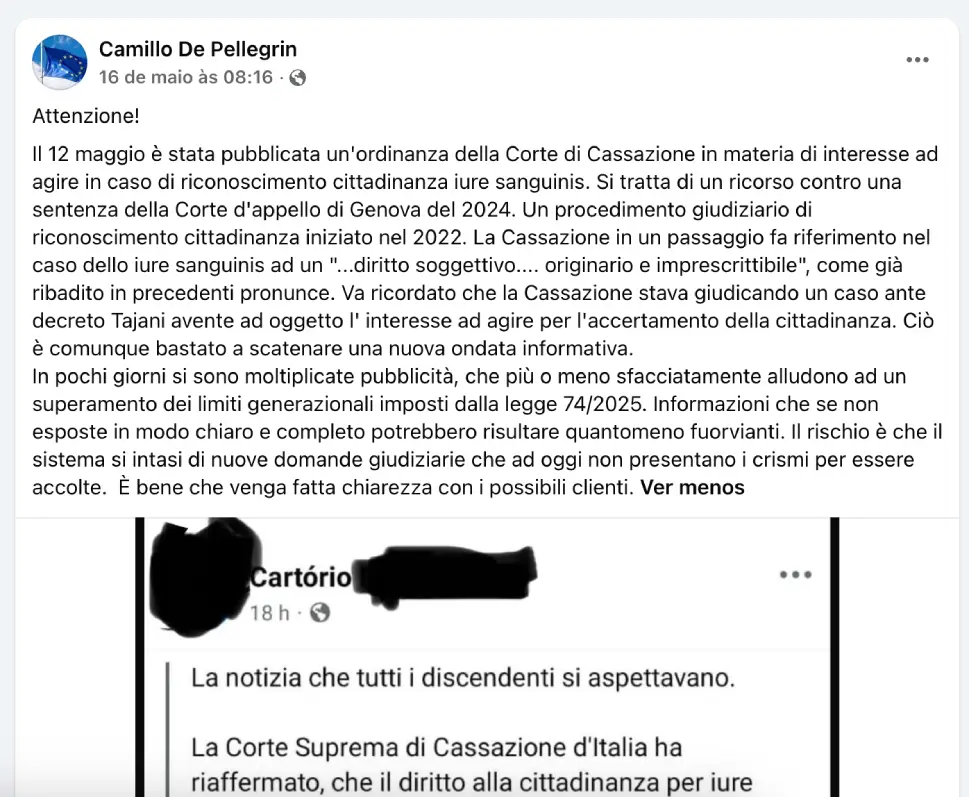
Attention!
On May 12th, an order from the Court of Cassation was published regarding the interest in acting in a case concerning the recognition of citizenship by descent (jure sanguinis). This is an appeal against a 2024 judgment by the Court of Appeal of Genoa. A judicial process for the recognition of citizenship was initiated in 2022.
The Cassation Act, in one passage, refers to the case of iure sanguinis as a "subjective right... original and imprescriptible," as already reaffirmed in previous pronouncements.
It is worth remembering that the Cassazione was judging a case prior to the Tajani decree, concerning the interest in pursuing the recognition of citizenship.
This was enough to trigger a new wave of information. In a few days, advertisements multiplied that, in a more or less blatant way, alluded to overcoming the generational limits imposed by law 74/2025. Information that, if not presented clearly and completely, could be, at the very least, misleading.
The risk is that the system will become clogged with new lawsuits that, so far, do not meet the necessary conditions to be accepted. It is important that potential clients receive proper clarification.

















Dani frustrating
May 18 from 2026 at 12: 10
A return to the cittadinanza is released into richness. The door of consolation is bloccata for all I can do. He sews no sleep that is uguale for every person.
Jicxjo
May 24 from 2026 at 23: 09
In the photo, the German lookalike of Dudu Bananinha, who, in an opportunistically electoral manner, treats South American Italians as if they were sub-Saharan immigrants, Muslims, or even aliens. That's it, close the doors to their descendants, who will later have to accept immigration from anyone, to clean up the mess they're making with this low-level populism.
Victor Massari
June 30 from 2026 at 10: 39
Another thing that Italia appears there for Muslims and così via… Povero tedesco…