






















Journalist lists his discoveries and passions for Italy. An itinerary worth visiting
Like many people, traveling to Italy was a long-held dream of mine. Perhaps because few places capture our imagination as much as the land of the boot – whether because of the delicious, universal cuisine, the aged landscapes of Tuscany, the enormous artistic heritage in statues, paintings and churches, or even other typical brands of this country – throw the first shopping bag who has never had a dream, even if disguised, of surrendering to Italian fashion, with its shoes, clothes and perfumes?
After three trips to Italy, always to different regions, I managed to officially fall in love with the country and choose my 7 favorite cities – and by that, I don't mean that they are better than the others just because they were privileged on this list.
No, not by a long shot: a trip to Italy is the kind of thing that deserves to be savored slowly and steadily, over and over again, because it doesn't get boring.
But if you won't have the chance to travel there again anytime soon and would like some tips to make your Italian itinerary a breeze, try including one – or more – of these unmissable cities in your plans. In each of them, I explain why they deserve your visit.
Rome
Yes, I know the saying that all roads lead there. But, if that's true, set aside at least a couple of days to explore Rome. The Italian capital has been controversial since the time of Caesar, and that hasn't changed today – it's still capable of dividing opinions: some only see the beautiful churches and the rich cultural heritage, while others only notice the crowded, confusing, noisy, traffic-filled, and chaotic streets.
But this doesn't mean Rome loses its charm or ceases to be the most important city in Italy, still present and irresistible in various charming corners of the capital: the painters in Piazza Navona at dusk, the charming alleys of the Trastevere neighborhood and, of course, the imposing presence of the main tourist attractions that must be visited.
Put it on your agenda and see what to do in Rome: visit the Colosseum, one of the current Wonders of the World and which still enchants with its grandeur and size – even with the sad history it still carries. The tip is to visit it in the morning, because from there you can head to the ruins of the Roman Forum, which are gigantic and still have the proportions that allow us to imagine what life was like during the time of Roman gladiators and senators.

In the afternoon, take the opportunity to cool off (Rome is usually very hot in the summer) by drinking a gelato and walking along Via del Corso, one of the city's main avenues, and excellent for shopping or window shopping. If you can, spend the night around Navona Square, where tourists and locals gather, and which is full of interesting bars.
The next day, wake up early because the commitment is sacred (literally): morning is the best time to visit the Vatican, its museums and, of course, the famous Sistine Chapel. For accessories, bring comfortable sneakers (the visit is long) and a little patience, because the place is usually packed with tourists. But it's worth it, as the museum is very rich in pieces and paintings.
Important tip: A good accommodation tip is the hotels in the Trastevere neighborhood. Oh, and when planning your trip to Rome, buy skip-the-line passes: they make a huge difference to your day, as the queues for the Vatican and the Colosseum can take up to an hour.
Perugia
A few hours from Rome is another less known and famous city, but equally friendly. Perugia is the capital of Umbria and, like many cities in this region, its medieval historic center is located on top of a hill, as a protective measure against constant battles centuries ago.
Because it is smaller and has less flow of tourists, in Perugia it is possible to calm down and feel a bit of the dolce far nienteItalian. But that doesn't mean it doesn't have its secrets there: in the historic “center of the center” of Perugia there is one of the most complete museums of sacred art in the world – because if Michelangelo was from Florence and Rome, in Perugia there was Perugino, another master of Italian art whose works, his and his disciples, are exhibited there.

Alleys in the Perugia region – Photo: Stefano_Valeri/Shutterstock.com
But the real tip is to go at a relaxed pace and, especially, with a prepared stomach: Perugia has several Italian trattorias that are as rustic as they are irresistible, many of them located on balconies overlooking the Umbrian valley – a beautiful combination of good food and enchanting views. The city also has no shortage of charming hotels for you to stay in.
If you need another reason to go, Perugia is also the capital of Italian chocolate – the Perugina factory is located there, which produces the Bacio bonbon (“kiss” in Italian). Didn't I say that Italians really know how to be passionate?
Assisi
It is close to Perugia and is very popular with people who make a day trip from Rome just to visit the hometown of the famous saint who even inspired the Pope. Yes, you can travel to Assisi in a day trip. But, for those who stay longer than that, the tip is: stay in hotels in the center of Assisi, close to the Basilica.
Once in Assisi, you will discover a special city, with an aura of peace rarely found elsewhere. Much of this is because of Saint Francis of Assisi, a saint who was born, lived and died in the region (his body is still buried in the Basilica that bears his name), and who became famous for preaching peace, charity and love – universal messages that still sound today on the city streets.

Basilica of Saint Francis of Assisi – Photo: DiegoMariottini/Shutterstock.com
So, when you go, take the time to visit some of the places he was, such as the Church of Santa Maria Degli Angeli (in the neighboring town of the same name, where there is still a small chapel built by him, and also the place where he passed away), the Eremo della Carceri (one of his favorite places to meditate) and, of course, the Basilica of San Francisco.
Believe me: even those who are not Catholic will be enchanted by the visit, as all these places have a delicate beauty – and in the Basilica it is still possible to see Giotto's original frescoes.
And, after you go, even if you've seen everything, tell me: won't you want to visit again?
Norcia
Still in Umbria, leave to escape for at least a day or two to Norcia, a small and charming town. Warning: the city is so small that it doesn't have a train station; You have to take a bus or rent a car. But Norcia makes up for every second of the detour.
The first reason is almost sacred: it is where Saint Benedict and his sister Scholástica were born – for those who don't remember, he was the founder of the Order of Benedictines.
The second reason is more earthly, and delicious: Norcia is the capital of black truffles, and it is possible to book a tour to “hunt” them accompanied by sniffer dogs – the search for truffles takes place in the hills surrounding the city, with a enchanting view of the Norcia valley.

Field of flowers in Castelluccio – Photo: Simon Kovacic/Shutterstock.com
The experience is salty in terms of value, but it is beautiful and unforgettable: after the truffles are “discovered”, you can wash them, grind them and serve them, very fresh, with warm bread, salt and olive oil on an impromptu picnic ( accompanied by wine, of course). You know that phrase that says that certain things are priceless? That's one!
And it doesn't stop there: in addition to black truffles (get ready, here is the best place to buy them at good prices), Norcia is also the capital of raw hams, especially wild pigs. Party: gluttony may even be a sin, but here you are forgiven. If you have time, stay in a good hotel and enjoy every minute of this city.
Florença
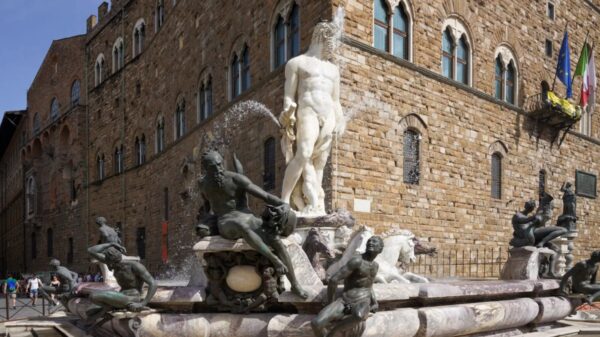
Just like Rome, Florence is an unmissable city, starting with its cultural menu. As it was the center of the Italian Renaissance, take some time to see the great works of art present there up close. The most famous, of course, is the statue of David sculpted by Michelangelo – the original is in the Galleria Dell'Accademia, which invariably has a huge queue to see it. But you can already get a taste of it when you see the replica, in an open-air square in front of the Pallazzo Vecchio.
Florence was one of the most powerful cities in the past, and culture still thrives today because of this legacy. For those who love to breathe art, this is the place – and you can start the tour at the Uffizzi Galleria, with works by Botticelli, Giotto, Leonardo da Vinci and Raphael. Churches are also a must-visit: start with the Florence cathedral and head to Santa Maria Novella, both of which have an indescribable interior beauty.

Florence at dusk – Photo: Gurgen Bakhshetyan/Shutterstock.com
But if you're feeling culturally tired, don't worry: Florence is extremely walkable, as almost all the attractions are close to each other, and there's nothing that a good walk can't solve. Another good thing: Florence is full of charming little shops selling clothes, accessories, shoes, coats. A good tip is to buy leather jackets here with that super stylish Italian cut – and you can always negotiate the price.
And not to say that we don't talk about food, a special tip: every time you see something like truffled cheese or bisteca fiorentina in a restaurant, you can order it with your eyes closed – it's sure to be very good!
Another good thing is that Florence is a great starting point to get to know Tuscany, with its yellow and fascinating landscapes: you can rent a car on the way out of the city and go to Siena, set up base there and visit cities like Rapolano, Cortona ( where “Under the Tuscan Sun” was filmed), Arezzo, among others!
There is no shortage of variety in packages for Florence.
San Gimignano
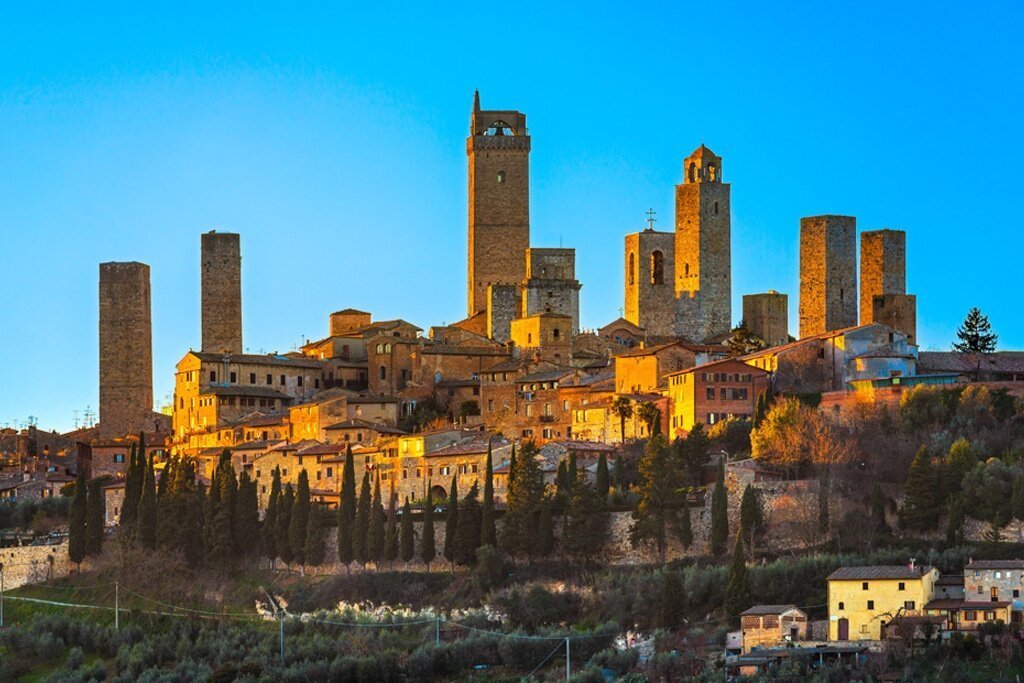
It's in the Tuscany region, and many people make a day trip from Florence to visit this small, medieval Italian city – which is a shame: if you stay the night in San Gimignano you'll discover a city that dawns and dusks is much more charming, very different. from the crowd of tourists in the middle of the day.
The little town still has a medieval aura, with all the charm and fear that this means – there is, for example, the Inquisition Museum, with very heavy exhibitions. But it is also charming, full of alleys, small wineries, delicious and hidden restaurants – there is, for example, “the best ice cream in the world”, which got its name because its manufacturer has participated in (and won) world production competitions. homemade ice cream. If it's the best in the world, I don't know – I found several delicious Italian ice creams –, but if the question is also the charm of the location, it's certain that this one gained several points ahead of the others.

San Gimignano with its medieval towers – Photo: StevanZZ/Shutterstock.com
A tip: if you enjoy cycling, try staying in San Gimignano for two days and go down the city by bike (or a vespa, to be more charming) towards the surrounding farms – many of them practice agriturismo, in which you can participate of the production routine and see up close how cheeses and wines are made. Besides the beauty of cycling through sunflower fields!
Tip: the month of September is when the harvest takes place, the harvesting of grapes for wine!
Riomaggiore
In fact, I mentioned Riomaggiore just to make you come here – because it is a small commune that, together with Manarola, Vernazza, Corniglia and Monterosso, forms the Cinque Terre region, or “Five lands”. Access is time-consuming and by train – it takes a three-hour journey from Milan – but this corner deserves all your time and attention. The Cinque Terre are small communes embedded in a jagged mountain range, with stone walls that plunge into the Ligurian Sea.
And what a sea; with outrageously turquoise green waters, it is the first reason for you to travel to Riomaggiore and the region, especially in summer. Don't expect a Brazilian-style beach; there is a shy strip of land in Vernazza and Monterosso, but even so, the sea, refreshing in color and temperature, is a delicious invitation that will be worth the trip.
The trails in the region are also worth a visit. Those who like to walk, exercise and, as a bonus, enjoy a beautiful view, can venture along the trails that connect the communities to each other – all of them have the sea as their main road companion. In fact, one of these paths is the famous Via Dell'Amore, or Via do Amor: legend has it that it was the construction of this path that made travel between the communes of Manarola and Riomaggiore possible, and because of this it was along the road that the young people from both communes arranged to meet to date. Don't notice if you find lots of locks and hearts around!

Riomaggiore seen from the sea – Photo: Andrew Mayovskyy/Shutterstock.com
I also need to talk, of course, about the food: with the sea so close, the Cinque Terre is particularly famous for its seafood-based cuisine. Special tip: stay in the city of Riomaggiore, which is at one end of the Cinque Terre (which makes it easier to take the train in just one direction), and look for the Dau Cila restaurant – one of the partners is Brazilian, and the The house specializes in delicious seafood and pesto pasta, outrageously delicious!
And, if I can still give you any tips, try to stay at least three days in the region to calmly enjoy what each little town has to offer. Riomaggiore has a beautiful sunset, the gateway to Via Dell'Amore and the Dau Cila restaurant. Manarola has the beach; Don't forget diving among the rocks, and also indulge in the ice cream and friendly shops. Corniglia is at the top, so run to the viewpoint and rest your eyes (and your heart) for a few minutes watching a beautiful landscape (and then come back, stopping at the cute little shops along the way!). Vernazza has the beach and restaurants, and Monterosso has the hustle and bustle, as some of the young people stop there.
FOLLOW ITALIANISM