























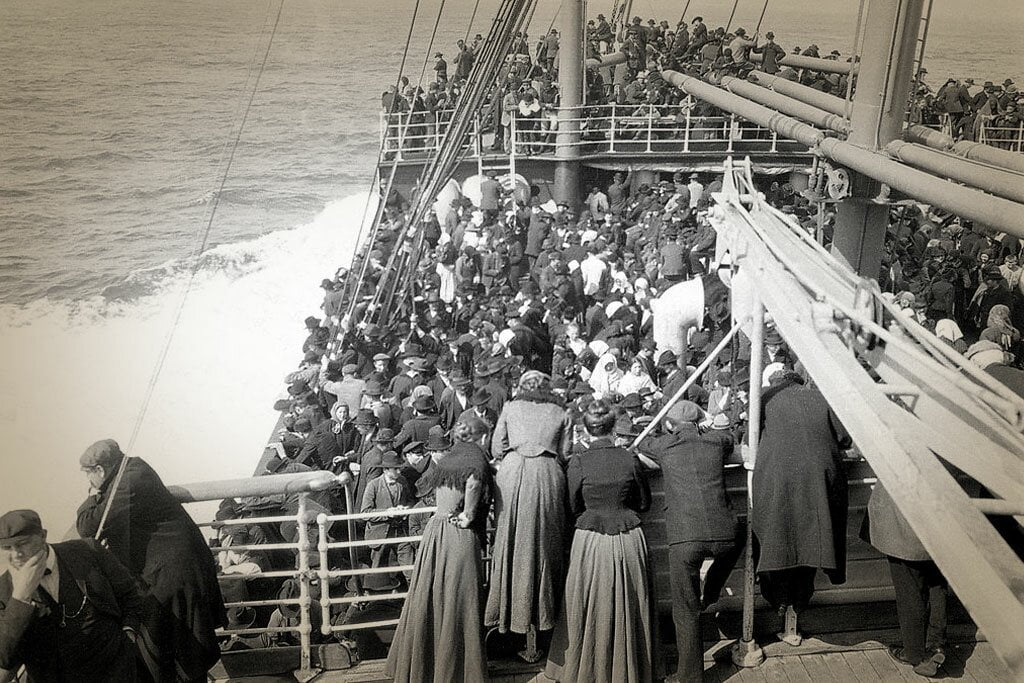
A long journey into the unknown, full of obstacles, but full of hope. That's how the first ones were Italian immigrants They set off for Brazil in search of a better life.
In the Italian imagination, Brazil was the land of plenty, where the mountains were golden and cheese was harvested from the trees.
Therefore, leaving Italy for Brazil opened up a new horizon for Italian immigrants.
But crossing the Atlantic towards America was not at all easy: the trip, in third class on a steam ship, could last up to 40 days.
"The travel conditions in third class were very difficult. It was a situation of poverty, many people and little food."
However, there were people who dreamed, who sang. The atmosphere of hope helped a lot to face the journey and the difficulties, illnesses”, says the president of Genoa Port Authority, Luigi Merlo.
Between 1876 and 1915, 24% of Italians who left Europe came to South America – mainly to Brazil, Argentina and Uruguay.
The voyages were documented by the ships' commanders and are preserved in the Genoa State Archive.
Fertile land
Only when they arrived at Brazilian ports did the families find out which region of the country they would be taken to. Arrival in Brazil took place in the port of Santos and also in Rio de Janeiro.
Despite the difficulties, in letters addressed to those who stayed in Italy, Italian immigrants said that Brazil was indeed a better country to live in.
“The land is fertile in the colony. There are many trees. Here a man who works for a month feeds a family for a year. The water and air are excellent, as in our country”, says a letter sent in 1876.
“It was a time when poverty was a drama in the country [Italy]. Brazil and Argentina were seen as new worlds, with great capacity and potential from an economic point of view”, says Luigi Merlo.
However, before leaving for Brazil, it was necessary to take a long trip to Italy. Depending on the location, it took families five days to get to the nearest train station heading to the port of Genoa.
A crossing made on foot, in the sun and rain, along dirt roads. They only had the help of animals to carry their belongings.
With information Guilherme Fadanelli, from RBS TV