









Most of the Italian immigrants who settled in southern Brazil came from northern Italy, and many surnames still carry the exact accent of their region of origin. In Veneto, Lombardy, Trentino, and Friuli, the ending of the name... It works like a map.According to onomastics, the science that studies the origin of names.
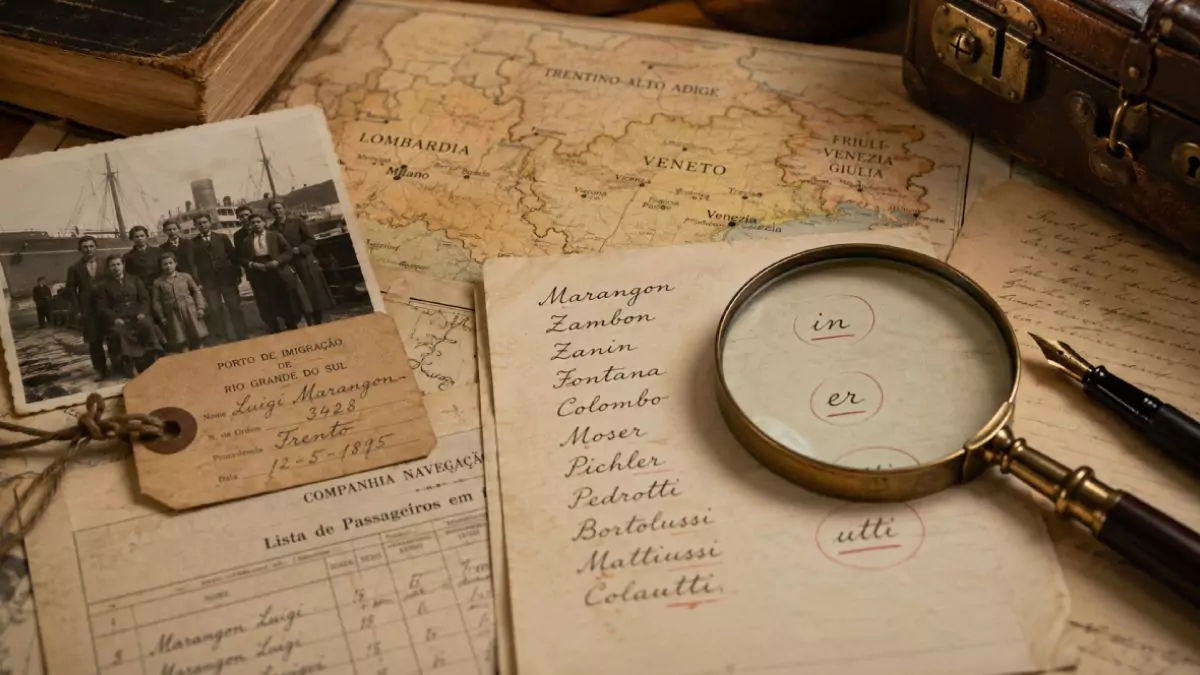
The clue is at the end of the last name. One "In"It is usually Venetian, a "er" points to German-speaking Trentino, a “utti” It refers to Friuli. It is not an absolute ruleHowever, when combined with the family history, this helps to narrow the gap in the search for the commune.
Veneto: the land of the "n"
Veneto was the largest source of immigration to São Paulo, Rio Grande do Sul, and Santa Catarina, and its surnames are easy to recognize. The hallmark is the ending in a consonant. As the onomast Enzo Caffarelli, from the Rivista Italiana di Onomastica, summarizes, "the ending in a consonant is typical, especially in 'n'”.
Hence come Marangon (from “marangone”, carpenter), Ballarin (dancer), Zanon, Zambon, Zanin and Marin, in addition to the ethnic names Trevisan (from Treviso), Visentin (from Vicenza), Pavan (from Padua) and Furlan (from Friuli). Another distinctly Venetian trait is the suffix "act"in Lovato, Volpato, Reginato, and Simionato. The Veneto surnamesMoreover, they are among those that have undergone the least Italianization process, which has helped to preserve these forms.
The Supreme Court reaffirmed: citizenship is born with the person.
- New legal front opened
- Processes can still be filed.
- Individual assessment before any decision.
Lombardy: the name tells you where the house was located.
In Lombardy, the surnames associated with residence are noteworthy, as they indicate the exact place where the family lived in the village. For Caffarelli, they "signal a fixation, an entrenchment," linked to points in the village such as the door, the road, the church, or the hillside. This is the case with Fontana, Villa, Sala, Porta, and Chiesa.
The region also has the most curious surname on the list: Colombo, one of the most frequent in Lombardy, which In many cases, it was attributed to foundlings., starting with the dove, which was the symbol of a Milanese care institution.
Trentino-Alto Adige: German surnames
Those with Trentino ancestry might find it strange at first glance. The region is "characterized by the presence of German surnames," marked by the ending... "er", such as Moser and Pichler. They coexist with Italian forms like Tomasi, Pedrotti and Zeni, and with local names like Degasperi, the same as the statesman. Alcide de Gasperi.
Read also Why do surnames from Southern Italy almost always end in "o"?
Friuli: the crossroads of three cultures
In Friuli, surnames are a mix of Italian, Friulian, German, and Slovenian influences. The typical ending is... “utti” e “ussi”, in Bortolussi, Mattiussi and Colautti, as well as Cargnelutti, literally “from Carnia”. Furlan appears, the number 1 surname in Trieste, and curiosities such as Blasutig, which adds the Friulan Blasùt (diminutive of Biagio) to the Slovenian suffix "ig".
In all cases, the same reminder applies: the ending indicates a trend, not a certainty. But, for those looking for the city of origin, it's a good first clue to follow.









Carlos Alberto CONEGLIAN
June 29 from 2026 at 16: 06
I am of Italian descent on both my paternal (Coneglian) and maternal (Capello) grandfathers' sides; both were born in Italy. I would like to know if I am eligible for dual citizenship.