























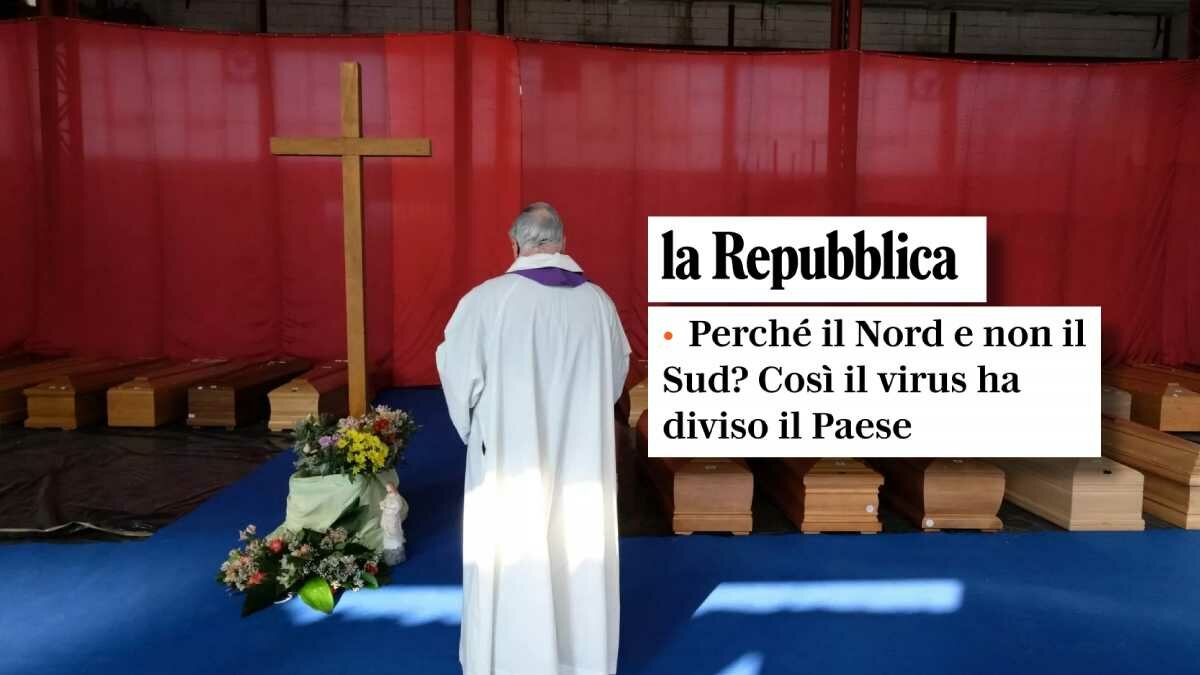
Fifty days after the outbreak of the Covid 19 pandemic in Italy, the data is clear: a real epidemic tsunami has hit Lombardy, Veneto, Piedmont and Emilia Romagna.
But why only the North and not the Central-South? Why Milan and Bergamo and not Rome and Naples?
The enigmatic questions were asked by the newspaper La Repubblica, which consulted experts on the topic.
The Covid 19 epidemic really traveled at two speeds across the country, the daily acknowledges.
The most intriguing hypothesis, however, comes from epidemiologist Massimo Cicozzi, from University of Rome. Could it be warmer weather in the South? He doesn't rule it out.
“It could be, but it is only a hypothesis, mind you, that the virus that had been circulating in the North for weeks (and was transported to the South) was already a little less potent than when it arrived in Lombardy. Its mutations to adapt to humans may have caused it to lose viral load. Theoretically this is possible. The virus changes to adapt to humans and, in doing so, can reduce its own potency”, he explains.
It was expected, for example, that the thousands of people who left Milan heading south, mainly to escape confinement, would spread the coronavirus in such a way that the disease would claim even more victims in the less wealthy part of the peninsula.
That hasn't been the case so far. While Lombardy, where Milan is located, has 60,3 cases, Lazio, where Rome is located, has 4,9. The case fatality rate also varies. In the North, it exceeds 14%; in the Center, it is 8,1%; and in the South, it is 7,8%.
Roberto Cauda, from the Gemelli Policlinico Hospital, also in Rome, believes that Rome prepared better than Milan, also because it had more time. “But it may be that the vast majority of those infected who certainly traveled between Milan and Rome were asymptomatic and, therefore, potentially a little less contagious. The issue of lower contagiousness among asymptomatic people has not been established for Covid-19, but it is also not excluded,” he says.
Asked about these hypotheses, microbiologist Antonio Cassone, director of the Instituto Superior de Saúde, stated: “Always theoretically, all of this is plausible. When mutating, the virus “errors” by adapting and does not know how to “correct” itself. Regarding Covid 19, no one has yet demonstrated that mutations may have “weakened” it. But this possibility can be excluded.”
A reporter is signed by Massimo Razzi.
FOLLOW ITALIANISM