


































Among the many Italian emergencies, there is one that is taking on dimensions never seen before. This is the case of Neets, that is, young people who do not study, do not work and are not included in training courses.
In Brazil, the term is known as “nem-nem”. In English, Neet means “not in education, employment, or training” (“disconnected young people”, as they say in the United States).
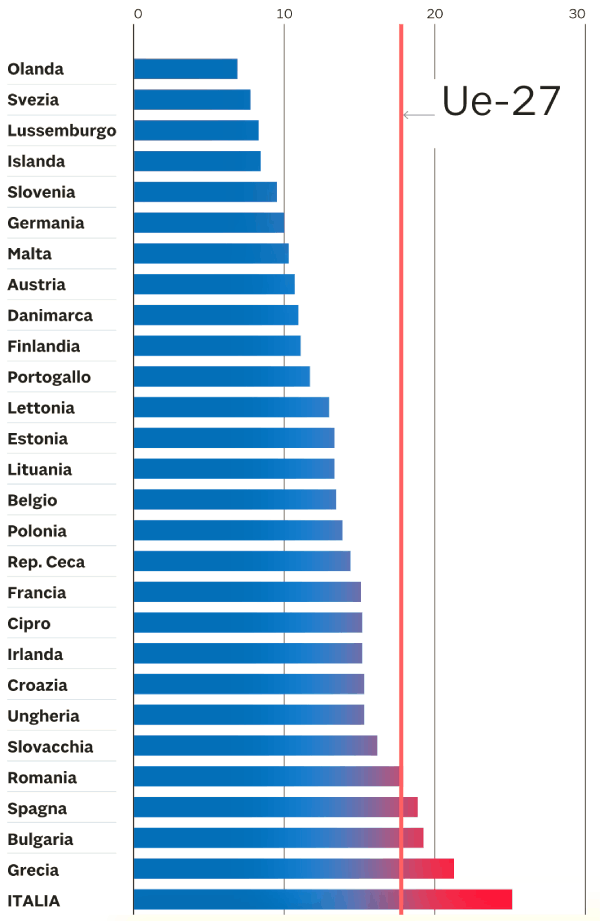
Among the 27 countries of the European Union, Italy is in last place, according to a study produced by Eurostat, the Statistical Office of the European Union. On the other hand, the Netherlands, Sweden and Luxembourg occupy the top three positions. Portugal is in 11th place.
Data in % of the population aged 15-34. Year 2020
Young people in Italy
According to the study, based on data from 2020, three million Neets represent 25,1% of young Italians between 15 and 34 years old, exactly 1 in every 4. In the last months of 2020, the pandemic worsened the situation.
The data also showed that in Italy one in two women does not work and 25% of girls under 30 are Neets. Of the 8,6 million women in this condition in Europe, a third are from Italy. The early school leaving rate is also high.
the lost generation
The identity of this “lost generation”, like the Prime Minister Mario Draghi recently defined, is quite clear: in the school age group (15-19 years) Italian Neets are 75% more than the EU average; in the university range (20-24) there are 70% more.
The situation is worse for women. The “pink” share among Neets goes from 45% in the 15 to 19 age group to 66% in the more mature age group (30 to 34).
In southern Italy, the gap is even more pronounced. Sicily has 30,3% of Neets aged 15-24, in Calabria it is 28,4% and Campania, 27,3%.
FOLLOW-US