












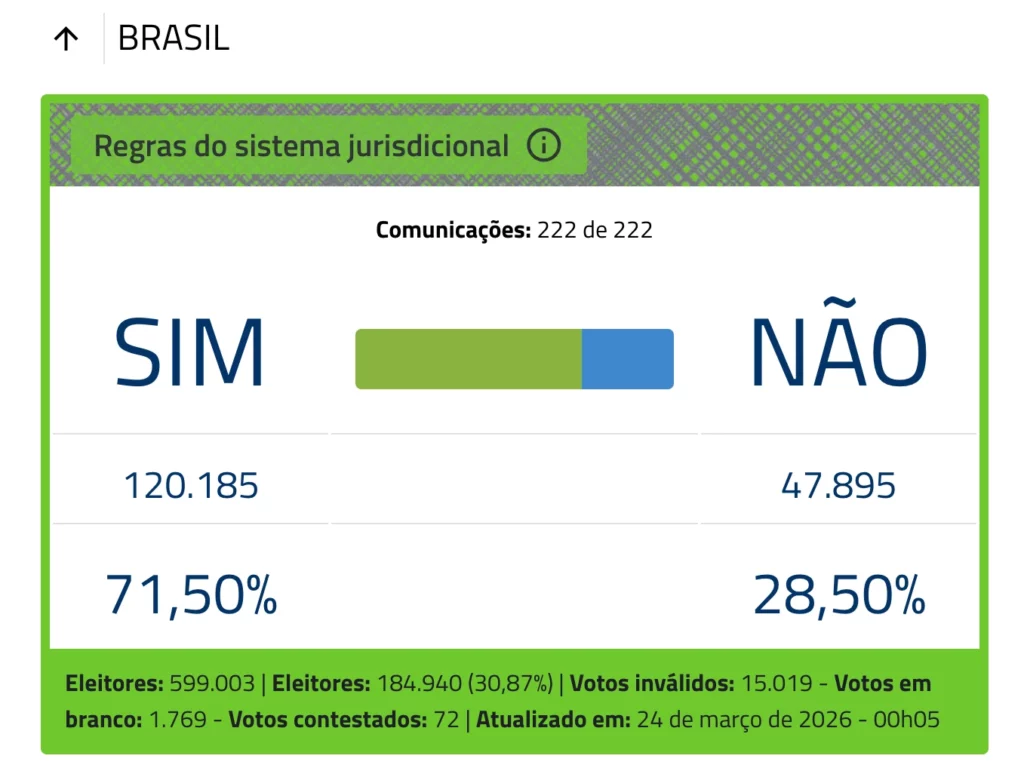
the map of judicial referendum of 2026 This paints a picture of an unprecedented geographical and ideological divide. In Italy, Prime Minister Giorgia Meloni suffered her worst defeat. In South America, she achieved a landslide victory. How can we explain that countries like... Venezuela (87,3%), Ecuador (81,8%) e Brazil (71,5%) Have they embraced a reform that the Italians themselves rejected?
The answer lies not in Rome, but in the feeling of "crisis of confidence in the judiciary" that dominates South America.
The Judiciary as a "caste"
According to the experts interviewed by ItalianismThe Italian vote in Brazil was a mirror vote. As the sociologist points out... Daniel TaddoneThere is a clear confirmation bias: voters identify the Judiciary as a "caste" and project onto the Italian reform the desire to "control" judges, a direct reflection of the political clash between the right and the Judiciary in Brazil (STF).
“Brazilians identify the ‘Yes’ vote as something from the right and voted to regulate judges, transferring the interpretation of the Brazilian case to the Italian one,” analyzes Taddone.
According to him, there is an effect of interpretation based on local reality. "People with little contact with the subject see that something will regulate the judges and they already make that transition from interpreting the Brazilian case to the Italian one."
He also mentions the role of influencers. "The person knows nothing about Italian politics, but identifies 'Yes' as something from the right, so they go there and campaign for 'Yes'."
Fragile democracies and the desire for change.
the numbers of Venezuela (87,3%) e Ecuador (81,8%) These are the most symptomatic examples. In countries where the perception of justice is marked by reticence and instability, any proposal for "reform" is seen as a breath of fresh air against the current situation. status quo.
The lawyer Christian Girardello He emphasizes that "ideological voting" in South America is fueled by a discourse of rupture. Furthermore, he raises a crucial technical issue: the lack of transparency in the postal voting system.
“We have an electoral system with little transparency and questionable effectiveness. Unfortunately, votes cast abroad can be easily manipulated by patronages and associations,” he said.
Another factor mentioned is the age profile. "In Italy, the 'no' vote was the majority among the younger and older age groups, and our participatory electorate is made up precisely of people in the age group that voted mostly for 'yes'," Girardello added.
The "slap in the face"
The businessman Marcelo Fragali, former owner of RedeTV! and candidate for the Italian Senate, attributes a significant political component to the result. According to him, the vote in favor of "Yes" expressed the position of the Italian-Brazilian community regarding the current scenario.

According to Carvalho, even in the face of dissatisfaction with restrictions on citizenship, such as those foreseen in the so-called Tajani DecreeThe electorate demonstrated ideological alignment.
“We knew how to vote for what is right. It was a slap in the face to the Italian government. If we were treated with respect, we would be Italy's greatest allies in the world,” Carvalho stated in a video posted on his social media.
FOLLOW-US



joao gualberto pinheiro junior
March 25, 2026 at 02:04 pm
This clarification from the Italian-Brazilian community is timely, relevant, and important in the context of the election. We need competent and effective representatives.