



















Do architectural tourism in Milan , capital of Lombardy, Italy, goes far beyond visiting its famous cathedral, in Piazza del Duomo, or seeing the Pirellone skyscraper.
The author of the book “111 Design Places in Milan You Must Discover”, Sara Pupillo reveals that the city is “an open-air museum of one of the most innovative arts of the 20th century, the Design, full of great masters”.

Here are 10 little-known places in the “city of design”:
1 – MUMAC – Coffee Machine Museum
Founded in 2012 by the company Cimbali, during the brand's centenary, the museum features bar machines from different brands preparing coffee from the beginning of the 20th century to the present day.
Highlighting the Cimbali Rapida model, from the early 1930s.
2 – Church of San Giovanni Bono
Built in 1958 in the Sant'Ambrogio neighborhood, this unusually shaped church is the work of architect Arrigo Arrighetti. Its triangular concrete façade is reminiscent of a camping tent, while its interior is cheerful and welcoming, with colored glass windows scattered throughout.
3 – “Michetta” sofa, at the Poldi Pezzoli Museum
The sofa, created by renowned architect, designer, painter and sculptor Gaetano Pesce in 2005, is inspired by one of the simplest breads produced on the streets of Milan, the michetta – whose fermentation and baking time are never the same. Pesce’s Michetta is also never the same, as the museum staff always displays it in different ways.
4 – Mount Amiata
It is a gigantic residential complex in the Gallaratese neighborhood. It is named after the Monte Amiata Mining Company, which financed the construction in an area that until then had been completely rural.
The project was designed by Carlo Aymonino and Aldo Rossi in the late 1960s, a period that marked the construction of large affordable housing complexes in many Italian cities. All the residences are different from each other and some still preserve details of the original design. The local library is the icing on the cake.
5 – Cylindrical palaces by Angelo Mangiarotti
Three small cylinders appear on the street. Supported by stilt pillars, they have lush gardens on the roofs.
Built in 1956, the project was designed by Angelo Mangiarotti and Bruno Morassutti and is considered one of the most original in Milan. The shape probably has American inspiration, since Mangiarotti lived in the United States.
6 – Red subway line
Built in 1957, the initial design featured elegant trains and stations, with details designed to guide the flow of users, such as the color red, signs and handrails in the shape of an inverted “T”. Despite the various modifications it has undergone in recent decades, the M1 line is still a masterpiece of Italian design.
7- Cement Panettone
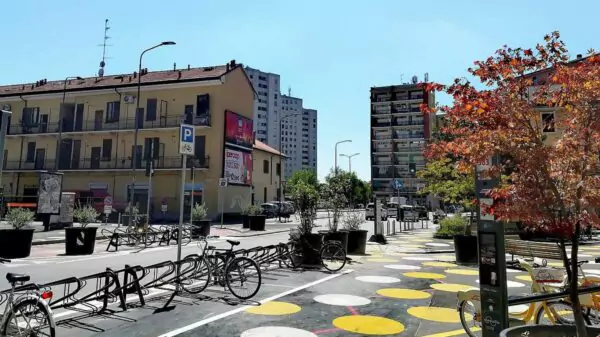
This is not about the Lombard dessert, but about the mounds of cement nicknamed “panettone” because they imitate the shape of the famous Christmas bread. Concrete panettones spread throughout several Italian cities after the architect Enzo Mari created them in 1980, with the aim of offering a cheap urban service, easy to transport and that could be used by pedestrians as a bench.
8 – The new headquarters of the IULM university
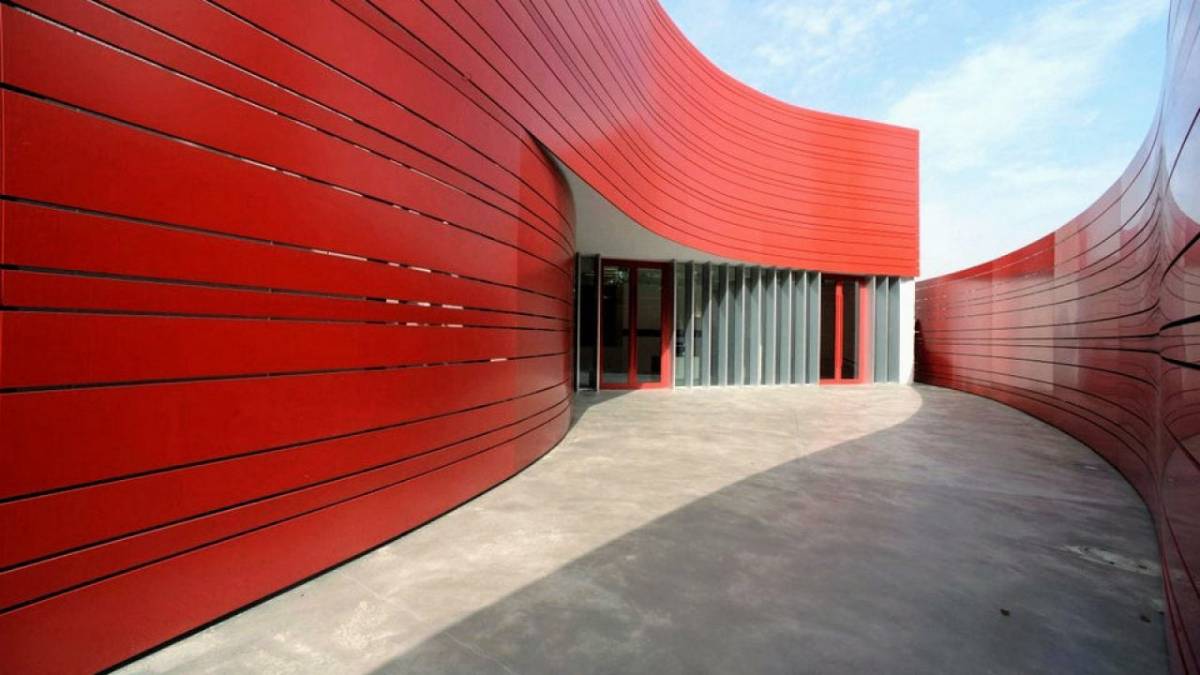
This lobster-colored giant, opened in 2015 and designed by Gianluca Peluffo and the 5+1AA studio, is part of the university's complex of classrooms, offices and services. The building's nine floors have a unique external staircase on one side, while the opposite side is made entirely of glass.
9 – House of books
The Kasa dos Livros, in the Isola neighborhood, houses old books, first editions of contemporary books, autographed art books and other relics. The place is a gigantic private library of the collector Andrea Kerbaker, with more than 30 thousand works.
10 – Kartell Museum
The gigantic Kartell building, with the orange cladding that gives color to the industrial area of Noviglio, south of Milan, was designed in 1967 by Anna Castelli Ferrieri and Ignazio Gardella.
In the company's museum area, hundreds of objects are on display that illustrate how the polymer has gradually been used in all types of household products, from lamps to ashtrays and sofas. A highlight is the classic Componibili line, designed by Anna Ferrieri in 1967. (HANDLE)