
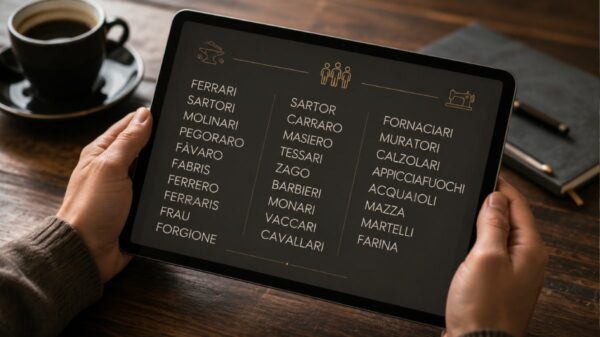






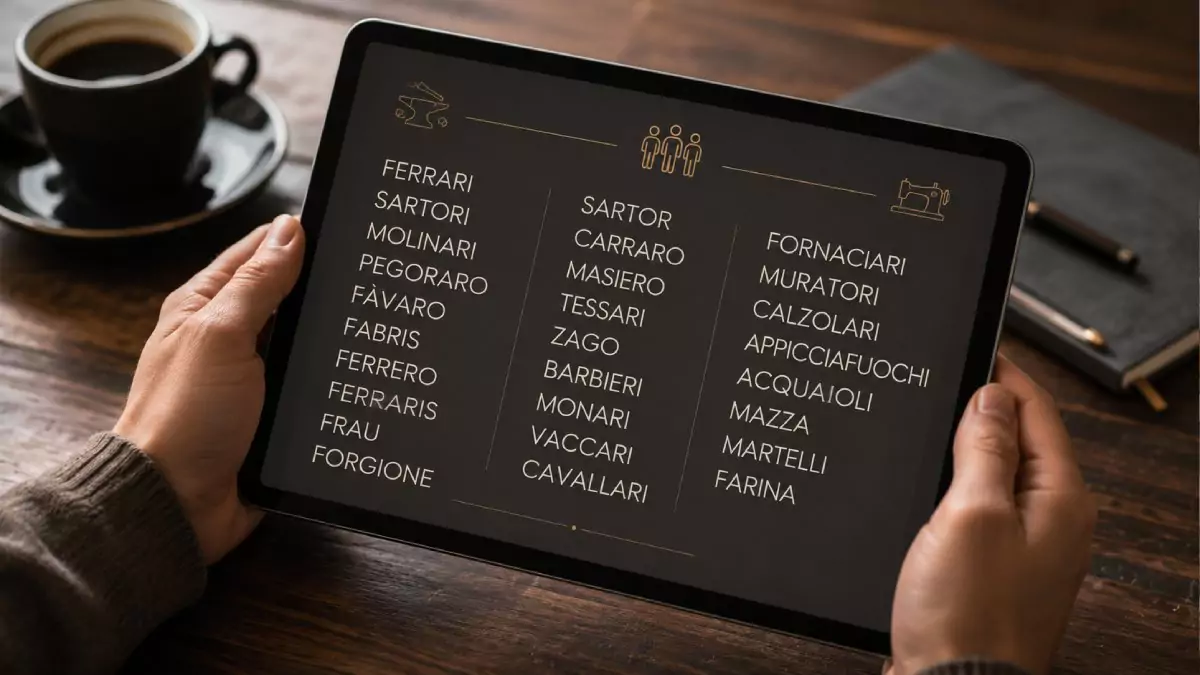
Many Italian surnames reflect the occupation of an ancestor. Ferrari worked with iron, Sartori sewed clothes, Molinari operated the mill, Pegoraro tended sheep. The name that the family carries to this day began as the simplest way to identify someone: by what they did.
For the name-maker Enzo Caffarelli, Italian Rivista di OnomasticaThese names hold a true treasure. "Surnames constitute a kind of linguistic museum where ancient memories survive." And many of these professions no longer exist.
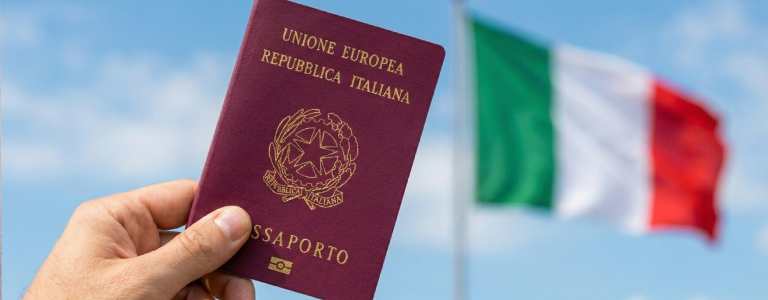
The blacksmith has a different name in each region.
Here's the most interesting detail: the same trade changed names according to the local dialect. The blacksmith, for example, gave rise to Ferrari in Lombardy and Emilia, but became Fàvaro and Fabris in Veneto, Ferrero and Ferraris in Piedmont, Frau in Sardinia, and Forgione in Southern Italy.
In other words, a surname doesn't just tell you what an ancestor did. It can also give clues about the region they came from. Fàvaro and Ferrero, for example, are surnames linked to the same profession, but they originated in different regions of Italy.
The most common occupations
In VenetoFrom where a large part of the immigration to Southern Brazil originated, we find Sartori and Sartor (tailor), Carraro (cart maker or driver), Masiero (sharecropper, colonist), Pegoraro (shepherd), Tessari (weaver) and Zago (sacristan, altar boy).
In Emilia-Romagna, the list is even longer, with Barbieri, Molinari and Monari (millers), Vaccari and Cavallari (who cared for cows and horses), Fornaciari (baker), Muratori (stonemason) and Calzolari (shoemaker).
According to Caffarelli, this repertoire reflects the Italy of the city-states and reveals "a greater propensity on the part of those in charge to define an individual by the activity performed".
Trades that time has erased.
Some surnames hide professions that have disappeared.
The ancestor of the Appicciafuochi, from Abruzzo, would light fires in the homes of Jewish families on feast days, for a fee, when religion forbade the residents themselves from doing so. The Acquaioli, on the other hand, are descended from itinerant water vendors.
These are professions that have disappeared over time, but which remain alive in surnames.
Not every Barbieri was a barber.
One should be careful. A surname may indicate the occupation of an ancestor long ago, but it doesn't mean that profession has been passed down through generations.
And some meanings have changed over time. Barbieri, for example, took care of beards and hair, but also performed minor surgeries and procedures such as bloodletting.
There are still hidden trades in names that today sound like something else. Mazza, Martelli, and Farina may point to an ancient professional activity, and not just to an object or food.
As always in onomastics, a surname is a good clue to investigating a family's origins, but it should not be treated as absolute certainty.
The profession behind the name
Ferrari, Fàvaro, Ferrero, Frau and Forgione: surnames linked to the blacksmith's trade in different regions
Sartori and Sartor: tailor
Molinari and Monari: miller
Pegoraro: shepherd
Carrara: maker or driver of horse-drawn carts
Muratori: bricklayer
Calzolari: shoemaker
The name points to the occupation that may be the origin of the surname, not to a profession practiced by the entire family.
(With information from Treccani)













Claudette Funghetto
18 July 2026 12 at: 38
What is the origin of surnames?
Santi – Angeli – Pozzato – Funghetto
Thank you very much!
Antonio Claudio Formenti
18 July 2026 13 at: 04
I would like to know the origin of the surname Formenti.