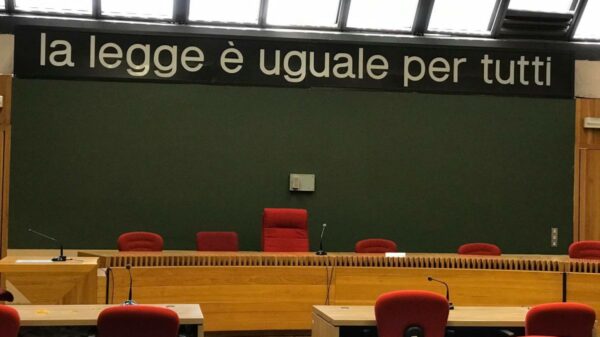






































The Italian Constitutional Court published this Tuesday (21) the Sentence No. 137/2026 and maintained the rule requiring a minimum payment of €43 from unified contribution so that a civil action can be filed.
The trial was being closely followed by those working with Italian citizenship because its reasoning could have repercussions on the €600 fee per applicant in legal recognition proceedings. jure sanguinis, in one of the blows dealt by the Meloni government against Italian descendants.

In May, Italianism had already anticipated this discussion.The most favorable scenario, with the removal of the tax barrier to access the process, did not materialize.
But the decision also did not end the debate about the €600.
Court admits tax limit, but imposes conditions.
The Court reaffirmed that the unified contribution It has a tax-related nature, but it was understood that a tax obligation can have repercussions on the right of access to justice when the principles of proportionality and "stretta necessità" (strict necessity) are respected.
In other words, the restriction must be proportionate, and the advance payment must be necessary to adequately protect the tax credit.
This understanding rejects an absolute interpretation according to which a tax could never condition access to the Judiciary.
In a previous analysis of Italianism, the lawyer Luigi Minari had highlighted precisely this conflict:
"The tax nature of the unified contribution cannot be used as a mechanism to impede access to justice."
The Court did not accept this argument in absolute terms.
Why were the €43 fees maintained?
One of the most important foundations of the decision lies in the value being analyzed.
The Court stated:
“Proprio l'estrema modestia dell'esborso […] competes a fare ritenere l'onere fiscale […] non sproporzionato.”
In a free translation, it is precisely the extremely small size of the disbursement that contributes to considering the charge not disproportionate.
The decision also took into account the difficulty and cost of subsequently collecting very small amounts. According to data analyzed by the Court, the new rule caused a significant reduction in outstanding debts in the lowest income brackets. unified contribution.
This reasoning was crucial in deeming the minimum requirement of €43 legitimate.
The court identifies the problem and leaves the solution to Parliament.
Despite maintaining the charge, the Court identified a constitutional problem in the way the rule currently works.
Today, the lack of payment allows the chancellorThe court clerk refused to register the lawsuit even before the case reached a judge.
According to the Court, granting an administrative body the power to impede access to the Judiciary effectively conflicts with constitutional guarantees.
The rule, however, was not overturned on that point.
The Court declared the question inadmissible because there are different ways to correct the problem and understood that it is up to the legislator to choose which solution to adopt.
Among the possibilities mentioned are allowing the judge to grant a period to regularize the payment, creating an appeal mechanism against the refusal of registration, or leaving the decision on the eventual closure of the process to the magistrate himself.
In practice, the Court upheld the €43 requirement, but left it to Parliament to correct how this barrier is applied.
€43 is not €600 per applicant.
Judgment 137/2026 did not address the specific fee of €600 charged in Italian citizenship recognition proceedings.
Therefore, the Court did not declare this charge constitutional.
Furthermore, since 2025, the €600 fee has been charged individually per applicant. A family of five pays €3.000. With ten applicants, the amount reaches €6.000.
The legal question, therefore, changes.
It is no longer enough to argue that a tax cannot limit access to justice. The Court itself has acknowledged this possibility.
The discussion then becomes whether €600 multiplied by the number of applicants in the same action also exceeds the proportionality and strict necessity tests established by Judgment 137..
Minari was already pointing to the origin of the charge.
In the analysis previously published by Italianismo, Minari also drew attention to the context in which the rate was raised:
"The €600 contribution was created precisely in a context of significant growth in Italian citizenship applications."
This aspect may remain relevant in a potential specific challenge to the charge.
Tuesday's decision makes it more difficult to formulate a general argument against any tax-related restriction on access to justice, but it does not answer whether a charge of €600 per person, multiplied within a single action, is proportionate and strictly necessary.
The legal battle has become more specific.
The expectations raised by Italianismo in May did not materialize in the broadest sense.
The Court did not overturn the €43 limit.
On the other hand, its rationale clearly defined the criteria that any eventual discussion about the €600 would have to address: proportionality, purpose, and the strict necessity of the advance payment.
The question now becomes more objective:
If €43 was deemed constitutional also because it represents an extremely modest outlay, can the same reasoning be applied to €600 per applicant?
The Italian Constitutional Court has not yet given that answer.
The full sentence can be read here: Sentence No. 137/2026