








































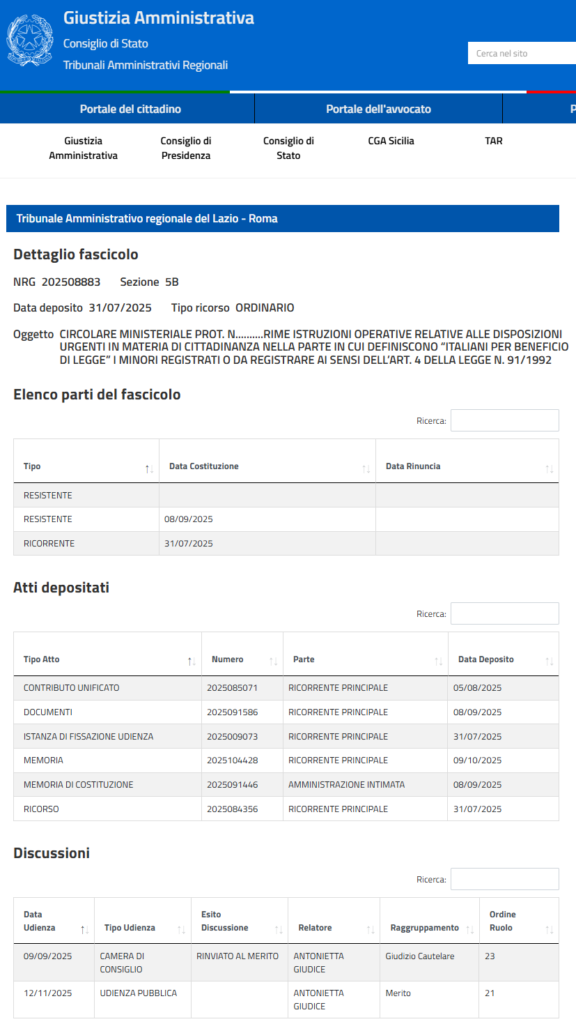
The Lazio Regional Administrative Court (TAR Lazio) held a hearing on Wednesday, November 12, to rule on an appeal against Circular No. 26185, issued by the Ministry of the Interior on May 28, 2025. The action, registered under number 8883, questions the legality of the new category "Italian citizen by benefit of law," applied to minors born abroad to Italian parents.
Changes in the rules of citizenship
The controversy began after the enactment of Law 74, of May 23, 2025, which amended Law 91/1992, the basis of Italian citizenship legislation. The reform eliminated the automatic recognition of citizenship for many born outside Italy and established new requirements: a formal declaration from the parents and proof of residence for the minor.
A few days later, the Ministry of the Interior published a circular to guide municipalities and consulates. The appeal alleges that the document created, without legal basis, the category "by benefit of law". (beneficio di legge), a term absent from the original text of the legislation.
Legal basis and arguments of the appeal
Although the term "benefit of law" is used in legal doctrine for cases where citizenship is not automatic, the authors of the appeal, from Studio Legale Pinelli Schifani & Caronia, representing Confederation of Italians in the World (CIM)They argue that the circular goes beyond its interpretative role. The central point of the criticism is that the document imposes administrative barriers that are not foreseen in the law approved by Parliament.

The Supreme Court reaffirmed: citizenship is born with the person.
- New legal front opened
- Processes can still be filed.
- Individual assessment before any decision.
Among the main legal foundations are:
Lack of legal basis
The authors claim that the circular imposes requirements beyond those stipulated in the legislation. However, article 4, paragraph 1-bis, of the new law already requires a formal declaration. Thus, the document would only guide its practical application.
Violation of constitutional principles
Another point raised mentions possible violations of constitutional principles, such as equality and respect for international treaties. This argument, however, focuses more on Law 74 than on the circular. Courts such as those in Turin and Mantua have already submitted questions about the constitutionality of the norm to the Constitutional Court.
Unconstitutional retroactivity
Applying the new rules to cases predating the reform is seen as problematic. The Campobasso Court, for example, ruled in judgment no. 375/2025 that the decree-law cannot be applied retroactively, preserving the principle of legal certainty.
Possible decisions by TAR Lazio
Although the TAR (Regional Administrative Court) does not have the power to declare a law unconstitutional, there are three possible outcomes:
1. Rejection
If the court finds that the criticisms refer to the law and not to the circular, the appeal may be rejected.
2. Partial acceptance
If it recognizes that the circular exceeds the limits of the law, it may annul specific points of the administrative text.
3. Referral to the Constitutional Court
The most significant scenario would be sending the case to the Constitutional Court, following other courts that are already challenging the validity of the new legislation.
The ruling, expected in the coming days, will be decisive for thousands of families seeking recognition of Italian citizenship for their minor children, following the changes imposed in 2025.