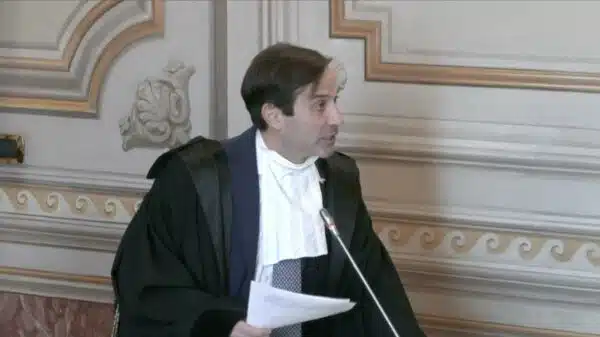







































The Italian Constitutional Court held its long-awaited public hearing on Wednesday, March 11, to analyze the constitutionality of the new Italian citizenship rules introduced in 2025.
The session brought together lawyers challenging the rule and representatives of the Italian state. The trial concerns the changes introduced to Article 3-bis of Law No. 91 of 1992 by Decree-Law No. 36 of 2025, known as the Tajani Decree.
The hearing is part of an analysis of the issue raised by the Turin Court, which questions whether the new limitations can also be applied to situations prior to the law coming into force.
Session suspended.
The proceedings began with the reading of the petitions by the case's rapporteur, Giovanni Pitruzzella.
After this stage, the lawyers for the parties would begin presenting their oral arguments. But the session was interrupted after... a request for intervention Presented by lawyer Marco Mellone.
He requested permission to participate in the proceedings, claiming that he represents clients involved in a similar case pending in the Campobasso court. According to the lawyer, the constitutional issue being discussed in the Court also directly affects this case.
Mellone argued that his clients should be considered substantial parties to the trial and asked the Court to allow the intervention or consider the possibility of consolidating the proceedings.
“I take the liberty of requesting that the President and this esteemed Court declare the intervention admissible, because it is timely, because my clients are holders of this subjective legal status and, in fact, are substantial parties to this constitutional process. Therefore, they should be placed on the same level as the appellants of today, and this defense on the same level as the defense acting today.”
The panel suspended the hearing at 10:05 AM Rome time to deliberate on the request in a closed session.
The session resumed at 11:11 AM, after a 1 hour and 6 minute interruption. The Court decided not to allow the intervention.
Arguments presented by the lawyers
During the hearing, lawyers challenging the law argued that recognition of citizenship by jus sanguinis is a right that exists from birth.
The lawyer Corrado Caruso He stated that the recognition of citizenship does not create a new right, but merely declares a right that already exists.

"The right to citizenship by jus sanguinis is a perfect, imprescriptible subjective right that does not depend on administrative discretion. The procedure serves only to recognize a right that already exists," he argued.
The lawyer Monica Lis Restanio She criticized administrative obstacles that, according to her, had hindered the recognition of citizenship by descent for years.
"The right to citizenship by jus sanguinis, which arises with parentage, cannot be transformed into a mere expectation conditioned on the timing of a protocol or the availability of an appointment," he said.
According to her, treating recognition in this way "annihilates the very essence of status civitatis and ignores its constitutional protection."

The lawyer Diego Corapi He also criticized the new law, stating that it creates unequal treatment between people who have the same right.
"The legislator created an arbitrary discrimination between people who have the same right to citizenship from birth, keeping some in and excluding others without any plausible justification," said Corapi.
According to him, the reform would have applied changes retroactively.
Defense of the Italian State
The state's defense argued that countries have broad autonomy to define rules regarding the acquisition and maintenance of citizenship.
“International law does not provide for any absolute right of a person to possess dual or multiple citizenship. What is guaranteed is only the right to have at least one citizenship and not to become stateless,” stated the State Attorney Lorenzo D'Ascia.
According to him, the absence of requests for recognition for decades or even more than a century could indicate a break in the effective link with Italy.
"The absence of any request for recognition for decades, sometimes for more than a century, on the part of ancestors and also of the descendants themselves, may be assessed by the legislator as grounds for considering the effective link with the Italian State broken."
The defense also argued that those who have not yet applied for recognition do not have an acquired right to Italian citizenship.
"Until recognition of citizenship is requested, it cannot be asserted that any right linked to Italian citizenship exists," said D'Ascia.
Next steps of the trial
The public hearing does not result in an immediate decision.
After this phase, the judges of the Constitutional Court begin internal deliberations on the case. There is no fixed deadline for the publication of the sentence.
The decision could be announced in the coming weeks or months.
The ruling could have a direct impact on thousands of ongoing Italian citizenship recognition processes.
FOLLOW-US












Dani
March 11, 2026 at 15:04 pm
Advogado de defesa muito fraco. Avvocado di difesa troppo debole.