























Dante Alighieri was the first major educational institution for Italian immigrants in Brazil
The chosen location could not be more noble, a farm 300 m from Paulista, the new avenue of São Paulo, with its mansions and tram lines. Amidst the dense vegetation of the 19,8 m² quadrangle between Rua Peixoto Gomide and alamedas Jaú, Itu and Casa Branca, Italian immigrants erected the building of their first major educational institution in Brazil, the Dante Alighieri school, which ends to be listed for its historical and architectural importance.
Opened in 1911, 20 years after Paulista Avenue, it was designed by Giulio Micheli, who had arrived from Italy in 1888 and participated in the reorganization of downtown streets and the construction of the Santa Casa de Misericórdia. Simultaneously with the school, the architect led the construction of the Santa Ifigênia viaduct, which would be completed in 1913.

Fathers in jackets and top hats and mothers in long dresses walked along the dirt streets to take and pick up their children. There were 60 boys and girls who were the first to enroll. Some of them, inmates, coming from other cities, used the dormitories on the upper floor, which were maintained until the 1940s.
Today, there are 4.580 students housed in five buildings, monthly fees range from R$2.100 in early childhood education to R$3.600 in secondary education, and the congestion of cars at arrival and departure times in no way resembles the bucolic image of the beginning of last century, even though the vegetation of the Trianon park, opposite, harks back to the past.
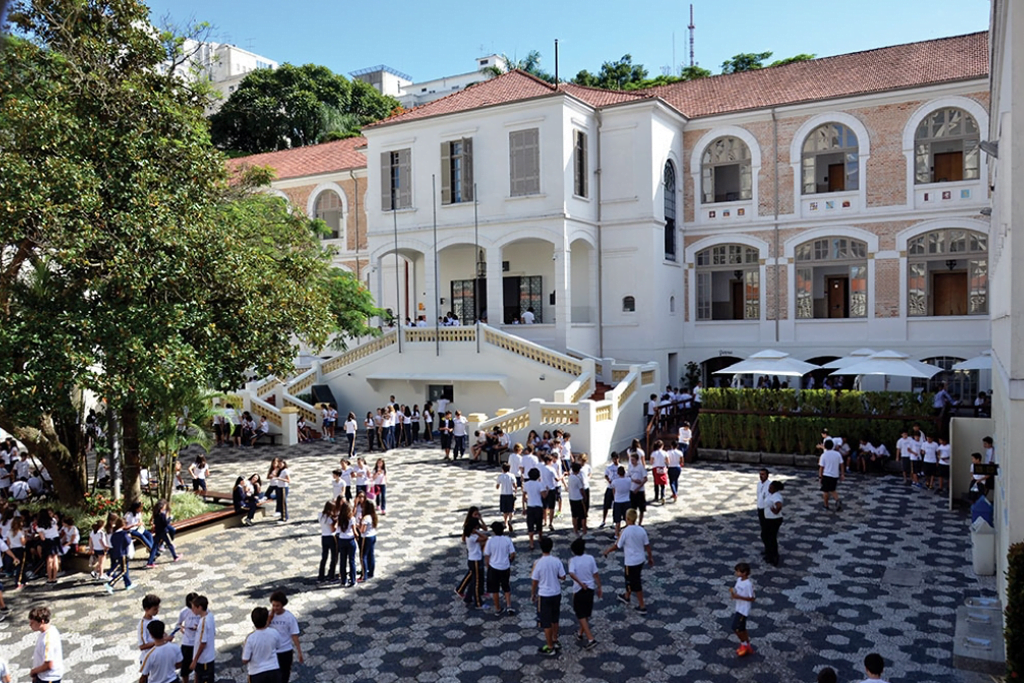
But the original construction, named Leonardo da Vinci, has been preserved. Made with exposed bricks on the external walls, it is “U” shaped, with an internal courtyard from the same period, also listed. Closing the “U” and functioning as a passage between its two ends is the other building to be preserved by the decision of the state heritage body, Condephaat, and the municipal body, Conpresp.
Called Colmeia, because it has a wall of hollow elements with this shape, from which you can see the courtyard and the back of the central building, it was inaugurated in 1959. It is a typical example of Brazilian modernist architecture, in contrast to European neoclassical architecture. of the previous building.
The same floor, a mosaic of green and white tiles, goes around the square formed by the two buildings. In the oldest, with a ceiling height of 5 m, the lower part of the walls is covered in travertine marble. At the top, frescoes that refer to Italian culture. Between the floors, stained glass windows provide colorful lighting to the stairs. The modern annex is supported by inclined and parallel columns, an image reminiscent of Brasília. The free space is a continuity of the patio.
In the decade prior to its construction, during World War II, with Brazil and Italy on opposing sides, the school was subject to federal intervention, was banned from using the Italian language and was forced to call itself Visconde de São Leopoldo. After the conflict, the school reverted to its original name and reintroduced Italian, not in all classes, as before, but in the teaching of foreign languages.
This and so many stories of Italian immigration are preserved by the listing of the complex, in which architecture reveals its ability to seal ruptures and unify distinct styles in harmonious opposition.
6 HISTORICAL MOMENTS
1. Dante Alighieri was the first major educational institution for Italian immigrants in Brazil. When founded in 1911, the school had 60 students; today, there are 4.580, up to high school;
2. The daughter of Italian dictator Mussolini, Edda, even visited the school. In 1939, despite her reception being an ode to fascism, she declared that she would not talk about politics, in line with her father's slogan: “A woman for the home”;
3. The building built for the inauguration and now listed was designed by the Italian Giulio Micheli, responsible for the Santa Ifigênia viaduct and Santa Casa, in the central region;
4. In the Second World War, with Brazil and Italy on opposite sides, the São Paulo school suffered federal intervention. Therefore, he had to change his name to Viscount of São Leopoldo and was prohibited from using the Italian language;
5. As soon as it was founded, it started a collection that forms its natural history museum, open to scheduled visits from other schools. It has 2.500 items; among them is a bearded dragon;
6. Between 1943 and 1948, Jânio Quadros taught at Dante. They say that, once, irritated by a student, the teacher, who loved mesoclysis, threw him out of the room through the window – he did not consider him worthy of passing through the door.
Sources: Folha Collection and Dante Alighieri
Originally published in Sheet