














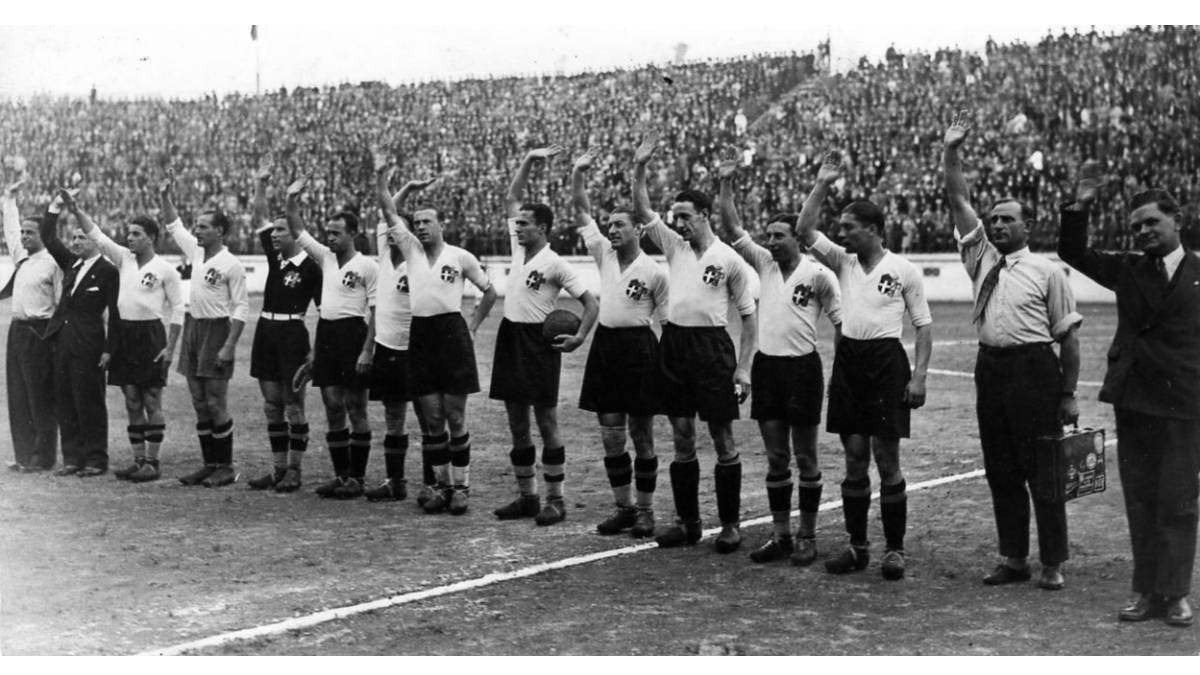
Il duce did not spare the use of controversial methods, as he used to do during his dictatorial regime
The dictator Benito Mussolini – or il duce, as he was known – was possibly the first leader to use football to implement popular policies.
He was also the first to see the World Cup as a form of propaganda for his government before the international community, which questioned the Italian politician's methods (among them, forcing teachers to wear fascist uniforms in the classroom and showing summary executions of ideological rivals).
In a way, Il Duce He took this methodical side to the pitch to organize and win the second World Cup in history, in 1934.
Mussolini believed that to immortalize himself he should “catechize” young peoples – and that the best tool for this was sport, especially football. The first step in this direction took place in 1926, when he wrote the letter that granted him “control of football in the country”: Mussolini began to appoint the presidents of the Italian Federation and to structure the tournaments.
His first major demonstration of his allegiance to football was his fight for Italy to host the first World Cup. However, in 1930, Uruguay was the natural host, having won the Olympic titles in 1924 and 1928. With the Latin country having been chosen, Il Duce he became possessed, and did not send the Italian team to the inaugural World Cup in Montevideo.
He only sent a mini-delegation of three scouts to recruit oriundis, the name given to the children of Italians born in America. Mussolini's plan to win the second World Cup began there.
Mission “win the World Cup”
After securing Italy's nomination to host the 1934 World Cup, Mussolini tasked Giorgio Vaccaro, president of the Italian Football Federation, with the biggest non-war mission of those times for the country: winning the World Cup. “Your responsibility, Vaccaro, is the world title,” said Mussolini to the Piedmontese. “I don’t know how you’re going to do it, but winning is an order, it’s not a request.”
The Italian team, finally champion in 1934, began to come together four years earlier, at the 1930 World Cup itself, when the dictator's scouts wrote the “definitive list” of the best natives, hand-picked to return to the land of their ancestors (eight Argentines, including Luis Monti, and six Uruguayans; in 1933, a year before the World Cup, Argentine strikers Alejandro Scopelli and Enrique Guaita also traveled).
The attraction to South American football grew as Latin players did well in Europe, especially Argentines Raimundo “Mumo” Orsi, Renato Cesarini and Julio Libonatti. The talent of the three made Mussolini believe that there were many other players to “rescue” on the other side of the Atlantic.
Among Argentinians and Uruguayans, there also appeared the first Italian-Brazilian to make history in Europe: Anfilogino Guarisi Marques, better known as Filó, who in 1931 left Corinthians and went to Lazio, the team Mussolini supported. In 1934, at the World Cup hosted by Italy, there were four Argentinians and one Brazilian in the team that ended up becoming the first European world champion: Monti, Guaita, Orsi, Attilio Demaria and Filó.
The second cup made the fascist summit happy not only because it was being held in Italy, but also because it was organized in a different knockout format: each instance would be decided in a single game, with 30-minute extra time if necessary, and a second match if the tie remained. Penalties should only occur as a last resort.
Political advertising
Proud to have the World Cup on Italian territory, Mussolini forced Vaccaro to carry out the biggest political propaganda for a World Cup ever held to this day. At the matches, a good part of the spectators were sympathetic to fascism – the public did not support the stars, shouting, most of the time, “Itália, Duce!”. In the presentations of the Azzurri – the name by which the Italian team is known –, Mussolini, who forced everyone, even the referees, to do the fascist salute in the middle of the field, gave the order to start the match.
All players on the Italy team underwent military training, but the psychological pressure exerted by Mussolini was much worse than any physical ordeal. Before the games, the dictator wrote, by hand, a note for each athlete and member of the coaching staff, with the same three words: “victory or death”, a fascist slogan.
The message, which could have many symbolic, subliminal and metaphorical interpretations, in this case was direct, without parables or euphemisms. An absurd climate of intimidation was created inside and outside the changing rooms.
During the championship, while Italy eliminated the United States, the other two representatives of the American continent also fell: the Argentine team lost to Sweden, and Brazil lost to Spain, 3 x 1. In the quarterfinals, against Italy, the Spanish team had seven injured players and still managed a draw (each team scored one goal), forcing a second and decisive game to be played.
The tiebreaker game, held the following day, at the same stadium, began with the result decided. Spain was without six starters, all of whom were severely injured after the violent attacks from the Italians.
There was another judge on the field, but in the stadium, Mussolini continued to command. Thus, the Swiss René Mercet canceled two legitimate goals from the Spaniards, due to non-existent offsides, but accepted an irregular goal from the legendary Giuseppe Meazza.
Il Duce He was close to achieving what he so desired. On June 10, 1934, a Sunday, the final took place in the capital, Rome. The Azzurri faced another technically superior team, Czechoslovakia.
The Czechs, despite knowing that the cards were marked, were not intimidated. They started playing much better than Italy; twenty minutes before the end they opened the scoring, but Italian-Argentine Raimundo Orsi equalized with nine minutes to go before the last whistle and got extra time.
When coach Vittorio Pozzo gathered the players in the dressing room before the extra half hour, an envoy from Il Duce came down from the box to give him a message. “Mr. Pozzo, Mussolini sent me to tell you that you are solely responsible for success, but God help you if you fail,” he said.
Pozzo passed on the message to the players in his own way. “I don’t care how, but you must win. Or destroy the opponent,” he stated, dramatically. “If we lose, we will all have very bad days ahead of us.” In extra time, Angelo Schiavio, assisted by the Italian-Argentine Guaita, gave Italy the victory.
Lots of joy, some treats for the protagonists and the fascist objective accomplished. But the celebrations celebrating the team's victory foreshadowed a dark moment in the history of football and the European country. In October 1935, Mussolini invaded Abyssinia, now Ethiopia, and to this end he summoned three natives – all Argentines – to go to the front: Enrique Guaita, Alejandro Scopelli and Andrés Stagnaro.
Lazio vs Rome
However, it wasn't the war in Abyssinia that would change with these three presences, but rather the results of the biggest football derby in the Italian capital, where Lazio, Mussolini's team, almost systematically lost to AS Roma, the club where the trio played.
Benito Mussolini wanted a double attack. First, in the name of Italy: get Abyssinia, which in the past had repelled the Italian invasion at the Battle of Adwa. Second, in the name of Lazio: weaken rival AS Roma by sending the team's stars to war.
The troops were mobilized a month before the start of the football tournament between Italian clubs, on August 2, 1935. Coincidentally, on September 19, 1935, the players were informed of Mussolini's plans. The three Argentines went directly to the home of AS Roma's sporting director, Vincenzo Biancone, who assured: “Don't worry, Italy will win in Abyssinia without you”.
Biancone himself accompanied them to the Argentine consulate to ensure that the three would show up early the next day for training in Testaccio, the club's training center – which didn't happen. The players ended up sleeping at the consulate and on the morning of September 20th they secretly left by car towards the French border, heading to Mentón, where they all boarded a cruise ship bound for the Argentine capital, Buenos Aires.
News of the escape spread quickly. By order of Mussolini, Enrique Guaita, Alejandro Scopelli and Andrés Stagnaro were accused of being deserters and traitors; their dual nationality was annulled and they were banned from returning to the country for the rest of their lives, a punishment that remained in effect until the three's deaths.
But, in the end, what Mussolini wanted actually came true: overnight, on the eve of a new championship, AS Roma lost three of its pillars. Given the absences, Roma ended up becoming runner-up, just 1 point behind the winner, Bologna.
At Mussolini's request, FIFA banned the Argentine trio from playing for any other European club the following year, but they were all immediately signed by the Argentine Racing Club in February 1936.
Win or die
In 1938, Scopelli went to Red Star, in Paris. The other two never tried to leave Argentina again (Guaita and Scopelli returned to play for the country's national team and won the 1937 South American title). “We lost almost everything we had gained. Emigrate again? Who would guarantee us that this would not happen again in another country?”, Guaita explained before dying, aged 49, poor, after having worked as director of the Bahia Blanca prison, in the south of the country.
In 1935, Raimundo “Mumo” Orsi, Italy's left winger in the 1934 final, also returned to Argentina, signing a contract with Independiente. He ended his career in 1939, playing for Flamengo, in Rio de Janeiro.
In 1938, in the third World Cup, played in France, Mussolini kept the same coach, Vittorio Pozzo, and sent the same messages to each of the players, every night before each match, with the succinct but “effective” sentence: “win or die”. Thus, Italy triumphed again, becoming the first two-time world champion team in the history of football.
By EDGARDO MARTOLIO/Rolling Stone
READ TOO