























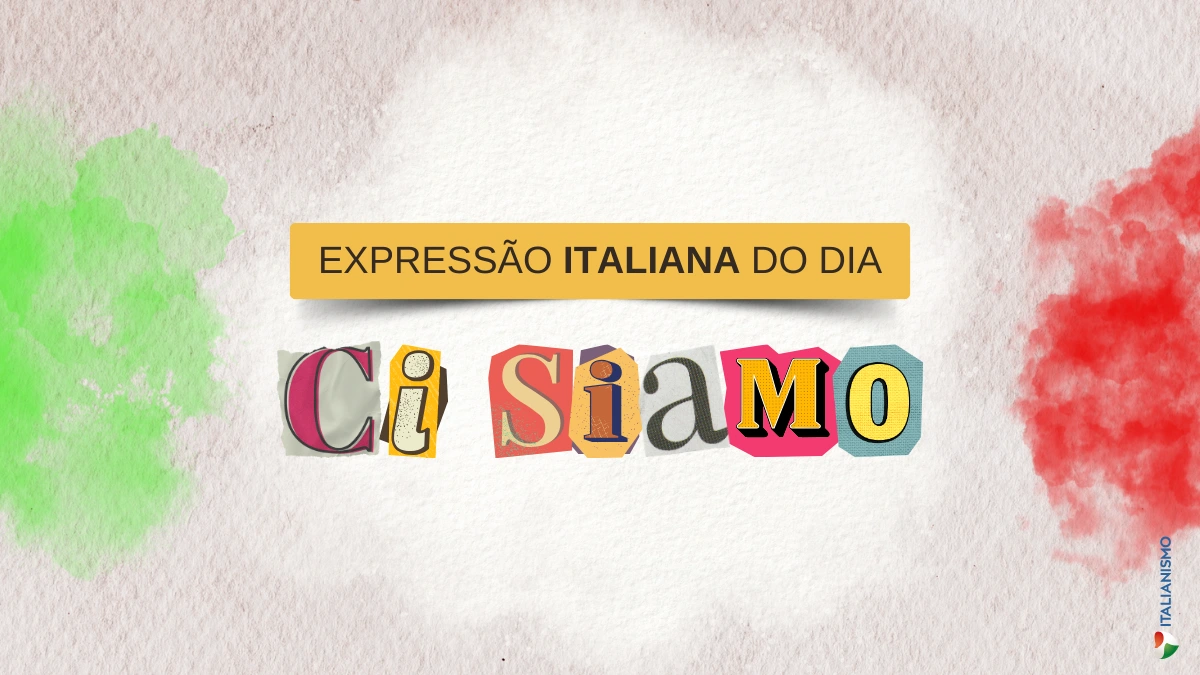
If you have ever been distressed by a italian menu — and honestly, for those who didn't stay — it's very likely that the waiter asked them: [responsivevoice buttontext=”” voice=”Italian Female” buttonposition=”after”] “Ci siamo?”[/responsivevoice]

Composed of the verb [responsivevoice buttontext=”” voice=”Italian Female” buttonposition=”after”] "essere”[/responsivevoice] ('ser/estar') and the adverb ci ('here/there'), it literally translates as 'here we are', but in the form of a question it can mean since 'Are you ready?' until 'All right?'
You can use it to check if someone understands, agrees with you, or is ready to move on.
When a waiter asks your group “Ci are?”, he is checking if you are ready to order, while a teacher interrupts the class to ask the class “Ci are?,” she’s making sure everyone is following along.
You can also use it as an affirmation: it's like saying 'here we go', 'it's settled, 'all right!' or “that’s it”.
think about "Ci are?" as a way of saying that you have reached a certain point, whether that point is a point of readiness ('Ready to go!'), a point of completion ('All done!'), a point of understanding ('Got it!') or a starting point ('Here we go…').
If you want to be emphatic, you can say something like [responsivevoice buttontext=”” voice=”Italian Female” buttonposition=”after”] “Now, here's the thing"Now we're really making progress!"
Naturally, the opposite is [responsivevoice buttontext=”” voice=”Italian Female” buttonposition=”after”]“we are not"This isn't going anywhere" or "This isn't right," for example.
In an internet conversation, you might even abbreviate it to NCS: 'no!' or 'not at all!'
And if you are closer to CS than NCS, but haven't quite reached it yet, you can say [responsivevoice buttontext=”” voice=”Italian Female” buttonposition=”after”]“ci siamo quasi”[/responsivevoice]: 'we're almost there' or 'we're close'.
Another common meaning of “here we are” is “here we go.” For example:
[responsivevoice buttontext=”” voice=”Italian Female” buttonposition=”after”]“Here we go, now's the time to leave!”[/responsivevoice]
Here we go, it's time to go!
It is important to remember that the meaning of the expression “ci siamo” may vary depending on the context in which it is used. In this case, the expression “ci siamo” has the role of a reflexive pronoun and indicates an action performed by “us” (first person plural):
[responsivevoice buttontext=”” voice=”Italian Female” buttonposition=”after”]“We can transfer it to a new home”[/responsivevoice]
We moved to a new house.
"Here we are” can also be used to express that something is finished or completed. For example:
[responsivevoice buttontext=”” voice=”Italian Female” buttonposition=”after”]“Ci siamo, abbiamo vinto!”[/responsivevoice]
It's over, we won!
Here are other additional examples of how the expression “ci siamo” can be used in Italian:
[responsivevoice buttontext=”” voice=”Italian Female” buttonposition=”after”]““Ci siamo quasi.”(We're almost there.)
[responsivevoice buttontext=”” voice=”Italian Female” buttonposition=”after”]“Ci siamo risosciti.”(We did it.)
[responsivevoice buttontext=”” voice=”Italian Female” buttonposition=”after”]“Ci siamo incasinati.”[/responsivevoice] (We got complicated.)
[responsivevoice buttontext=”” voice=”Italian Female” buttonposition=”after”]“We didn't hire you."We know each other."
[responsivevoice buttontext=”” voice=”Italian Female” buttonposition=”after”]“Ci siamo persi."We got lost."
And to finish this article:
[responsivevoice buttontext=”” voice=”Italian Female” buttonposition=”after”]“Ci siamo, abbiamo finito la lezione.”[/responsivevoice]
All done, we finished the class.
FOLLOW-US