

























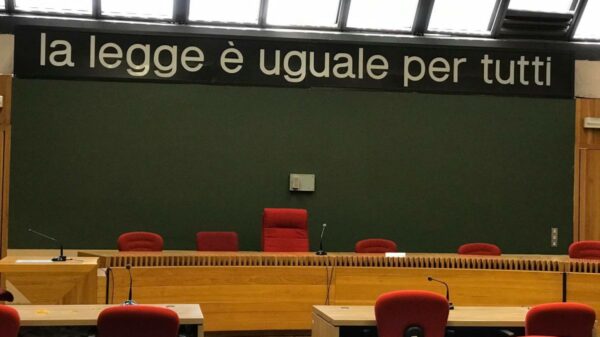










One day after the June 9 hearing in Italian Constitutional Court, which examined issues related to citizenship by descent, the president of the Court, Giovanni Amoroso, published a video interview with President Emeritus Mario Rosario Morelli. The central theme is what happens when the Constitutional Court and the Court of Cassation adopt different interpretations on the same issue.
The publication went almost unnoticed, but it caught the lawyer's attention. Monica Restanio, who acts as a defender in hearings on citizenship at the Constitutional Court and sponsors case 8845/24, which is awaiting a decision from the Sezioni Unite of the Court of Cassation. In an analysis published on her social media, she classified the material as an element of strong legal-institutional content that deserves attention.

The war of the courts
The video is part of a series by the Court itself featuring emeritus presidents and is the fourth in the initiative. Amoroso raises the topic: “How have you seen the relationship between the Cassation Chamber and the Constitutional Court over time? You have, in fact, witnessed what is called the war between the courts.”
Morelli explains that, in principle, the competencies were well defined. The Court of Cassation had the final say on the interpretation of ordinary legislation. The Constitutional Court was only responsible for verifying whether this interpretation was compatible with the Constitution.
The conflict arose in the 1970s, in a case involving tax commissions. Instead of directly addressing the constitutional question raised by the Court of Cassation, the Constitutional Court preemptively altered the interpretation of the law itself. By reinterpreting the rule as referring to an administrative body, and not a judicial one, it eliminated the basis of the constitutional question and declared it inadmissible.
This stance provoked a strong reaction from the Cassation Committee, which insisted on its interpretation and raised the issue again. To overcome the impasse, the doctrine of "living law" was consolidated. (living law), inspired by studies by Tullio Ascarelli.
The armistice of living law
According to this interpretation, the Constitutional Court began to consider the interpretation consolidated by the ordinary courts, especially the Court of Cassation, as a historical fact, and to examine the constitutionality of the rule as actually applied by the judges.
The Constitutional Court never formally relinquished its power to interpret the law autonomously. In practice, however, it began to respect the consolidated interpretation and only deviated from it in exceptional situations. Morelli describes the solution as a kind of institutional armistice, which better defined the functions: the Court of Cassation establishes the interpretation of sub-constitutional law, and the Constitutional Court controls its compatibility with the Constitution.
The president emeritus emphasizes that the dispute remained restricted to the field of interpretation of the norms. On another front, the two courts developed increasing cooperation. The Constitutional Court began to encourage ordinary judges, including the Court of Cassation, to directly apply the fundamental rights provided for in the Constitution, even when ordinary legislation was insufficient.
As an example, he cites a decision reported by Santosuosso and Granata that instructed judges to recognize the fundamental rights of a child born through heterologous fertilization, at a time when the technique was not yet authorized by Italian law.
The lawyer's reading
For Restanio, the interview helps to understand the current legal situation regarding Italian citizenship by descent, which is currently pending decisions from the Constitutional Court and the Sezioni Unite da Cassazione (United Sections of the Court of Cassation). The lawyer affirms that she remains firmly anchored in ruling 13818 of the Court of Cassation. of May 12, 2026and who reads the interview as institutional context for this scenario.
She herself makes two reservations. The interview does not anticipate the outcome of any decision and does not allow one to affirm that one position will prevail over the other. "With prudence... but with confidence," summarizes the lawyer, who reminds us that the outcome could define the future of thousands of Italians born abroad.
What is at stake
The Constitutional Court held hearings on the subject on June 24, 2025, March 11, 2026, and June 9, 2026. In parallel, the Sezioni Unite da Cassazione (United Chamber of Cassation) is expected to rule on case 8845/24, which is being closely followed by the Italian-descendant community. The expectation within the legal community is that the decisions will be known before the Italian judicial recess, which begins on August 1st.
Watch the interview: https://www.youtube.com/corte