


























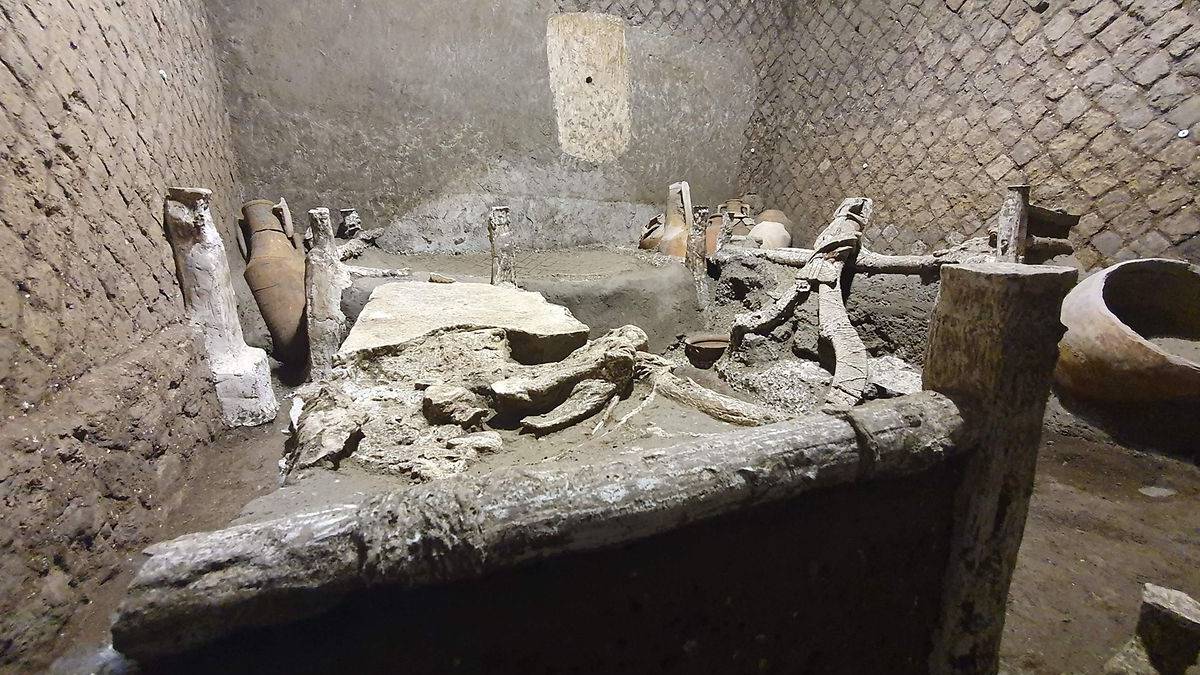
A team of archaeologists from Pompeii found remains of a “slave room,” an exceptionally rare find in a Roman village destroyed by the eruption of Vesuvius nearly 2 years ago.
The small room with three beds, a ceramic vase and a wooden chest was discovered during an excavation at the Civita Giuliana Villa, just a few hundred meters from the rest of the old city.

Earlier this year, archaeologists also discovered a nearly intact, ornate Roman chariot. Archaeologists believe that the room discovered on Saturday housed the slaves responsible for maintaining and preparing the carriage.
“It is a window into the precarious reality of people who rarely appear in historical sources, written almost exclusively by elite men,” said the archaeological site’s general director, Gabriel Zuchtriegel, of the discovery that he described as “one of the most exciting ” from his life as an archaeologist.
Pompeii was buried under ash when Vesuvius erupted in 79 AD, killing those who failed to leave the city in time.
Reality of slaves
The 16 square meter room served as a bedroom and pantry: in addition to three beds – one of them for children – there were eight vases in a corner. The wooden chest contained metal objects that appeared to be part of the horses' harnesses in the carriages.
“The room offers us a rare vision of the daily reality of slaves, thanks to its exceptional state of conservation”, informed the Pompeii archaeological park.
Slave “family”
The beds were made up of several wooden planks, which could be adjusted according to the height of the person using them.
Two of them were about 1,7 meters long and the other 1,4 meters, which could have belonged to children.
According to the archaeological park, the three slaves could be a family.
Archaeologists also found several personal items under the beds, including a container for personal belongings, ceramic jugs and what may have been a chamber pot.
The room was lit by a small upper window and there were no traces or decorations on the walls.
The excavation is part of a program launched in 2017 with the aim of combating illegal activity in the area, which includes digging tunnels to find parts that could be sold in illegal markets. (AFP)