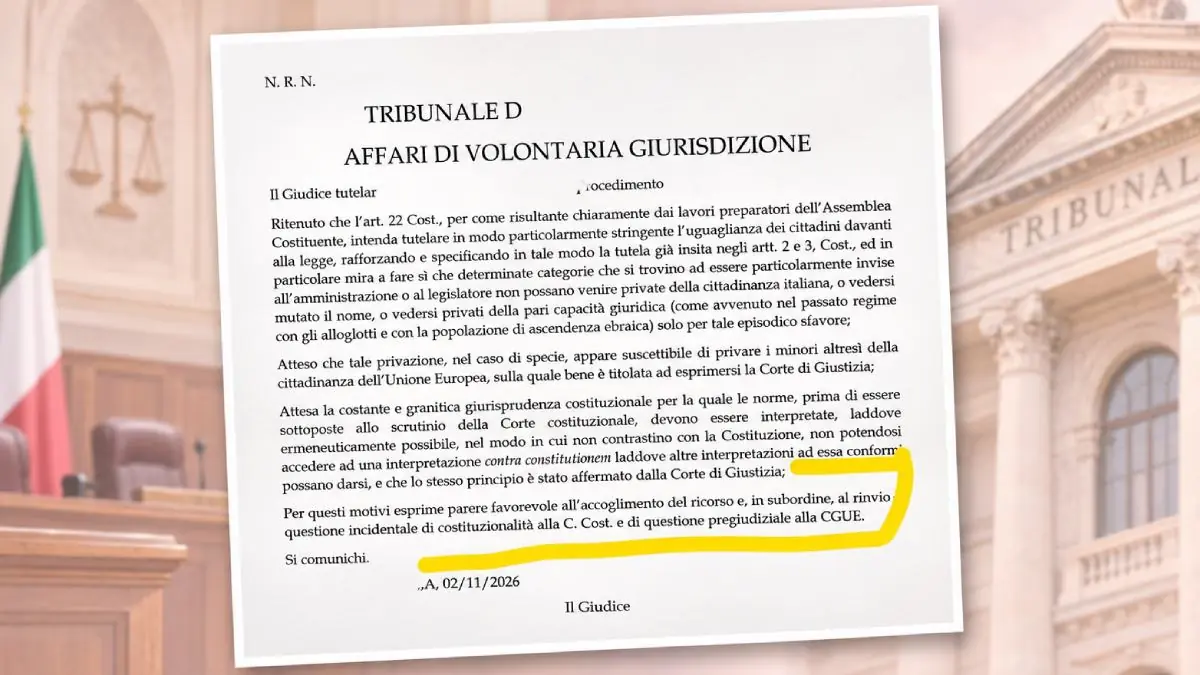
An Italian magistrate invoked Article 22 of the Constitution, which prohibits deprivation of citizenship for political reasons, in issuing a favorable opinion on an appeal for recognition of Italian nationality. The document, dated Nov. 2, 2026 and obtained by Italianismo, also points to possible consequences of citizenship restrictions for minors.
The opinion comes amid legal disputes over the 2025 reform, which restricted recognition of citizenship by descent, including for people born before the new rules took effect. The magistrate links the constitutional guarantee to the principle of equality and, alternatively, considers the possibility of referring issues to Italy’s Constitutional Court and the Court of Justice of the European Union (CJEU).
Article 22 protects against deprivation of citizenship for political reasons
Article 22 of the Italian Constitution states: “Nessuno può essere privato, per motivi politici, della capacità giuridica, della cittadinanza, del nome.” In Portuguese: “No one may be deprived, for political reasons, of legal capacity, citizenship or name.”
The provision was incorporated into the Constitution after the fall of fascism, in response to discriminatory practices of the regime, including measures targeting linguistic minorities and people of Jewish descent. It seeks to prevent the state from using citizenship as a tool of political persecution.
In the Nov. 2 document, the magistrate links this guarantee to Articles 2 and 3 of the Constitution, which protect fundamental rights and equality before the law.
The argument is part of the controversy over Decree-Law 36/2025, converted into Law 74/2025. The reform began to consider that certain people born abroad, even before it took effect, who hold another nationality did not acquire Italian citizenship, subject to the exceptions provided by law.
The legal question is whether the measure represents a legitimate limitation on the acquisition of nationality or whether it may affect previously protected situations. Invoking Article 22 does not, in itself, mean that the judge found a deprivation of citizenship for political reasons.
Italianismo had already reported on the Article 22 argument
Although it is expressly provided for in the Constitution, Article 22 is an uncommon basis in constitutional case law on citizenship.
Italianismo had already highlighted this argument on June 9, 2026, when constitutional law expert Alfonso Celotto invoked the provision before the Constitutional Court to challenge the effects of the reform on a minor. At the time, Celotto described the article as a parameter rarely used before the court.
The interpretation was challenged by the Italian state’s defense, which rejected the automatic association between an involuntary loss of citizenship and political reasons.
In September, the outlet also reported on a constitutional question raised by the Court of Avellino, which included Article 22 among the provisions examined. The November opinion, therefore, does not initiate this line of argument but adds another episode to the debate.
Magistrate points to effects on minors and European citizenship
The document also states that the restrictions could affect the status of the minors involved in the case as citizens of the European Union. That status derives from the nationality of a member state and ensures rights such as freedom of movement and residence within the bloc.
Although states are responsible for establishing their nationality rules, the exercise of that power must comply with European law in situations where it applies. For this reason, the magistrate mentions the possibility of submitting the dispute to the CJEU.
Favorable opinion is not yet a final decision
In its conclusion, the document states: “Per questi motivi esprime parere favorevole all’accoglimento del ricorso e, in subordine, al rinvio di questione incidentale di costituzionalità alla C. Cost. e di questione pregiudiziale alla CGUE.”
In Portuguese, the magistrate issues a favorable opinion on accepting the appeal and, alternatively, on referring questions to the Constitutional Court and the Court of Justice of the European Union. The passage does not prove the final recognition of citizenship or the formalization of any of those referrals.
A possible ordinanza may clarify which aspects of the reform the magistrate considers incompatible with Article 22 and whether a question will actually be submitted to the higher courts.
Reform is already being discussed in European courts
In ruling 63/2026, Italy’s Constitutional Court rejected certain challenges to the reform and found that the new restrictions constituted an original limitation on the acquisition of citizenship, rather than the removal of a previously acquired nationality. The distinction is relevant to the discussion surrounding Article 22.
In ordinanza 147/2026, the Constitutional Court decided to refer to the CJEU a question on the reform’s compatibility with European Union law. This is a formal referral, distinct from the possibility mentioned in the Nov. 2 document.
The name of the court, the case number and the identification of the magistrate were redacted from the copy provided to Italianismo. According to the source, the measure seeks to protect those involved and prevent possible challenges. The absence of this information prevents independent verification of the document’s origin and procedural scope.
Newsletter
Últimas do Italianismo
Todo dia, às 18h, um resumo do que aconteceu na Itália direto no seu e-mail.
É gratuito e você cancela quando quiser.