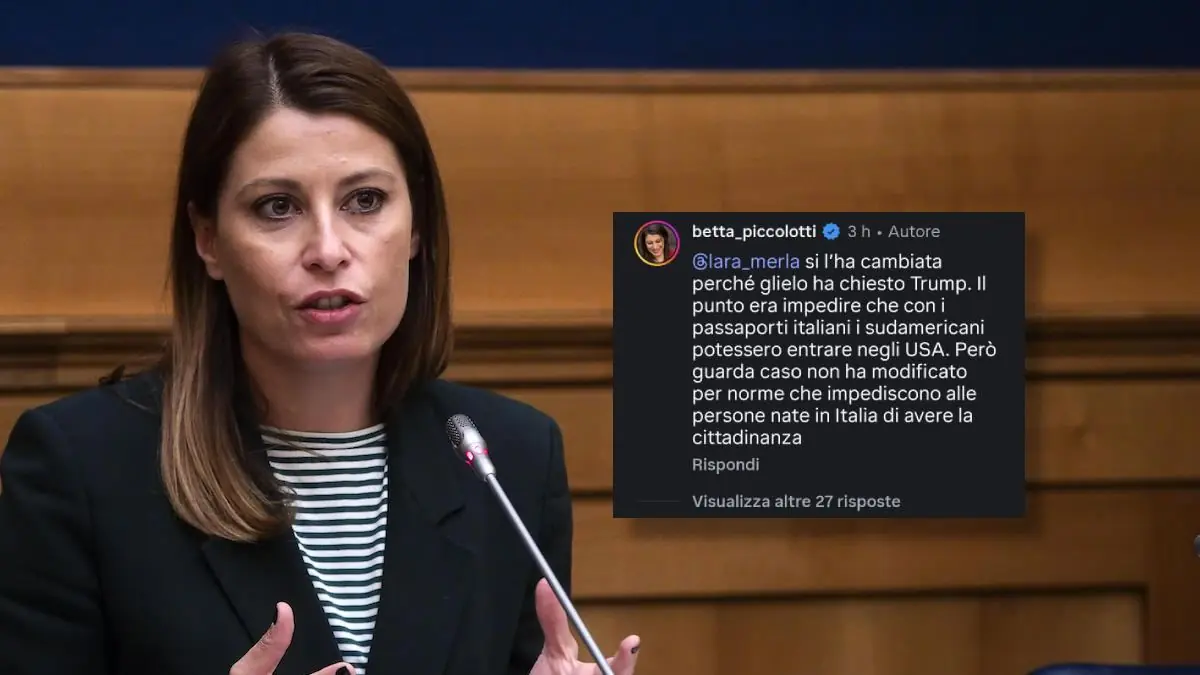
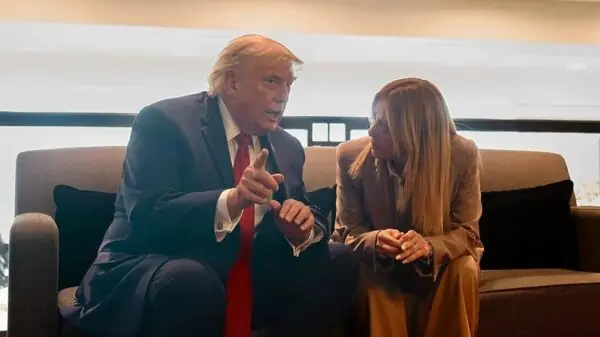
Italian lawmaker Elisabetta Piccolotti, of the Green and Left Alliance (AVS), said in an Instagram discussion that U.S. President Donald Trump asked the Italian government to change its legislation on citizenship by descent (ius sanguinis).
According to the lawmaker, the intent was to prevent South Americans from using Italian passports to enter the United States.
The statement appears in a response attributed to Piccolotti, recorded in screenshots sent to Italianismo.
“Yes, it changed because Trump asked for it. The goal was to prevent South Americans from being able to enter the United States with Italian passports,” the lawmaker wrote, translated from Italian.
The comment came in response to an internet user who argued that the reform had been allowed by law and approved by the current Italian government.
Piccolotti also criticized the continued rules that make it difficult for children of foreigners born in Italy to obtain citizenship.
Advertisement
The statement draws attention because it revives a suspicion reported by Italianismo in April 2025, shortly after Giorgia Meloni’s government restricted recognition of citizenship by descent.
Italianismo published report in April 2025
On April 15, 2025, Italianismo published the report “Did Trump pressure Meloni to change citizenship laws?”, based on statements by Pasquale Metafora, a former employee of the Italian Embassy in Brazil.
Metafora, who worked for 26 years in the consular department of the Italian diplomatic mission in Brasília and was a Democratic Party candidate for deputy in 2018, said the United States had pressured Italy to restrict citizenship by descent.
In a video released at the time, he maintained that the U.S. administration was concerned about approximately 50,000 people of Italian origin who had entered the United States using Italian passports and overstayed their authorized period of stay.
The number cited by Metafora was not accompanied by official documentation that would make it possible to confirm its scale or those individuals’ immigration circumstances.
The former employee also said previous Italian governments had resisted similar pressure from Washington.
Italianismo’s report noted at the time that the hypothesis had no official confirmation.
Piccolotti’s new statement puts the same allegation back into the debate, this time publicly presented by a sitting Italian lawmaker.
Advertisement
What changed in Italian citizenship law
The Meloni government approved Decree-Law 36 on March 28, 2025, introducing restrictions on the automatic recognition of Italian citizenship by descent.
The text was converted, with amendments, into Law 74 on May 23, 2025, effective the following day.
The reform established limitations for people born outside Italy who hold another citizenship, while preserving specific grounds for recognition and transitional rules.
The exceptions include certain conditions related to the citizenship of parents or grandparents and the residence of one parent in Italy before the child’s birth.
In presenting the reform, the Italian government justified the changes as necessary to strengthen citizens’ effective ties to the country and address distortions in recognition procedures.
The official documentation reviewed does not establish a U.S. demand as the basis for the legislative change.
Advertisement
Lawmaker’s claim still needs clarification
Piccolotti’s statement is not, in itself, proof that the U.S. government demanded the reform or took part in drafting it.
In the screenshots reviewed by Italianismo, the lawmaker presents no documents and does not explain the source of the information.
It is also unclear whether the claim is based on political contacts, information obtained in Parliament or accounts previously made public.
There is also an important distinction between restricting the granting of new citizenship recognitions and preventing entry by people who already hold Italian passports.
The 2025 reform changed the conditions for recognition of Italian citizenship, but did not in itself change U.S. immigration rules.
Thus, even if U.S. concerns influenced the debate, it would be necessary to demonstrate the connection between that concern and the decisions made by the Meloni government.
The central question remains unanswered by documentation: Did the Trump administration actually ask the Italian government to change citizenship legislation?
The lawmaker’s statement increases the political significance of that question, whose answer depends on clarification and independent evidence.