















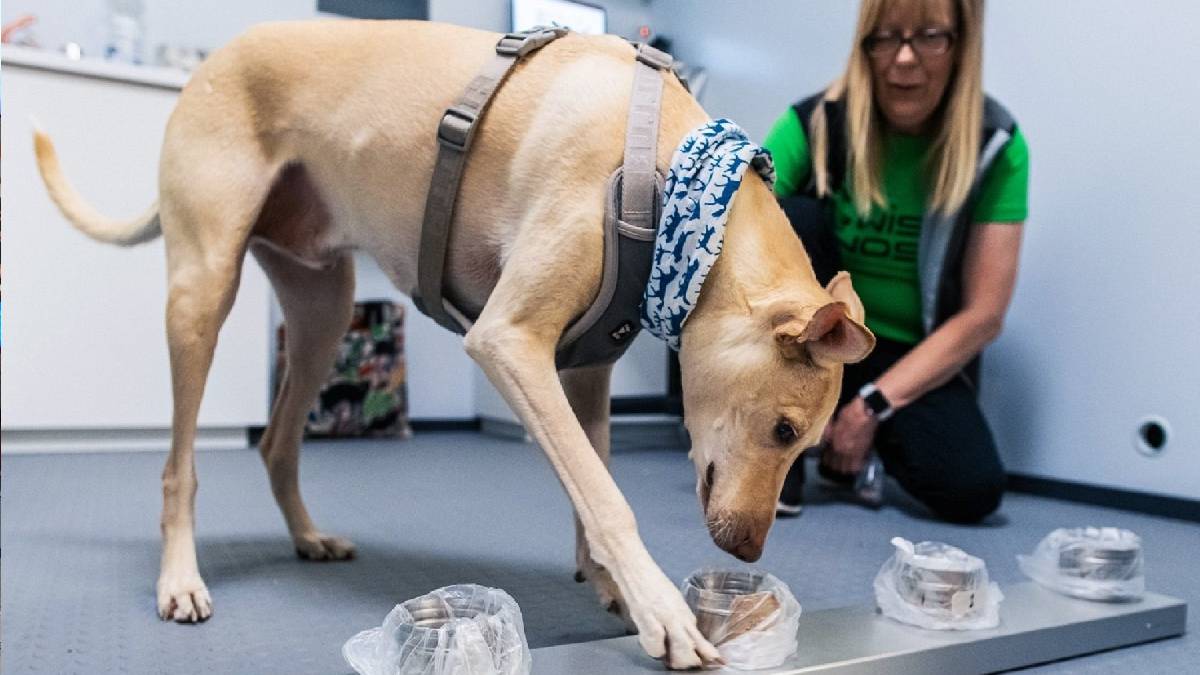
Italy is using trained dogs to detect Covid, with almost 100% accuracy. Despite skepticism from some, the pilot project has been rolled out at Cuneo Airport in Piedmont.
The sniffer dog only needs a few seconds to alert if someone is infected with Sars-Cov-2.
Not everyone who passes through the airport lounge will be subjected to the canine test. In fact, this is a voluntary choice.
The study is in the hands of Onlus MDDI (Medical Detection Dogs Italy), in partnership with researchers from the University of Helsinki, Finland.
“We can make our contribution to the safe resumption of air transport by offering effective and rapid screening for all passengers who wish to be tested”, explains Anna Milanese, director of Cuneo Airport.
How dogs recognize Covid
The test takes less than a minute and does not require a saliva test. According to what happens at the Finnish airport, and repeated at Cuneo, in Italy, dogs are encouraged to smell a sample of sweat and, in case of a positive result, the passenger is taken to another area of the airport to be tested for conventionally, free of charge, to confirm or not the indication of the dog.
According to a study at the University of Helsinki, dogs were trained to recognize the smell of the virus in sweat or urine samples.
If positive, they emit a specific sound. In a negative sample, the dog does not have any type of reaction and moves on to the next one.
“Dogs’ sense of smell is incredible, we have already used them to discover and identify tumors, with 95% success. We are able to train anti-Covid dogs, capable of recognizing even asymptomatic ones. It would take more or less a few weeks of preparation”, said Aldo La Spina, technical director of Onlus MDDI.
The dogs are already trained to sniff out cancer, malaria, Parkinson's, among other diseases. This is because dogs have a keen sense of smell and some diseases leave a characteristic smell.

So yes, Sars-CoV-19 probably has a unique odor – although scientists still don't know exactly what that smell is.
It can be either a chemical substance secreted by the infected person's body or a change in the odor of sweat, for example.
Other studies
The study is not limited to Italy and Finland. Also in Germany, researchers announced promising results with dogs as Covid-19 detectors, but so far they have not been used anywhere.
According to Professor Holger Volk, from the University of Veterinary Medicine in Hannover, there has been neither political will nor funds to move the project forward.
The prejudice against being diagnosed by an animal explains the lack of interest on the part of politicians.
In a series of tests, eight sniffer dogs from the Bundeswehr (German Armed Forces) were trained for just one week to distinguish between mucus and saliva from patients infected with Sars-Cov-2 and healthy individuals.
Confronted with positive and negative samples through a machine, randomly, the animals were able to positively detect secretions infected with the virus with a success rate of 83%, and control secretions with 96%. The overall detection rate, combining the two, was 94%.
Dubai, in the United Arab Emirates, had already deployed police animals to help with screening. The process was practically identical to the Finnish one, with the difference that the passenger collected a sweat sample from his armpit.
FOLLOW-US