
































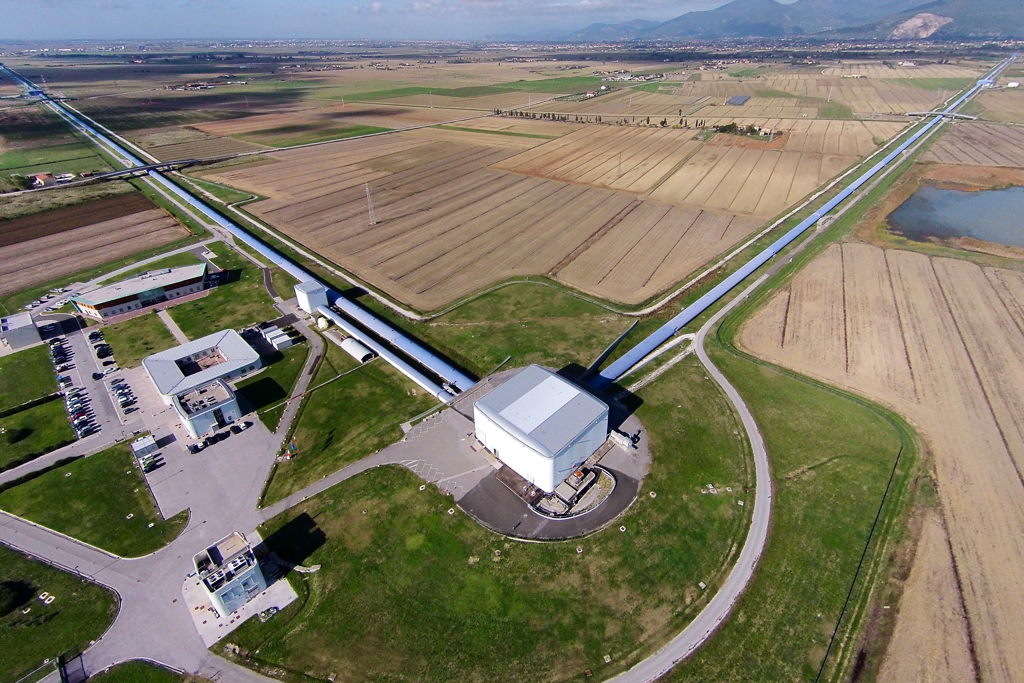
Project Virgo searches for gravitational waves to unlock the fascinating secrets of the cosmos.
In the heart of Italy, there is a giant sensor capable of “listening” to signals arriving from the immeasurable limits of the Universe. Located on a wide esplanade between the Tuscan hills, near the town of Cascina, the Virgo Project’s mission is to detect the gravitational waves predicted by Albert Einstein in his “General Theory of Relativity” (1915).
These are a type of waves that arise from events such as the collision of extraordinarily massive objects, such as two black holes: they rotate until they collide, causing the emission of waves that propagate like when a stone is thrown into water, but this time through space-time, shrinking and lengthening it.

The theory, discussed by many, was established, but proof was missing, which took no more, no less than a century to arrive.
And this will require the construction of three large, expensive and sophisticated sensors: two in the United States, known as Ligo, and another in Italy, called Virgo, from the French-Italian consortium European Gravitational Observatory, for which scientists from Spain also work. , Netherlands, Poland and Hungary.
Seen from the sky, Virgo, similar to the others, is L-shaped: it is made up of two perpendicular galleries three kilometers long that come together in a building, creating a right angle.
Inside this installation, a powerful laser projects its beam of light onto two mirrors located at the bottom of two tubes that run through the interior of these galleries, subjected to a vacuum so that the trajectory and precision of the ray are undisturbed.
In the building, in addition to the laser, a precise set of prisms and mirrors were installed to direct the ray, suspended with a series of pendulums to avoid “noise”, that is, any phenomenon that could alter the ground and the sensor, in a sensitivity so incredible that it can detect an earthquake in Japan, Spanish expert Julia Casanueva, in charge of controlling the position of the mirrors, explains to Efe Agency.
As soon as a wave crosses the Earth, it deforms its space, producing a variation smaller than that of an atomic nucleus, imperceptible to the human eye. It is at this moment that Virgo comes into action, registering how its mirrors move, changing the ray of light.
Gravitational waves are a fact. They were detected for the first time in September 2015 by LIGO and their discovery was considered the beginning of a new era for astrophysics, and for this they were awarded the Nobel Prize in Physics.
But why is detecting these waves so important? Traditionally, astronomy learned through light what was happening in space, glows from distant new worlds, but now these “waves” provide additional information.
“Before we had eyes, and now we have ears”, explains Spaniard Alejandro Torres-Forné, astrophysicist from the Valencia Group in Virgo.
What caused the detection of these waves was the merger of two black holes, a phenomenon that does not generate light, which is why it can only be noticed through these cosmic waves.
For Torres-Forné, the weak point of instruments like Virgo and Ligo is their extreme sensitivity, which makes them detect any noise, so “to be able to say that something is a gravitational wave, it has to appear in several detectors” .
Therefore, collaboration is essential: the first wave was captured by American interferometers, as Virgo was in the update phase, but the last, from the merger of two neutron stars, was recorded by the three sensors in August this year.
Also Spanish, José María González Castro, a specialist in light studies, explains that Virgo and Ligo, “in terms of data analysis, function as a single entity”, to the point where the first detection occurred thanks to the an Italian.
“The idea is to move towards a network of sensors” distributed around the world, a project already underway in Japan and India, according to Julia.
The coordinator of the Valencia Group, José Antonio Font, believes that these waves “are opening doors to the Universe that will offer future generations a totally new and fascinating vision of the cosmos”.
But, to achieve this, Font defended the need for detectors to be built in space. “It is the only way to avoid the loss of sensitivity that inevitably occurs on Earth due to seismic vibrations of the surface”, he argued.
All this with a non-negligible objective: to advance the knowledge of the Universe thanks to the echoes of its unknowns.
By Claudio Liberato / meioambienterio.com