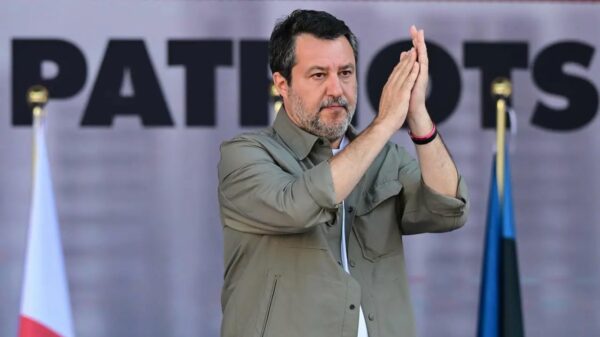





















Matteo Salvini has dominated Italian politics for the past three years, first as interior minister and then as opposition leader, but he has recently gained a challenger in his ambition to one day become prime minister of the European Union's third-largest economy.
And this rival does not come from the left or the center, but from the same conservative and sovereigntist camp that has been led by Salvini since 2018.
Giorgia Meloni, 44 years old, is a journalist, deputy, former minister of Silvio Berlusconi and founder and president of the far-right party Brothers of Italy (FdI), which already appears in some polls ahead of the League, its sister on the populist right and which had been swimming in favor of the electorate.
The last five opinion polls published in Italy (two from the SWG institute, two from Termometro Politico and one from Euromedia) put the FdI in the lead nationally, with 20% to 20,9% of the votes, depending on the survey.
The League appears right on the heels, it's true, with a disadvantage that never exceeds half a percentage point, but it is far from the more than 30% it had until the beginning of 2020.
This is, by far, the best moment experienced by the FdI, a party whose history is intrinsically linked to Meloni. During the post-war period, Italy always had a large right-wing party, a role that was played in the First Republic (1948-1994) by the Italian Social Movement (MSI), of neo-fascist inspiration.
In 1995, during the Second Republic, the MSI was renamed National Alliance (AN), an acronym then led by Gianfranco Fini and which reached 10% to 15% of the votes. In 2008, however, AN merged with Força Itália (FI), a personalist party founded and chaired by Berlusconi.
“Fini did this because he hoped to become the leader of the largest Italian party after Berlusconi. He didn't succeed and today he has disappeared politically,” Roberto D'Alimonte, professor of the Italian political system at the Guido Carli International Free University of Social Studies (Luiss) in Rome, tells ANSA.
At that time, Fini's decision caused discomfort within the National Alliance and, in December 2012, a group of dissidents, including Meloni, founded a new party called Brothers of Italy.
“The FdI represents what was once the historic party of the Italian right,” adds D'Alimonte. Presided by Meloni since 2014, the FdI even incorporated the tricolor flame that was part of the emblem of the MSI, a party that had been founded by former members of Benito Mussolini's fascist regime.
Trajectory of Giorgia Meloni
Born in Rome on January 15, 1977, Giorgia Meloni became involved in politics at the age of 15, when she joined the "Youth Front," a youth organization linked to the MSI.
Over the years, she climbed the ladder in the National Alliance and was elected councilor of the province of Rome in 1998, remaining in the position until 2002. In 2006, she won a seat in the Chamber of Deputies, where she remains today, having also held the position of Minister of Youth in the Berlusconi government between 2008 and 2011.
In the same year that she was first elected to Parliament, Giorgia Meloni gave an interview in which he said he had a “serene relationship with fascism”. Regarding Mussolini, he stated that the dictator “made several mistakes, such as racial laws, entering the war and the authoritarian system”.
“Historically, he also produced a lot, but that doesn’t save him,” declared Meloni at the time. Upon taking command of the FdI, he rebuilt the ruling class that previously orbited around the National Alliance and also reached a new slice of the electorate having spent the last decade always in opposition.
Salvini, in turn, governed with the anti-system 5 Star Movement (M5S) between 2018 and 2019 and today is one of the guarantors of Prime Minister Mario Draghi, one of the great symbols of that European Union that the far right has always criticized.
“The FdI is the only true opposition party in Italy today and it concentrates the discontent that exists,” says D'Alimonte.
According to the professor, Giorgia Meloni capitalizes on the dissatisfaction of groups ranging from workers laid off because of the crisis to self-employed people penalized by the pandemic, as well as anti-vaccines – the deputy was vaccinated against Covid only on July 26, but did not take a photo.
Meloni has also sought to distance himself from openly neo-fascist movements, such as CasaPound and Força Nova. “But, at the level of activism, I am not sure that there is this distinction”, says the Luiss professor.
Internal dispute
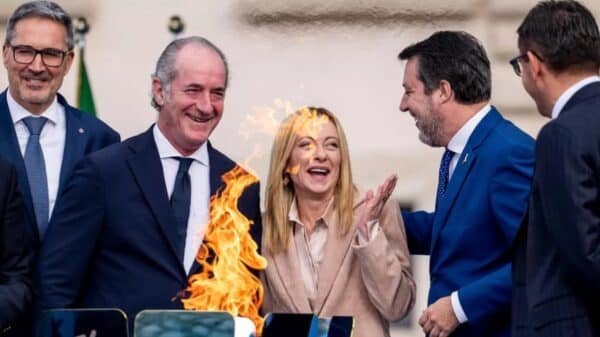
Although they compete vote by vote for the electorate's preference, Meloni and Salvini are part of a coalition called “center-right” by the Italian press and which also includes Silvio Berlusconi.
This coalition administers 14 of Italy's 20 regions, but there is an internal dispute for the position of party with the most votes within the alliance in the next legislative elections, scheduled for 2023.
In 2018, Salvini's League overtook Berlusconi's FI and took command of the coalition, and now Meloni plans to do the same with the former Interior Minister.
The latest polls indicate that the conservative alliance would have a good chance of obtaining an absolute majority in Parliament in the event of early elections, and the leader of the party with the most votes would naturally claim the position of prime minister.
According to D'Alimonte, the ideological differences between Salvini and Meloni are “very modest”. They converge in defense of the so-called “traditional family”, at the same time as they are against mandatory vaccination, the right to adoption for homosexuals and the reception of migrants saved in the Mediterranean.
Both are sovereignists and until recently they defended Italy's exit from the European Union, but today they no longer talk about it – the country will be the biggest beneficiary of the EU post-pandemic fund, entitled to almost 200 billion euros.
Still, Meloni and Salvini maintain a critical tone towards Brussels and reject projects that lead to more integration.
“But the point is that Salvini is in an ambiguous position. On the one hand, he competes with Meloni on the issue of sovereignism, but on the other, he supports the former president of the European Central Bank. Meloni, a sovereigntist who opposes Draghi, is in a more coherent position”, says D'Alimonte.
The former Minister of the Interior, however, is not complacent and is already rehearsing a reaction to prevent Meloni from assuming the leadership of the conservative coalition. In recent months, representatives of the League have floated the hypothesis of creating a right-wing “federation” with Força Itália, something similar to what Fini and Berlusconi did in the 2000s.
With the votes of League and FI combined, Salvini would be strengthened in the internal dispute against his ally-rival. But, according to D'Alimonte, the emergence of this federation is still in the realm of hypotheses. (ANSA).