Santa Teresa di Cordeiros, São Paulo, March 9, 1889.
Rosolen Bortolo began the letter to his former employer in Italy by saying that he needed to tell him something terrible.
“Con grande dolore devo manifestargli una spaventevole mia sorte.”
“With great sorrow, I must tell you of my terrible fate.”
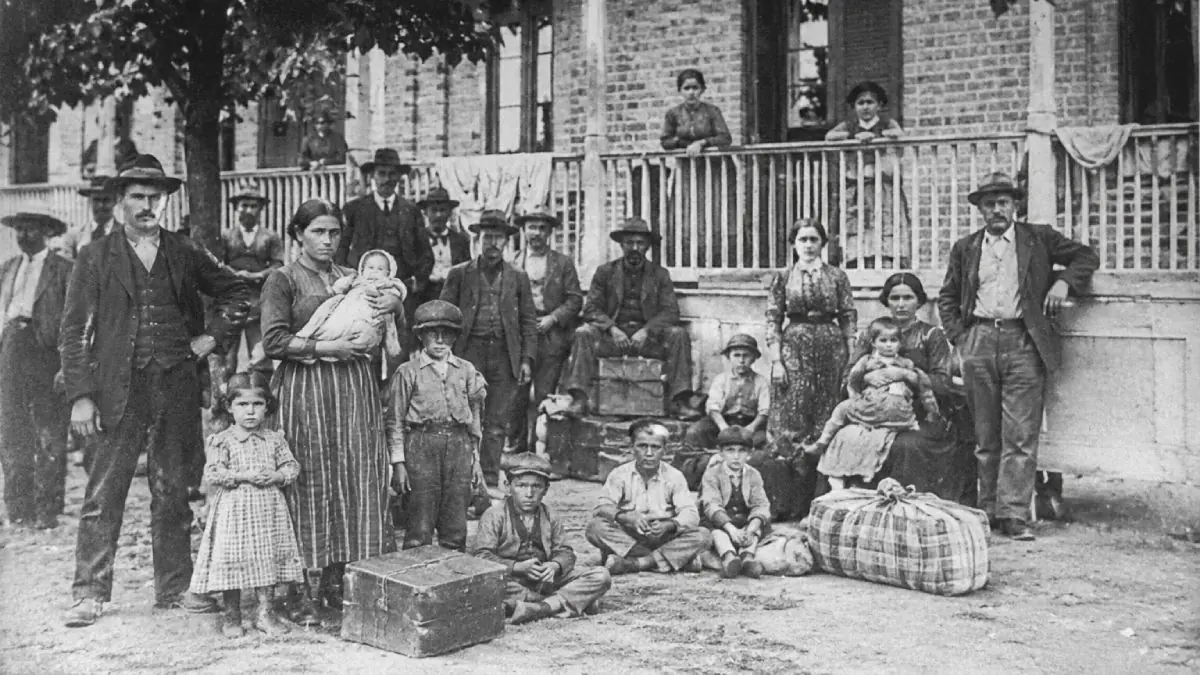
The Italian emigrant had crossed the Atlantic with his family, landed in Santos and traveled on to São Paulo. On the first night at the immigrant hostel, he saw his children sleeping on planks and cried, convinced that he was to blame for the children’s suffering.
But the tragedy was not over yet.
In the correspondence, dated March 9, 1889, Bortolo said that he had brought 11 children to Brazil and that only five were still alive.
The transcription of the letter was published by Emilio Franzina in Merica! Merica! and is reproduced by the Centro Studi sulle Migrazioni Aletheia.
The document records an immigration experience marked by hardship, illness and regret, far from the promises of prosperity that had led thousands of Italians to leave their country.
“Not even the dog I left in Italy”
Bortolo began his account by describing the sea voyage.
The crossing lasted 26 days. For four of them, the vessel faced a severe storm.
According to the emigrant, there were too many passengers aboard. In the final days, the heat made the journey even more difficult.
To explain the suffering, he wrote that he would not wish those conditions even on the dog he had left in Italy.
“questo e statto molto pesante tanto ché per mio consiglio non incontrerebbe tali tribulazioni nepur il mio cane che ò lasciato in Italia”
Advertisement“The journey was so arduous that, in my view, not even the dog I left in Italy should face such tribulations.”
The irregular spelling is part of the letter’s historical transcription.
After nearly a month at sea, the family finally landed in Santos.
Bortolo expected his arrival in Brazil to mark the end of the hardships.
That was not what happened.
Arrival in Santos and fear of continuing the journey
Still on the coast of São Paulo state, Bortolo sought to speak with Italians who were already living in Brazil. Their responses, he said, were discouraging.
Each conversation heightened his concern about what he would find in the country.
Soon afterward, the family boarded a special train to São Paulo. The journey took about four hours.
At the so-called Casa da Imigração, Bortolo found a crowd of recent arrivals. He also heard accounts of the high mortality rate among young children. His fear grew.
He had left Italy accompanied by his children. Now, faced with the news circulating at the immigrant hostel, he began to question his decision to leave.
The children slept on planks
At night, the children fell asleep, exhausted after the sea crossing and train journey.
Bortolo remained awake. He watched his children and other family members lying on planks.
In the letter, he said they were surrounded by about 10,000 people. Around them, other families were also facing exhaustion and despair.
On one side of the lodging, a woman was crying.
On the other, a man.
Bortolo looked at the children again.
He thought that he was responsible for bringing them there.
“d’essere colpevole di averli fati suplire tante tribulazioni”
“That I was guilty of having made them suffer so many tribulations.”
He then wrote to his former employer:
“io non poteva tratenermi di piangere lungo la notte”
“I could not contain myself and cried all night.”
That was how Bortolo described his first rest in America.
The suffering continued on the farm
After their stay at the immigrant hostel, the family went on to Santa Teresa, in the São Paulo region of Cordeiros, now Cordeirópolis, São Paulo state.
A more extensive translation of the letter, attributed to Silvia Scotoni Levy and reproduced in studies and publications on immigration, reports that the family remained in São Paulo for four days before continuing to their destination.
Upon arriving, Bortolo encountered difficulties he had not expected. The housing intended for the new arrivals was not yet ready.
According to this version of the document, 139 people had to sleep in a small house.
Bortolo also encountered Italian families who had been living on the farm for several months. The children’s health conditions caught his attention.
He described feet and legs covered in sores attributed to insect bites. Some children were reportedly so debilitated that they could barely remain standing.
The scene made him cry again.
The emigrant said that he even moved away from his own children, fearing that they too would be affected by the same conditions.
Soon afterward, the family would face an even greater tragedy.
“We brought 11 children, and now we have five left”
In the letter, Bortolo reported that, a few days later, the children fell ill. The women in the family also became sick.
The document does not specify the illnesses that affected the children.
But it records the scale of the losses.
“noi che ne abbiamo condotto 11 figli nell’America ora siamo rimasti con 5 e gli altri li abbiamo perduti”
“We, who brought 11 children to America, now have five left, and we lost the others.”
The passage was reproduced by journalist Gian Antonio Stella in an article published in the Italian newspaper Corriere della Sera in July 2021, with reference to Emilio Franzina’s work.
No individual death records were identified in the sources consulted for this article that would make it possible to establish the dates, ages or causes of death.
The father’s testimony, however, makes the family’s despair clear.
Bortolo wrote that, if he had been able to choose, he would not have remained in America for even an hour.
His wish was to return to Italy with his surviving children.
“I would have preferred death before leaving”
The regret appears explicitly in the correspondence.
Bortolo said that he would have preferred to die before leaving Italy if he had known what he would find in Brazil.
He also left a warning for his countrymen.
“per mio consiglio non partirà alcuna persona da l’Italia per venire ne l’America”
“In my view, no person should leave Italy to come to America.”
The message ran counter to the expectations of prosperity that had encouraged so many families to cross the Atlantic.
In the letter, Bortolo acknowledged that healthy people willing to work could earn money in Brazil.
The problem, he said, arose when someone became ill.
Medical expenses could quickly consume a family’s savings.
It was an assessment based on his own experience, at a time of profound suffering.
Who was Bortolo Rosolen?
Historical sources identify Bortolo Rosolen as an emigrant connected to Pieve di Soligo, in the province of Treviso, in the Veneto region.
His letter was addressed to Dr. Ferdinando Chisini, whom he called “Sig. Padrone,” an expression indicating a previous employment or dependent relationship.
The document was written in Santa Teresa di Cordeiros, in what was then the province of São Paulo, on March 9, 1889.
Letters from America
More than 137 years later, Bortolo Rosolen’s letter remains a testimony to the hardships faced by some Italian emigrants in Brazil.
The document does not merely describe a sea voyage or the conditions at an immigrant hostel.
It also records the guilt of a father who believed he had put his children in danger in seeking a better life.
Letters from America is Italianismo’s Sunday series dedicated to letters, diaries and correspondence left by Italians who emigrated to Brazil and other countries in the Americas.
Read also: “We have to work to live”: The 1885 letter that reveals an Italian family’s struggle in Brazil; “Perhaps fortune awaits me far away”: The letters of the Italian who left Parma for Brazil in 1908; “With my heart squeezed as if in a vise”: The diary of an Italian on his way to Brazil in 1911.
Newsletter
Últimas do Italianismo
Todo dia, às 18h, um resumo do que aconteceu na Itália direto no seu e-mail.
É gratuito e você cancela quando quiser.