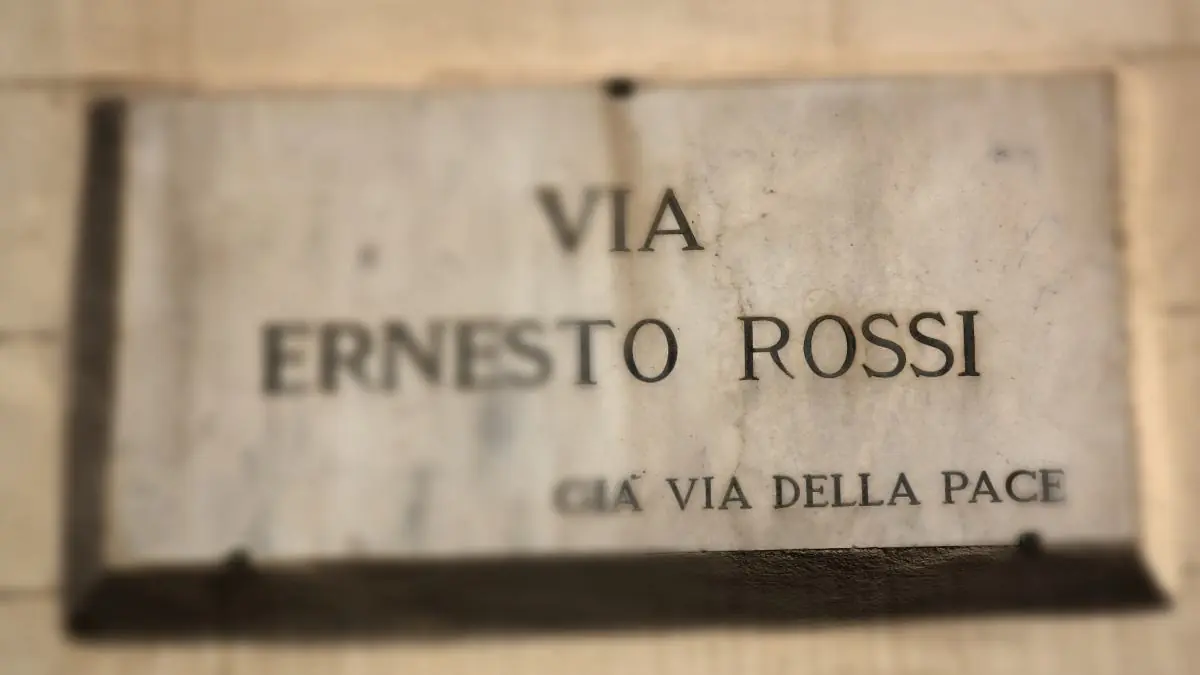
Rossi, Ferrari, Bianchi, Romano and Colombo. Just look at some of Italy’s best-known surnames to notice a common feature: they all end in a vowel.
It is no coincidence. The explanation lies in the history of the Italian language, the transformation of Latin and the way families came to be identified over the centuries.
Studies published by Treccani, one of the leading authorities on the Italian language, show that the predominance of final vowels is an ancient feature of the language. In the case of surnames ending in -i, there is another explanation: the custom of identifying a family through the plural of the name or nickname of one of its members.
Why does Italian have so many words ending in a vowel?
In an article published by Treccani on June 11, 2026, linguist Pietro Maturi explains that the vast majority of Italian words end in a vowel, mainly a, e, i or o.
This feature is related to the transformation of Latin into the linguistic varieties that gave rise to Italian.
In Latin, many words ended in consonants, especially m, s and t. Over the centuries, these consonants disappeared in numerous forms that gave rise to Italian words.
One example is the Latin patrem, which evolved into padre (father). Another is bonam, which gave rise to buona (good).
The phenomenon also occurred with verbs. The Latin form amat, meaning “he or she loves,” became ama in Italian, with the loss of the final t.
These changes helped establish one of the language’s most recognizable features: the predominance of words ending in a vowel.
Because many surnames arose from common words, given names, occupations and nicknames, this linguistic structure also appears in family names.
Why do so many Italian surnames end in I?
The -i ending has a particular history.
According to linguist Carla Marcato, in a study published by Treccani in September 2024, many surnames with this ending arose from so-called family plurals.
In practice, a person could be identified by an occupation, physical characteristic or nickname. Over time, the name also came to designate that person’s relatives.
A man known as Fabbro, the Italian word for blacksmith, could have his relatives collectively called Fabbri.
The designation was eventually passed down to descendants and became a surname.
The same mechanism helps explain the relationship between Rosso and Rossi.
But not every surname ending in -i originated this way. Treccani points to other possible origins, including personal names, place names and old formulas used in notarial documents.
What do Rossi, Ferrari and Bianchi mean?
Many Italian surnames preserve references to occupations, physical characteristics or nicknames attributed to ancestors.
Rossi is associated with the word rosso, meaning red. One possible origin is a nickname related to red hair, although there are other historical interpretations.
Ferrari belongs to a group of surnames associated with ironworking, as do Ferraro and Fabbri.
Bianchi, meanwhile, is related to the adjective bianco, meaning white. The specific origin of the nickname, however, depends on the history of each family.
These designations were important in communities where several people shared the same given name.
An individual could be identified by occupation, place of birth, father’s name or some characteristic that distinguished them from others.
When these forms of identification began to be inherited by descendants, they gave rise to many of today’s surnames.
According to Carla Marcato, the use of hereditary surnames began to appear in Italy around the 12th century, although they became established at different times depending on the region.
Not all Italian surnames end in a vowel
Despite the predominance of vowel endings, there are many exceptions.
Surnames such as Marangon, Visentin and Bionaz show that Italy’s linguistic history is more complex than the structure of standard Italian might suggest.
For centuries, the Italian peninsula was marked by the coexistence of different dialects and regional languages.
In several of these languages, especially in northern regions, phonetic changes led to the loss of final vowels.
In Veneto, for example, several surnames end in -n because of characteristics of local dialects.
In the Valle d’Aosta region, meanwhile, surnames ending in -az and -oz are found, linked to their own linguistic and spelling traditions.
This diversity helps explain why surnames of the same origin may have different spellings and endings.
Does the last letter of a surname reveal a family’s region of origin?
The ending can offer clues, but it does not by itself make it possible to determine which Italian region a family came from.
Surnames ending in -i are widespread in central and northern Italy, while some forms ending in -o appear more frequently in the south.
This division, however, is far from absolute.
According to Carla Marcato, surnames ending in -o also predominate over equivalent forms ending in -i in northern regions such as Piedmont and Liguria.
In addition, internal migration, changes in spelling and adaptations made over time can alter the distribution and form of family names.
For this reason, two similar surnames do not necessarily indicate kinship or an origin in the same locality.
What does this mean for descendants of Italians in Brazil?
For millions of Brazilians of Italian descent, surnames represent one of the most visible connections to family history.
But the spelling known today does not always correspond exactly to that used by ancestors.
Parish records, civil documents and certificates may contain variants resulting from dialects, spelling changes or the interpretation of whoever recorded the names.
According to Treccani, Italy’s surname heritage includes more than 300,000 forms, the result of centuries of linguistic diversity and historical transformations.
This variety helps explain why families with similar surnames may have different origins and why the same name appears in several regions of Italy.
To discover where a family came from, the most reliable path remains documentary research, beginning with birth, marriage, death and immigration records.
The last letter of a surname can be a clue. But it is in ancestors’ documents that family history becomes precise.
Newsletter
Últimas do Italianismo
Todo dia, às 18h, um resumo do que aconteceu na Itália direto no seu e-mail.
É gratuito e você cancela quando quiser.