Italy’s political landscape is showing changes in voting intentions, with the two main parties in Giorgia Meloni’s government declining and the Movimento 5 Stelle (M5S) growing. At the same time, the Ipsos poll figures show the electoral weight that Futuro Nazionale, led by Roberto Vannacci, could represent in shaping the center-right.
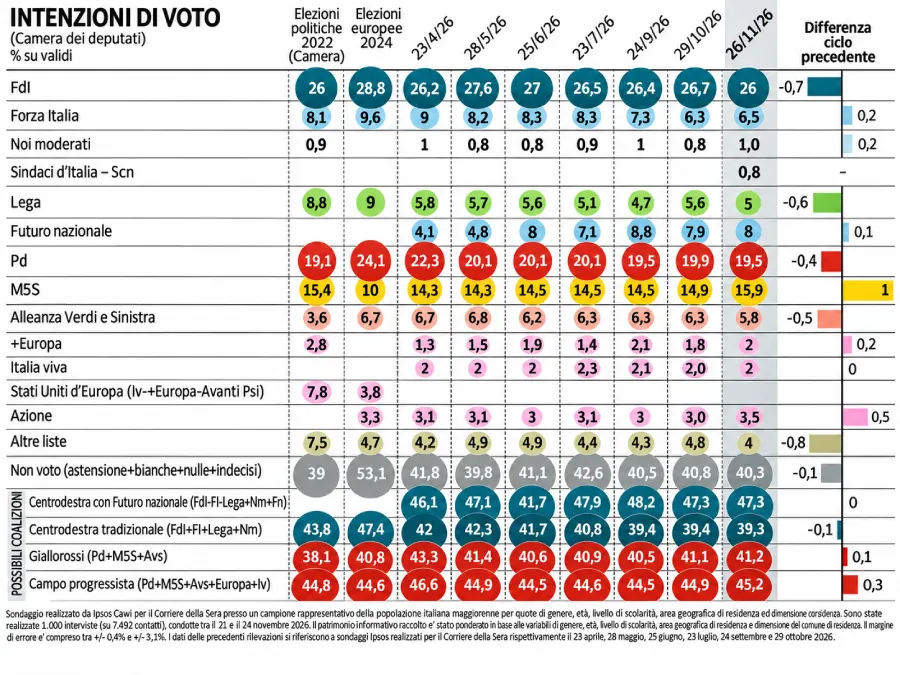
The survey, conducted by Nando Pagnoncelli and published Saturday (28) by Corriere della Sera, gives 26% of voting intentions to Fratelli d’Italia, down 0.7 percentage points from October. Matteo Salvini’s Lega fell 0.6 points to 5%.
Futuro Nazionale remains at 8%. In the simulation presented by the pollster, the combined total of the traditional center-right and Vannacci’s party would reach 47.3%, above the 45.2% attributed to the so-called Campo largo, a grouping of opposition parties.
The comparison considers a possible electoral arrangement among right-wing forces. It does not mean the alliance has already been formalized.
Vannacci maintains his position on the right
Roberto Vannacci and his party, Futuro Nazionale, are positioned on the Italian right. The leader himself has described the center-right as the natural interlocutor for his political movement.
In a statement to the ANSA news agency on September 2, Vannacci said he did not see himself engaging in dialogue with left-wing leaders, citing Elly Schlein, Angelo Bonelli and Nicola Fratoianni.
On the same occasion, he said Futuro Nazionale is willing to talk with political forces that accept its principles and values.
The position was reinforced on September 8. Vannacci said his party’s votes are not an asset that other members of the center-right can simply absorb. He advocated an alliance based on clear, shared policy commitments.
The position makes an important distinction: Futuro Nazionale is not automatically part of the current governing coalition, but its declared sphere of dialogue is the center-right.
With 8% of voting intentions, the party represents a relevant force in negotiations to form a possible electoral alliance.
Fratelli d’Italia and Lega post their lowest figures
Fratelli d’Italia remains the party with the highest individual voting intention in Italy, but it fell to 26%, its lowest figure in the series cited by Pagnoncelli.
The decline was 0.7 percentage points from the previous month.
The pollster links the result to disagreements within the parliamentary majority and dissatisfaction among different sectors with the budget proposal currently under consideration.
Lega also reached its lowest figure, at 5%, after falling 0.6 percentage points.
Forza Italia, led by Antonio Tajani, stands at 6.5%, while Noi Moderati registers 1%.
The traditional center-right forces together total 39.3%.
Movimento 5 Stelle grows to 15.9%
The main gain among opposition parties was recorded by Giuseppe Conte’s Movimento 5 Stelle.
The party reached 15.9%, up one percentage point from October. It is its best result since the European elections.
The Democratic Party, led by Elly Schlein, stands at 19.5%, down slightly.
Alleanza Verdi e Sinistra registers 5.8%, down 0.5 percentage points. +Europa and Italia Viva each stand at 2%.
Outside the main groupings, Carlo Calenda’s Azione reaches 3.5%, up 0.5 points.
Campo largo totals 45.2%
The combined voting intentions of the Campo largo parties reach 45.2%, about six points above the traditional center-right’s 39.3%.
The grouping includes the Democratic Party, Movimento 5 Stelle, Alleanza Verdi e Sinistra, Italia Viva and +Europa.
According to Pagnoncelli, in this scenario Campo largo would obtain the majority bonus provided for under the current electoral law, which is still under review by the Constitutional Court.
The pollster, however, emphasizes that this is an arithmetic sum. The actual formation of a coalition depends on agreements among the parties and their ability to rally their respective electorates around a common candidate.
Points of disagreement include Italy’s policy of support for Ukraine, the taxation of large fortunes and the choice of leadership for a possible alliance.
With Vannacci, the center-right total reaches 47.3%
Futuro Nazionale’s performance changes the numerical comparison between the groupings.
With the 8% attributed to Roberto Vannacci’s party, the traditional center-right would rise from 39.3% to 47.3% in an alliance simulation.
The percentage would be above Campo largo’s 45.2%.
The scenario presented by Pagnoncelli considers an electoral rapprochement among forces that share the right-wing political camp but still need to establish a political understanding.
The challenge involves defining policy commitments and negotiations among the leaders.
It will also be necessary to assess voters’ reaction to a possible arrangement, both among center-right parties and in the opposition camp.
Government approval remains stable
The poll also assessed Italians’ perception of the government.
The government maintained a positive approval rating of 41%, the same result as the previous month. Giorgia Meloni recorded a slight decline, falling from 42% to 41%.
Among political leaders, Giuseppe Conte remains in first place, followed by Elly Schlein and Antonio Tajani.
For Pagnoncelli, the results show minor management difficulties within Fratelli d’Italia and a rebalancing of forces on the center-left, especially in the contest for leadership of the opposition.
The survey thus reveals three distinct movements: declining voting intentions for Fratelli d’Italia and Lega, growth for Movimento 5 Stelle, and the importance of Futuro Nazionale in shaping a possible right-wing alliance.
Newsletter
Últimas do Italianismo
Todo dia, às 18h, um resumo do que aconteceu na Itália direto no seu e-mail.
É gratuito e você cancela quando quiser.