




















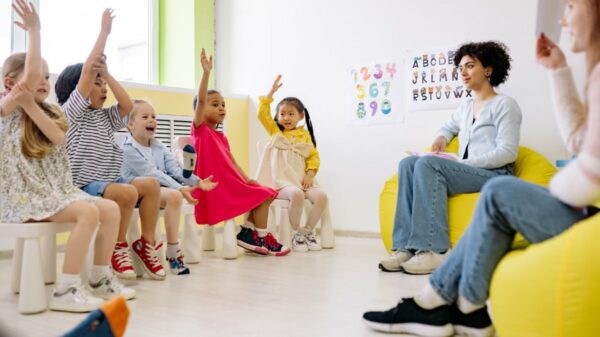







The Leonardo Da Vinci National Museum of Science and Technology in Milan has opened a new 400-square-meter educational space that aims to be the first museum aimed at children aged 3 to 6.
Named “PlayLab”, the space is dedicated to childhood and is an open invitation to play creatively and to a journey into the imagination that arises from the long experience in educational programs and spaces that the museum has developed and offered to schools and families since the 1990s.

As part of its mission, the Museum contributes to education, guidance, well-being and social cohesion, providing tools that are expressed in activities and courses dedicated to schools and families.
And it is in this context and based on the increasingly emerging consideration that, in a complex society, it is essential to build, from an early age, a relationship with science and technology, that the project in which the protagonists are boys and girls between 3 and 6 years old fits in.
At PlayLab, each environment and experience is designed to place children at the center of the learning process, inviting them to discover what surrounds them through observation, interaction, exploration and storytelling as fundamental actions for the development of scientific, social and emotional thinking.
“Transform and Explore” are the two themes that guided the design of the space and the interpretation of the content on science, technology, engineering and mathematics in a transversal way.
Each activity and environment proposes themes of exploration and transformation through scientific, fantasy and narrative interpretation. The aim is to create an environment suitable for building an active and curious attitude towards the world and laying the foundations for the acquisition of useful knowledge and skills to develop a positive relationship with science from childhood.
“Over the past 20 years, the educational commitment defined by the mission and the desire to contribute to the well-being and social cohesion of society have led the Museum to address and serve diverse audiences. Supporting younger generations, schools and the educational community are therefore an expression of the institution’s strategic direction”, explains Francesca Pasinelli, member of the Board of Directors of the National Museum of Science and Technology.
According to her, “PlayLab completes and integrates this commitment in the conviction that in a complex society like the one we live in, it is necessary to build, from an early age, a peaceful relationship with science and technology that establishes the foundations for an active, creative life, conscious and inclusive citizenship”.
The innovative space is organized into five rooms and offers two different modes of use: four are characterized by artistic installations and exploration, construction and storytelling activities, where visitors can move freely.
The last one, the Atelier, is dedicated to structured itineraries, following the tradition of the Museum's interactive laboratories, and invites you to delve deeper, experiment, share ideas and reflect on your own experiences.
The classrooms encourage children not to separate the multiple dimensions of the learning experience or to simplify it. On the contrary, they try to enrich it through very different languages and tools of exploration and discovery.
Therefore, each room has its own characteristics and arises from dialogue and shared planning between the teaching staff and other figures, both internal to the Museum (designers and curators) and external (artists, teachers and pedagogues).
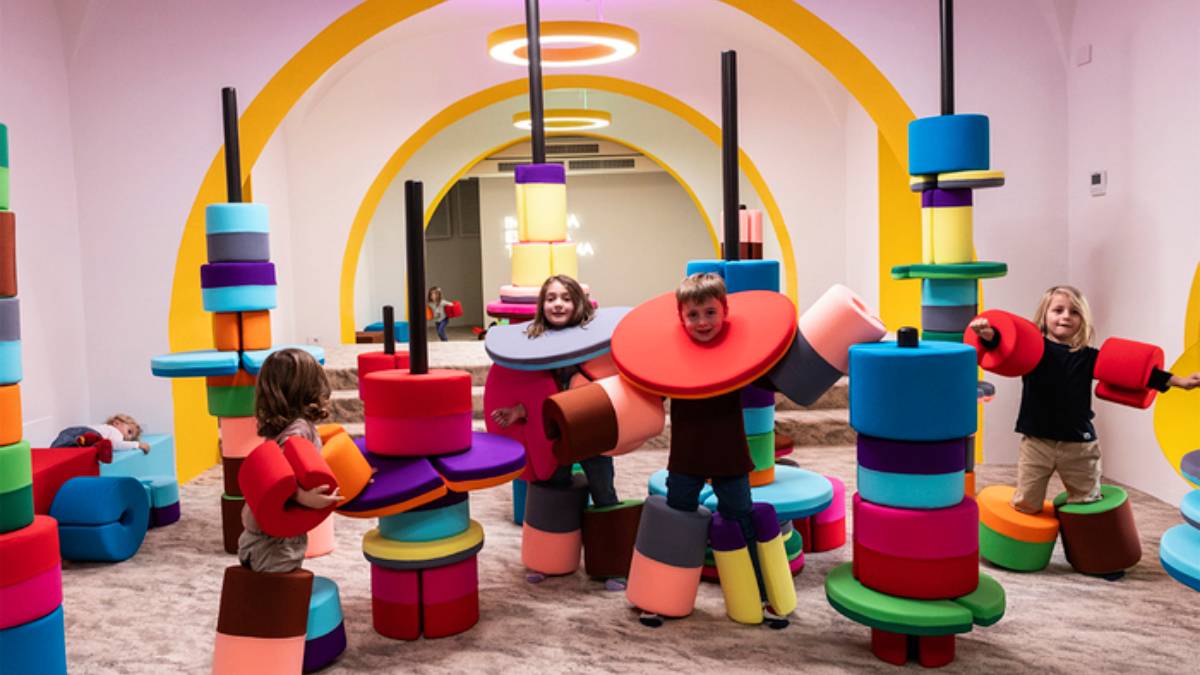
The first room is a forest of tree-like scenes and shapes, complete with nests to swing and hide in, a soundscape of birdsong, forest noises and whispers. The second room houses “Le Beau Chantier,” a site-specific installation born from a collaboration with two French sculptors and choreographers, Yvan Clédat and Coco Petitpierre.
This is a large space populated by simple structures that must be invented: circles, triangles, shapes made of soft, colorful foam that girls, boys and the adults who accompany them can use, combine and dress to imagine and build their own environment-landscape.
The third room offers a variety of activities that change according to the schedule. For example, drawing with light beams and transparent materials and exploring reflections to fill an imaginative digital forest with animals.
Finally, the fourth is the stories and objects room, which aims to create connections with the Museum's collection through storytelling and symbolic play.
The last room, the Atelier, is a space where the Museum's teaching staff, sometimes supported by special guests such as artists, musicians, actors or storytellers, offers a program of facilitated activities for the school public and families, allowing visitors to dedicate time to more in-depth work.
“Today, PlayLab is the expression of our most advanced pedagogical reflection and the result of extensive research into themes, approaches and languages that aim to enhance the complex and wonderful nature of childhood,” says Maria Xanthoudaki, the Museum’s Director of Education. (HANDLE)