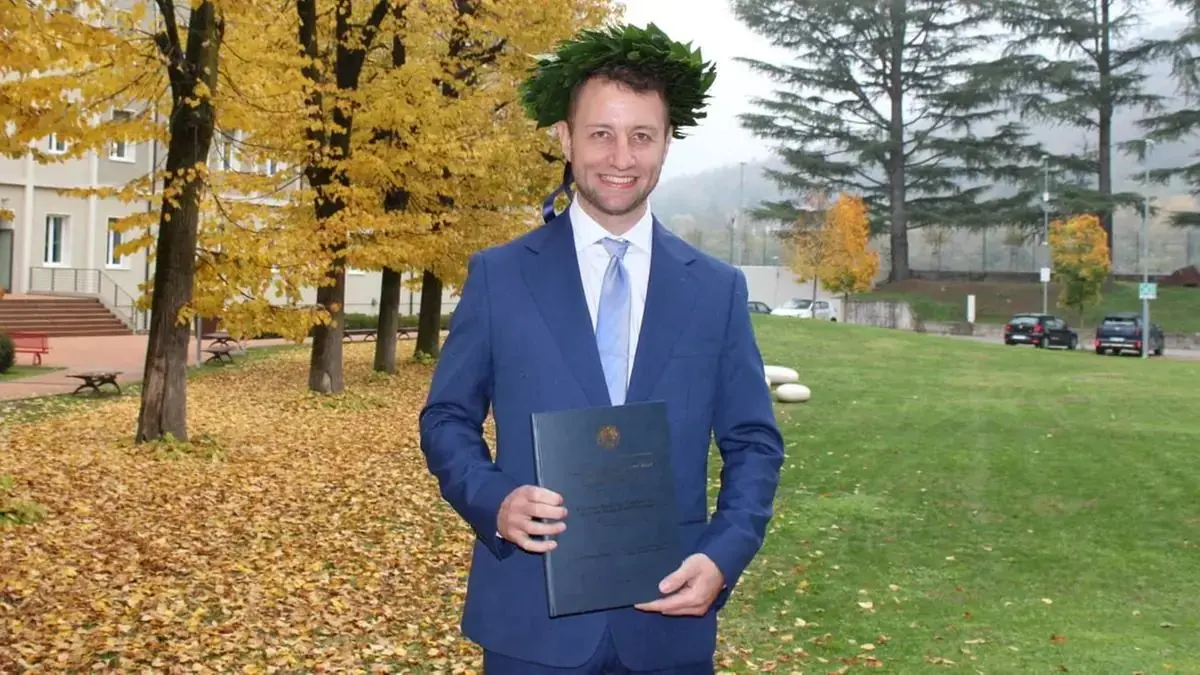
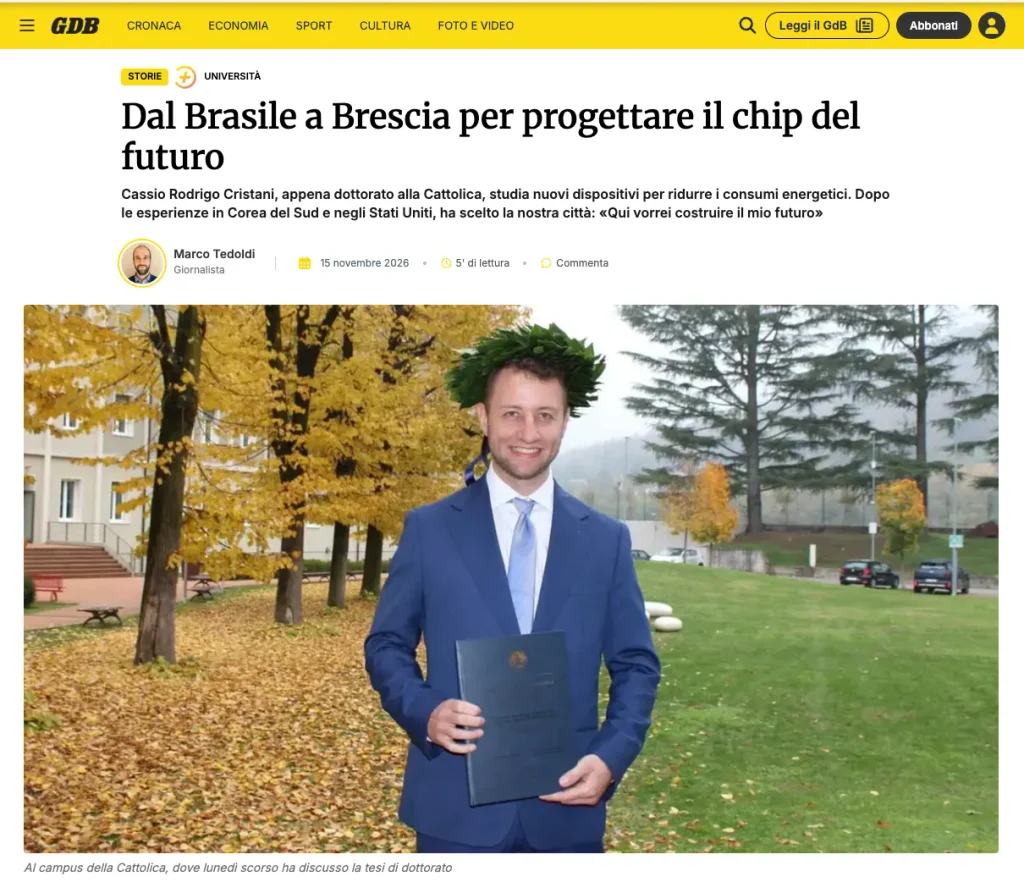
Italian-Brazilian Cassio Rodrigo Cristani, who obtained Italian citizenship in 2024, was featured in Giornale di Brescia on Sunday (Nov. 15).
In an interview published by the Italian newspaper, titled “From Brazil to Brescia to design the chip of the future”, the researcher discussed his international academic path, his family’s history and the reasons that led him to choose the Italian city to build his future.
Cristani has just completed a doctorate in Computer Science at the Catholic University of Brescia, after also conducting part of his studies at the University of Notre Dame in the United States.
His academic research uses machine-learning methods to identify different phases of matter. In the interview, the Brazilian researcher also presented a technological perspective related to the development of devices capable of integrating data processing and storage, with the potential to reduce energy consumption.
In explaining the current stage of this possibility, he made a point of clarifying that it is still theoretical work.
“The work carried out so far is theoretical. We have developed the scientific and mathematical foundations to envision a new device. The next step will be to experimentally verify whether this technology can work,” he told the newspaper.
Advertisement
According to Cristani, the proposal is to study a device capable of performing two functions that currently tend to take place in separate components: processing and storing information.
“This could allow for faster processing and, above all, much lower energy consumption,” he explained.
If developed, the technology could have applications in areas such as artificial intelligence, which requires ever-greater processing capacity and demands large amounts of energy.
From Samsung to an Italian university
Born in Brazil, Cristani began working in scientific research at age 17, while studying computer science and electrical engineering.
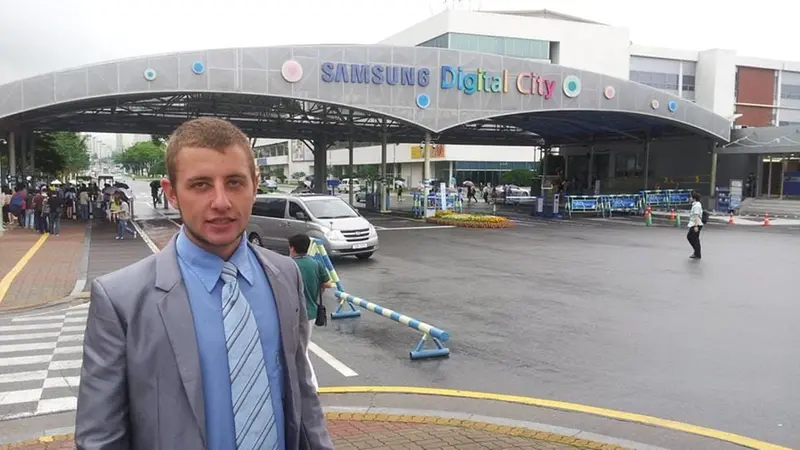
Still in Brazil, he received recognition for his scientific work in microelectronics for two consecutive years. At age 20, he had the opportunity to work at Samsung in South Korea, in the semiconductor sector.
Regarding the experience, he highlighted South Korean investments in education and technology.
“I was impressed by the ability to think about the future and work toward collective goals. It is an example of how education can transform a society,” he said.
He later continued his academic path in the United States, where he conducted part of his research at the University of Notre Dame, in the Mathematics Department.
Discovering his Italian roots
His arrival in Italy was also motivated by family reasons.
Cristani told the newspaper that his ancestors left Lombardy for Brazil during the major migration wave between the 19th century and the early 20th century.
His grandfather maintained a deep connection with Italian culture. He helped create a choir, a radio program and a cultural center to preserve the community’s traditions.
After his grandfather’s death, the researcher decided to reconstruct the family’s history.
During his search, he was able to identify Cernusco sul Naviglio, in the Lombardy region, as the place of origin of his ancestors. He also found original documents at the parish of Santa Maria Assunta and visited the places where the family had lived.
In 2024, he obtained Italian citizenship.
“Thinking that, after approximately 150 years, a descendant returned to the land from which the family had left still moves me,” he said.
Why he chose to remain in Italy
Despite professional opportunities in the United States, Cristani decided to return to Brescia and build his career in Italy.
“If we look only at economic possibilities, the United States can offer a great deal. But life is not made up only of money,” he said.
He also highlighted the quality of life, human relationships and the welcoming atmosphere he found in the city.
“I feel good in Brescia. I like the city, the lakes and my relationship with people. Here, I feel welcomed and would like to build my future,” he said.
In the coming years, the researcher plans to continue working in science and innovation, preferably in Italy. He would also like to contribute to the creation of new business initiatives and expand opportunities for young researchers.
“I would like other young people to have the opportunities I had. Italy has great expertise and a strong industrial tradition. Conditions must be created so that new generations can turn their ideas into concrete projects,” he concluded.
Source: Giornale di Brescia, interview by Marco Tedoldi.
Newsletter
Últimas do Italianismo
Todo dia, às 18h, um resumo do que aconteceu na Itália direto no seu e-mail.
É gratuito e você cancela quando quiser.