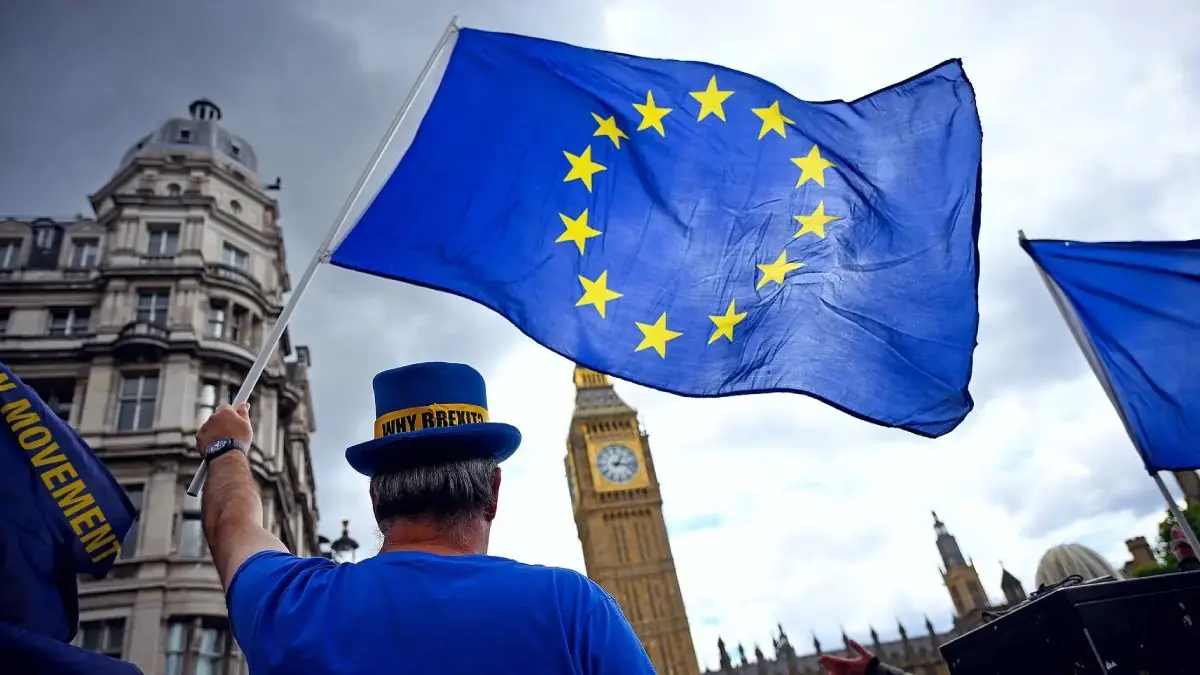
The European Union is open to discussing a possible return of the United Kingdom to the bloc without necessarily requiring it to adopt the euro or join the Schengen Area. The indication was made by two European officials interviewed by Politico and could facilitate British Prime Minister Andy Burnham’s plans to bring the country closer to Europe.
According to the report, published Monday, Nov. 2, Brussels could consider specific conditions for a future British readmission, taking into account the country’s history as a member of the European Union.
That does not mean, however, that the exceptions are guaranteed. The United Kingdom has not yet submitted a formal application to return, and European institutions have not defined an official position on the conditions of possible membership.
The discussion comes 10 years after the June 2016 referendum, when 51.9% of British voters voted to leave the European Union.
United Kingdom could keep the pound
Before Brexit, the United Kingdom had special terms for participating in the bloc. The country kept the pound sterling, with no obligation to adopt the euro, and remained outside the Schengen Area, which eliminates regular controls at internal borders between participating countries.
These exceptions were the result of negotiations held during decades of European integration.
Currently, countries joining the European Union undertake, in principle, to adopt the euro once they meet the required criteria. Participation in Schengen is also among the obligations for new members, although its implementation depends on specific conditions.
The possibility of the United Kingdom regaining some of its former exceptions is therefore a central issue for any return negotiations.
The flexibility mentioned by the European officials could remove two of the main political obstacles to British reintegration.
Majority of Britons support return to the European Union
The debate comes at a time of growing dissatisfaction with the results of Brexit.
A YouGov poll released in June 2026 showed that 57% of Britons considered the decision to leave the European Union to have been wrong.
The survey also found that 55% supported returning to the bloc. However, that percentage fell to 35% when respondents were told that readmission could require participation in the euro and the Schengen Area.
A more recent Ipsos poll, conducted between Oct. 15 and 22, found that 56% would vote in favor of applying to return to the European Union in a new referendum, while 30% would prefer to remain outside.
The figures show that there is significant support for reintegration, but also resistance to the possibility of the United Kingdom losing the special terms it had before Brexit.
France and Germany could complicate negotiations
Possible British readmission would also depend on the willingness of current European Union members to accept new exceptions.
A YouGov poll conducted in France and Germany and released in June showed that 58% of French people and 63% of Germans supported, in principle, the United Kingdom’s return.
However, support fell to 36% in France and 39% in Germany when the scenario involved restoring the United Kingdom’s former exceptions.
The results indicate that negotiations on the euro and Schengen could face resistance even among populations that favor the United Kingdom’s return.
Under Article 49 of the Treaty on European Union, the admission of a new member requires unanimous approval by member states, the consent of the European Parliament and ratification of the accession treaty in accordance with each country’s constitutional rules.
There is no automatic readmission procedure for countries that were previously part of the bloc.
Brexit returns to the center of political debate
Since taking office in July 2026, Andy Burnham has criticized Brexit’s economic results and advocated a closer relationship with the European Union.
The prime minister has already acknowledged that the possibility of returning to the bloc could be part of the Labour Party’s platform in a future election.
Burnham, however, rejects the idea of recommending membership that would require the United Kingdom to adopt the euro or join Schengen.
During the current parliamentary term, the government is also maintaining its campaign commitments not to restore the free movement of people or return to the single market and the customs union.
The discussion of possible reintegration, therefore, has not yet become a formal proposal by the British government.
Ten years later, the cost of Brexit remains under debate
The United Kingdom officially left the European Union on Jan. 31, 2020, after nearly four years of negotiations that began with the 2016 referendum.
The departure ended British participation in the single market and the customs union, creating new trade requirements and restrictions on the movement of people between the country and the European Union.
During the referendum campaign, Brexit supporters argued that leaving would make it possible to regain control over immigration, national laws and trade policy.
A decade after the vote, the results of the decision continue to divide British society.
The government seeks to reduce trade barriers and expand cooperation with the bloc, while public support for reversing Brexit is growing.
The next stage of this rapprochement is scheduled for Nov. 20, when Burnham will take part in a summit with European leaders in Brussels.
The meeting is expected to address trade, security, energy, climate and youth mobility, but it does not constitute formal readmission negotiations.
The indication of flexibility on the euro and Schengen does not represent a change in membership rules. It does, however, show that some in Brussels are open to discussing specific conditions should Britons decide to try to return to the European Union.
Newsletter
Últimas do Italianismo
Todo dia, às 18h, um resumo do que aconteceu na Itália direto no seu e-mail.
É gratuito e você cancela quando quiser.