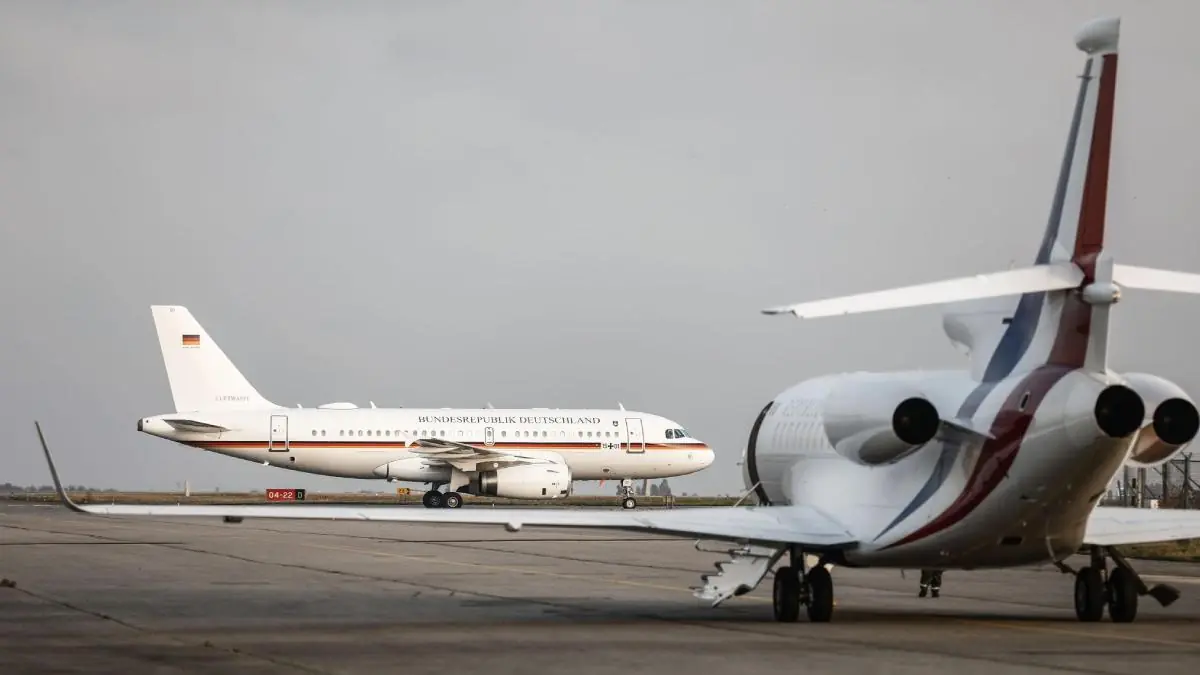
A wave of bomb threats has affected at least 32 commercial flights in Europe since the beginning of the week, prompting route diversions, emergency landings and the deployment of military fighter jets. On Thursday (5) alone, at least 25 flights were affected, according to a tally by the British newspaper The Guardian.
The incidents affected several airlines, including Ryanair, Aer Lingus, Wizz Air, Finnair, Iberia and easyJet, with cases reported in countries including Italy, France, Spain, Portugal, Ireland, Bulgaria and the Czech Republic.
All the planes involved landed safely. So far, inspections carried out by authorities have found no explosives.
The threats raised suspicions of a coordinated operation aimed at disrupting European aviation. However, those responsible remain unknown.
Messages mention Russian extremist group
One of the main elements of the investigation is emails sent to airports in Rome and Sofia, Bulgaria, that mention the Russian far-right movement Muzhskoye Gosudarstvo, known as Male State.
The messages were signed by alleged members of the group, which describes itself as ultranationalist and advocates misogynistic views.
The movement was founded in 2016 by Vladislav Pozdnyakov and banned by a Russian court in 2021 after being classified as an extremist organization.
According to Agence France-Presse (AFP), the emails contained threats of explosions on aircraft and said the attacks would take place within 60 minutes.
The reference to the movement, however, does not prove its involvement in the incidents. There is no public evidence that the group organized the threats or that the Russian government was involved.
European authorities continue to investigate the origin of the messages and possible connections between the incidents.
Italy among main targets
Italy was one of the countries most affected by the alerts, with incidents involving flights originating in or bound for Rome and Milan.
One of the most serious incidents involved Aer Lingus flight EI402, which departed Dublin, Ireland, bound for Fiumicino Airport in Rome.
After receiving a bomb threat, the aircraft was diverted to the Évreux military air base in France, under escort by French fighter jets.
The plane was carrying 151 passengers and six crew members, who were safely evacuated.
French authorities also began investigating the pilot’s conduct, who, according to information reported by AFP, initially resisted the order to land at a military facility, preferring a civilian airport.
The airline said it is cooperating with French authorities.
Another incident involved a Finnair flight between Helsinki and Rome, which was escorted by military aircraft before landing normally in the Italian capital.
In Milan, a Wizz Air plane traveling from Malpensa to Warsaw was diverted to Vienna, Austria.
Alerts were also reported against flights arriving at Malpensa airport from Thessaloniki, Greece, and Porto, Portugal, operated by Aegean Airlines and Ryanair, respectively.
None of the inspections identified explosives.
Military fighter jets deployed in three countries
In addition to Italy and France, Bulgaria deployed its Air Force after threats against three Ryanair planes bound for Sofia.
The aircraft had departed from Madrid, Copenhagen and London.
The first two flights landed in the Bulgarian capital. The third, from London, was diverted to Plovdiv airport.
After inspections, Bulgarian authorities ruled out the presence of explosives.
In the Czech Republic, four planes bound for Prague were also targeted by threats. All landed safely, and police checks came back negative.
Other alerts were reported at airports in Madrid, Brussels and Copenhagen.
European Union investigates possible coordinated operation
European Commissioner for Transport Apostolos Tzitzikostas said it is still too early to conclude whether the incidents are related.
He called for cooperation among national authorities, airlines, airport operators and security forces to ensure passenger safety.
In Italy, Defense Minister Guido Crosetto linked the pattern of incidents to the characteristics of operations carried out below the threshold of a conventional military conflict, often referred to as hybrid warfare.
This type of action can involve cyberattacks, sabotage and other operations intended to create instability without direct military confrontation.
Despite the suspicions, there is no public evidence that would allow the threats to be attributed to a specific country, organization or group.
The series of incidents drew authorities’ attention because of the number of flights affected in a few days and the similarity among some messages sent to different airports.
Even when alerts prove false, security procedures require inspections of aircraft, passengers and baggage, as well as possible route changes.
The operations cause delays and additional costs for airlines.
Investigations are continuing in several European countries to identify those responsible and determine whether the threats are part of the same operation.
Newsletter
Últimas do Italianismo
Todo dia, às 18h, um resumo do que aconteceu na Itália direto no seu e-mail.
É gratuito e você cancela quando quiser.