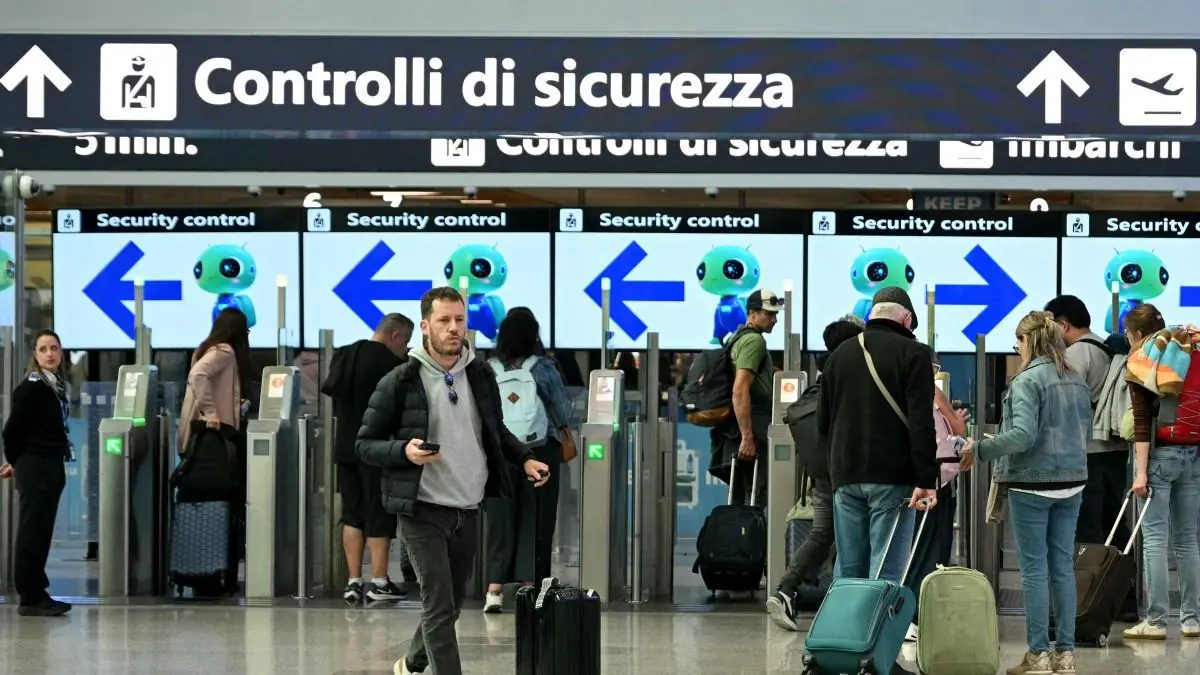
The easing began in 2025, when the Italian Civil Aviation Authority (ENAC) announced that five airports already allowed passengers to carry liquids in containers larger than 100 ml. Since then, Milan Bergamo Airport has also adopted the change.
See the current rules at each terminal.
Which Italian airports have already eliminated the restriction?
- Rome Fiumicino: allows liquids in containers of up to 2 liters on most flights. There are exceptions for passengers traveling to the United States and Israel and certain connecting passengers.
- Milan Malpensa: the easing applies to Terminal 1. At Terminal 2, the 100 ml rule remains in effect, except for passengers using Fast Track.
- Milan Linate: allows liquids in containers of up to 2 liters.
- Bologna: has eliminated the 100 ml restriction for passengers going through security checkpoints.
- Turin: the easing is available only to passengers using Fast Track. In other lines, the 100 ml limit remains in effect.
- Milan Bergamo: eliminated the restriction in November 2025 and allows containers of up to 2 liters.
Which airports still maintain the 100 ml rule?
In Catania, despite the installation of modern scanners, implementation of the technology was suspended in July 2025 for new software certification. As of the publication of the report, there was no confirmation that the restriction had been eliminated.
At the airports in Lampedusa and Pantelleria, the 100 ml rule remains in effect, in accordance with ENAC guidance.
Naples may be the next airport
Naples-Capodichino Airport may eliminate the restriction in December 2026, after modernization work is completed and new inspection equipment is installed.
However, as of November 25, the airport was still informing passengers that the 100 ml rule remained in effect. The change, therefore, had not yet been officially confirmed.
Advertisement
Why is the rule changing?
The easing was made possible by the installation of computed tomography (CT) scanners, capable of producing three-dimensional images of luggage and identifying potential explosive materials.
With this equipment, security checkpoints can allow containers of up to 2 liters without requiring passengers to remove liquids and electronic devices from their carry-on luggage.
The 100 ml rule was introduced in 2006 following the discovery of a terrorist plot in the United Kingdom involving the use of liquid explosives on airplanes.
Attention: authorization is not the same at all airports. Passengers should check the rules at their departure terminal as well as at connecting and return airports.