In Italy, even All Souls’ Day has its traditional sweets. Celebrated on November 2, the date is marked by recipes ranging from bone-shaped cookies to specialties made with almonds, dried fruit and chocolate.
Known as dolci dei morti, these sweets are part of the customs of different Italian regions. Many are prepared especially between All Saints’ Day, on November 1, and All Souls’ Day, the following day.
Unlike the treats associated with Halloween, Italian sweets are linked to the memory of ancestors. In some places, ancient traditions include preparing food to honor the dead and giving gifts to children.
The recipes vary by region, but five specialties stand out for their history, ingredients and curious names.
Discover five traditional All Souls’ Day sweets in Italy
1. Ossa dei morti Sicily
The bones of the dead. The ossa dei morti are among the most curious sweets in the Italian tradition. They are hard, crunchy cookies whose shape resembles small bones. There are different recipes throughout the country. In Sicily, one of the best-known versions is made with flour, sugar, cinnamon, and cloves. The texture is quite firm.
2. Pan dei morti Lombardy
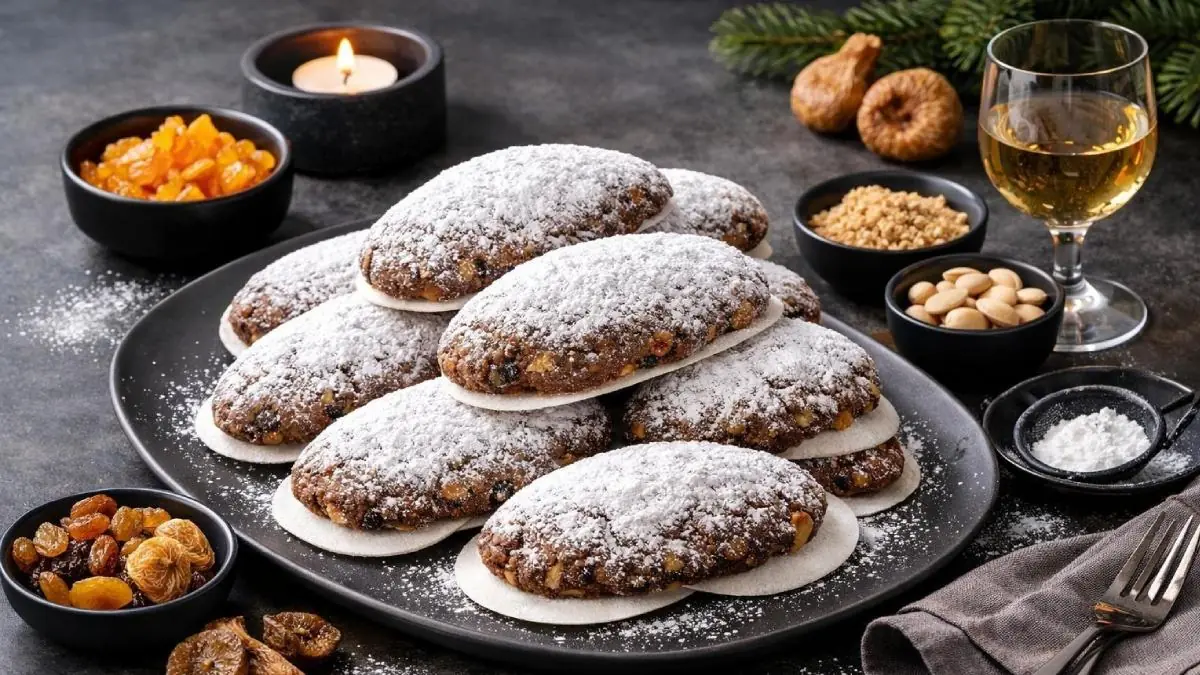
The bread of the dead. Despite its name, pan dei morti is more like a dense cookie than bread. Traditional in Lombardy, especially in Milan, it is made with crushed cookies, such as amaretti and savoiardi, as well as cocoa, raisins, dried figs, dried fruit, and spices. It is usually dusted with powdered sugar.
3. Fave dei morti Central and northeastern Italy
The broad beans of the dead. They are small sweets made with ground almonds, sugar, flour, and eggs. Their shape resembles that of a fava bean. The recipe is found in central Italy and the country's northeast. Depending on the region, the cookies may include cinnamon, cocoa, or liqueur. The association of fava beans with the dead dates back to ancient funeral traditions.
4. Pabassinas Sardinia
The colorful cookies of Sardinia. The pabassinos, also called pabassinas, are traditionally prepared for All Saints' Day. The recipe includes raisins, dried fruit, and spices. The cookies are usually topped with white sugar icing and colorful sprinkles. They also appear at other celebrations, such as Christmas and Easter.
5. Rame di Napoli Sicily
The chocolate sweet from Catania. Despite their name, rame di Napoli are a specialty of Catania, Sicily, not Naples. They are soft cookies made with cocoa and spices, covered in chocolate. Some versions have an orange jam or pistachio cream filling.
.itg{margin:24px 0 28px;font-family:Inter,system-ui,sans-serif;background:#111;color:#fff;max-width:100%;overflow:hidden}
.itg *{box-sizing:border-box}
.itg-stage{position:relative;aspect-ratio:16/9;background:#000;overflow:hidden}
.itg-track{position:absolute;inset:0}
.itg-slide{position:absolute;inset:0;margin:0!important;opacity:0;visibility:hidden;transition:opacity .25s}
.itg-slide.is-on{opacity:1;visibility:visible}
.itg-slide img{color:transparent;font-size:0;width:100%!important;height:100%!important;max-width:none!important;object-fit:cover;display:block;margin:0!important}
.itg-cred{position:absolute;right:8px;bottom:6px;font-size:10px;line-height:1.2;color:#fff;opacity:.85;text-shadow:0 1px 2px #000;padding:0!important;margin:0!important;background:none!important}
.itg-count{position:absolute;left:12px;top:12px;z-index:3;background:rgba(0,0,0,.72);color:#fff;font-size:13px;font-weight:600;padding:4px 10px;letter-spacing:.02em}
.itg-count b{color:#D6001C;font-weight:800}
.itg-nav{position:absolute;top:50%;z-index:3;transform:translateY(-50%);width:44px;height:44px;border:0;border-radius:50%;background:rgba(0,0,0,.6);color:#fff;font-size:30px;line-height:40px;cursor:pointer;padding:0;display:flex;align-items:center;justify-content:center}
.itg-nav:hover{background:#D6001C}
.itg-prev{left:10px}.itg-next{right:10px}
.itg-thumbs{display:flex;gap:6px;padding:8px;overflow-x:auto;scrollbar-width:thin;background:#111}
.itg-thumbs button{flex:0 0 84px;height:52px;padding:0;border:2px solid transparent;background:#222;cursor:pointer;opacity:.55;transition:opacity .2s}
.itg-thumbs button.is-on,.itg-thumbs button:hover{opacity:1;border-color:#D6001C}
.itg-thumbs img{width:100%!important;height:100%!important;object-fit:cover;display:block;margin:0!important}
.itg-texts{padding:14px 18px 20px;background:#000}
.itg-text{display:none}
.itg-text.is-on{display:block}
.itg-text h3{margin:0 0 8px!important;font-size:20px!important;line-height:1.25!important;font-weight:700!important;color:#fff!important}
.itg-text h3 span{color:#D6001C;margin-right:4px}
.itg-text h3 em{font-style:normal;font-weight:600;font-size:14px;color:#bbb;margin-left:6px;white-space:nowrap}
.itg-desc{margin:0!important;font-size:15px!important;line-height:1.55!important;color:#e6e6e6!important}
@media (max-width:767px){
.itg{margin:18px -15px 24px;width:calc(100% + 30px);max-width:calc(100% + 30px)}
.itg-nav{width:38px;height:38px;font-size:26px}
.itg-thumbs button{flex-basis:68px;height:44px}
.itg-text h3{font-size:18px!important}
.itg-desc{font-size:15px!important}
}
#itg-doces-finados-italia .itg-cred{left:auto!important;right:8px!important;bottom:5px;max-width:75%;text-align:right!important;font-size:8.5px!important;line-height:1.25;opacity:.8}
.itg-cred a{color:#fff!important;text-decoration:underline}
@media (max-width:600px){#itg-doces-finados-italia .itg-cred{font-size:7.5px!important;max-width:85%}}
(function(){
document.querySelectorAll(‘.itg’).forEach(function(g){
if(g.dataset.ready)return;g.dataset.ready=1;
var slides=g.querySelectorAll(‘.itg-slide’),texts=g.querySelectorAll(‘.itg-text’),thumbs=g.querySelectorAll(‘.itg-thumbs button’),num=g.querySelector(‘.itg-count b’),n=slides.length,cur=0;
function go(i){
cur=(i+n)%n;
[slides,texts,thumbs].forEach(function(list){list.forEach(function(el,k){el.classList.toggle(‘is-on’,k===cur);});});
num.textContent=cur+1;
var t=thumbs[cur],box=t.parentNode;box.scrollTo({left:t.offsetLeft-box.clientWidth/2+t.clientWidth/2,behavior:’smooth’});
if(window.gtag){gtag(‘event’,’galeria_slide’,{galeria:g.id,slide:cur+1});}
}
g.querySelector(‘.itg-prev’).onclick=function(){go(cur-1);};
g.querySelector(‘.itg-next’).onclick=function(){go(cur+1);};
thumbs.forEach(function(t,k){t.onclick=function(){go(k);};});
var x0=null,stage=g.querySelector(‘.itg-stage’);
stage.addEventListener(‘touchstart’,function(e){x0=e.touches[0].clientX;},{passive:true});
stage.addEventListener(‘touchend’,function(e){if(x0===null)return;var dx=e.changedTouches[0].clientX-x0;if(Math.abs(dx)>40)go(cur+(dx<0?1:-1));x0=null;},{passive:true});
g.tabIndex=0;g.addEventListener('keydown',function(e){if(e.key==='ArrowRight')go(cur+1);if(e.key==='ArrowLeft')go(cur-1);});
});
})();
A tradition that keeps the memory of the dead alive
In different regions of Italy, sweets are part of customs that link All Souls’ Day to the remembrance of deceased family members.
In Sicily, for example, an ancient tradition holds that the dead leave gifts and sweets for children on the night before November 2. Sweets associated with the celebration also include frutta martorana, made from almond paste, and pupi di zucchero, figures molded from sugar.
Advertisement
Although celebrations have different characteristics in each region, dolci dei morti remain present in pastry shops and on the tables of many Italian families during the first days of November.