Italian Deputy Prime Minister and Foreign Minister Antonio Tajani said Thursday (29) that the old Italian citizenship law was “very generous.” The statement, made while commenting on the Italian passports of Jair Bolsonaro’s children, exposes a contradiction in the rhetoric of the minister who led the 2025 reform.
The previous law did not grant citizenship out of generosity. It recognized a birthright.
Under the principle of iure sanguinis, anyone who met the legal requirements was considered an Italian citizen from birth, even if administrative recognition occurred decades later.
The state was not doing anyone a favor. It was complying with the law.
That distinction is fundamental, but Tajani appears not to understand it. Recognition of citizenship by descent was an act mandated by law, not a discretionary government decision.
Tajani acknowledges the right but calls the law generous
In an interview with Corriere della Sera, reproduced by the Foreign Ministry itself, Tajani acknowledged that Bolsonaro’s children received passports because they were entitled to them.
“By right of blood: We gave passports to citizens who were entitled to them. I was the one who changed the law, receiving much criticism, because many people were doing business with citizenship,” he said, translated from Italian.
Later, while commenting on the same matter in Rome, he described the previous legislation as “very generous.”
The contradiction deserves attention. If the Bolsonaros were entitled to citizenship, its recognition was not the result of generosity by the Italian state.
Tajani may support more restrictive rules. But calling legislation that recognized birthrights generous does not legally explain the change.
The argument that people were doing business with citizenship also requires a distinction: combating fraud and irregularities is not the same as restricting the right of descendants who comply with the law.
The reform introduced by Decree-Law No. 36/2025, converted into Law No. 74/2025, went beyond combating irregularities. It changed citizenship criteria and affected, with exceptions, people born before the legislative change.
Trump reportedly requested the reform
Tajani’s statements come after a revelation published by Italianismo on Thursday (30).
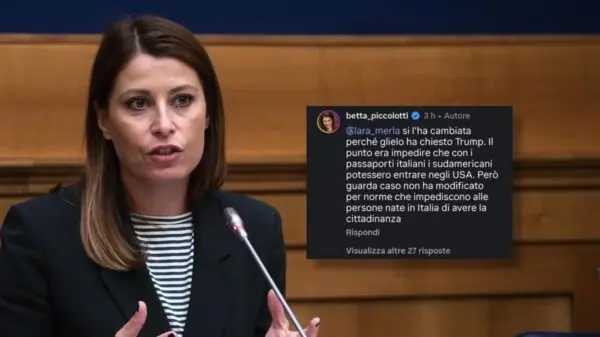
Lawmaker Elisabetta Piccolotti, of the Green and Left Alliance (AVS), said Donald Trump had requested the Italian citizenship reform to prevent South Americans from using Italian passports to enter the United States.
The allegation revives a suspicion raised in April 2025 by Pasquale Metafora, a former employee of the Italian Embassy in Brasília.
So far, there is no public evidence confirming the alleged U.S. demand.
But the lawmaker’s statement raises a question the Italian government needs to clarify: Was there foreign influence in drafting the reform?
Lorenzato calls for investigation and cites possible crime
Former Italian lawmaker Luis Roberto Lorenzato responded to Piccolotti’s statement and called for an investigation into the actions of the Farnesina, the ministry headed by Tajani.
“If the Farnesina, Italy’s Foreign Ministry, illegally yielded to foreign interference to restrict Italian citizenship, those responsible must be investigated, including regarding the possible application of Article 264 of the Italian Criminal Code, Infedeltà in affari di Stato, if its legal requirements are met!”
Lorenzato also raised a second possibility: that sectors within the Farnesina itself may have invented or used the narrative of American pressure to persuade the Meloni government to approve a reform they already wanted.
“Did Trump actually make this request, or was this story fabricated to justify Decree-Law No. 36/2025?” he asked.
Neither of these possibilities has been proven. The potential application of Article 264 depends on specific legal requirements that cannot be established merely by the existence of diplomatic pressure.
The former law could be amended, as it was. That does not mean that citizenship recognitions carried out under its rules were favors or privileges.
Those who were born Italian under the legislation in force at the time did not need Tajani’s generosity. They needed the Italian state to comply with its own law.
EXPLAINER: Recognition is not a grant
RECOGNITION: In Italian citizenship by blood (iure sanguinis), the state does not create a new right. It recognizes an original citizenship that has existed since birth, once the requirements set out in the applicable law are proven.
GRANT OR ACQUISITION: These are legally different situations, such as naturalization by residence or acquiring citizenship through marriage. In these cases, the person is not considered Italian from birth by descent. They must meet specific legal conditions and go through the corresponding procedure. Marriage alone does not result in automatic citizenship.
Newsletter
Últimas do Italianismo
Todo dia, às 18h, um resumo do que aconteceu na Itália direto no seu e-mail.
É gratuito e você cancela quando quiser.